
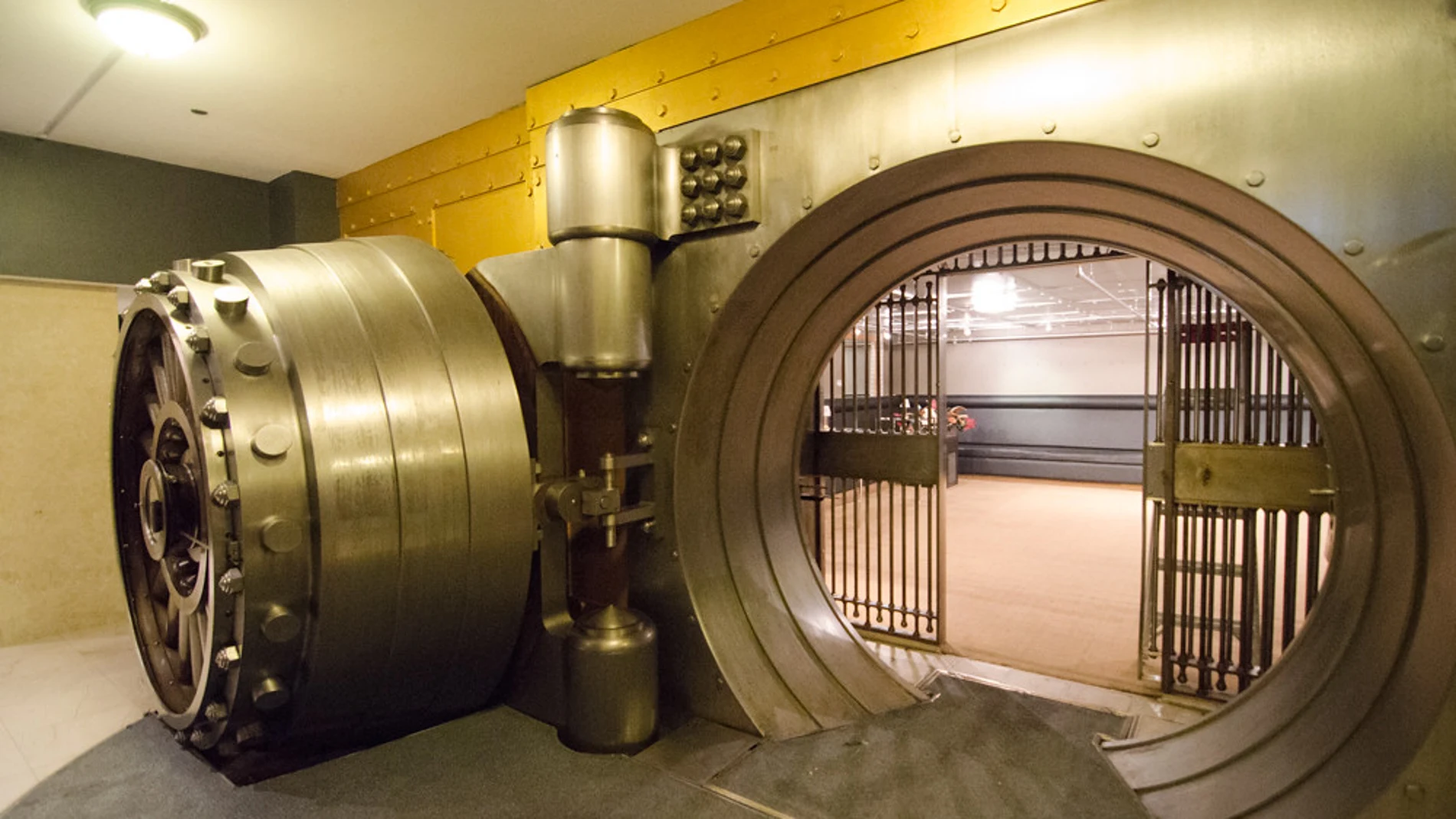
A wall that seems like just another part of the house, a hidden hallway and, in the background, an armored door that cannot be opened with a conventional password. The vault discovered in the mansion of former Paraguayan President Santiago Peña seemed designed to protect more than just money or valuables. According to information released during the raid, Its security system combined facial or iris recognition, fingerprints, numerical codes and special keys. A set of mechanisms that kept the Paraguayan prosecutor’s office without access to the premises for more than a day. Finally, the door was able to open when Peña himself indicated where the key was.
History provides a glimpse into one of the most sophisticated areas of physical security: vaults that combine mechanical, electronic and biometric barriers. Its principle is simple, although its application can reach enormous complexity: not entrust protection to a single lock, but rather force different layers of security to be overcome. In this case, the first barrier was not even the vault door: the access was hidden behind a wall that seemed to be part of the house. This concealment adds an initial difficulty to reaching the first shield equipped with different identification systems.
Biometrics, the first of them, turns the body into a kind of password. The fingerprint reader, for example, makes a comparison of the grooves and ridges of the fingers. A study published in IEEE Transactions on Pattern Analysis and Machine Intelligence calculated that the probability of two random footprints sharing 12 feature points out of 36 would be approximately 1 in 16 million.
Iris recognition, for its part, uses cameras with infrared illumination to capture the patterns of the colored area of the eye, which an algorithm transforms into a digital template. How reliable is it? A study led by John Daugman of the University of Cambridge compared 2.3 million iris images and estimated that The probability of two different irises matching by chance more than 70% of their code was approximately 1 in 7 billion. And no, twins are not valid: Daugman’s study showed that even the irises of identical twins showed statistically independent patterns. Something that also happened with both eyes of the same person.
Finally, more advanced systems can incorporate presence tests to verify that they are identifying a real person and not a photograph or reproduction. Added to these mechanisms is the numerical code, which belongs to a different category: something that the user knows. In security, there are three main authentication factors: something that is known, such as a PIN; something you own, such as a key or card; and something that is, like a footprint or the iris pattern. The combination of several of them is known as multi-factor authentication. Its advantage is that the failure or loss of a credential should not be enough to grant access.
Special keys are another important piece. Some information has mentioned “multilock” systems, a name that could allude to Mul-T-Lock, an Israeli manufacturer founded in 1973 and specialized in high-security locks and cylinders. Its products include patented mechanisms and key duplication control systems: They can only be duplicated in authorized centers and by presenting a unique code card. However, it has not been confirmed that this company is responsible for the Paraguayan installation nor that its components were present at the gate.
The vault has also been described as a level 7 system, although that expression needs clarification. In Europe, the EN 1143-1 standard classifies the resistance of safes and vaults using grades ranging from 0 to XIII. Grade VII exists, but It does not refer to the number of identification mechanisms, but to the physical resistance of the premises against standardized intrusion tests. For example, the door must have “600 resistance units (RU) against a full access attack,” basically the resistance equivalent to one minute of using a simple tool.
In any case, the resistance of a chamber does not depend solely on its door. The walls, ceiling, floor, anchors, ventilation, electrical connections and detection systems must be designed as a whole. An extraordinarily strong door is of little use if the rest of the structure offers a weak point. The Paraguayan vault ended up demonstrating that even a very sophisticated identification system can depend on an element as traditional as a key. But his story leaves a broader technological lesson: Maximum security is not based on a lock that is impossible to open, but on combining architecture, materials, electronics and different methods of verification who is on the other side of the door.