
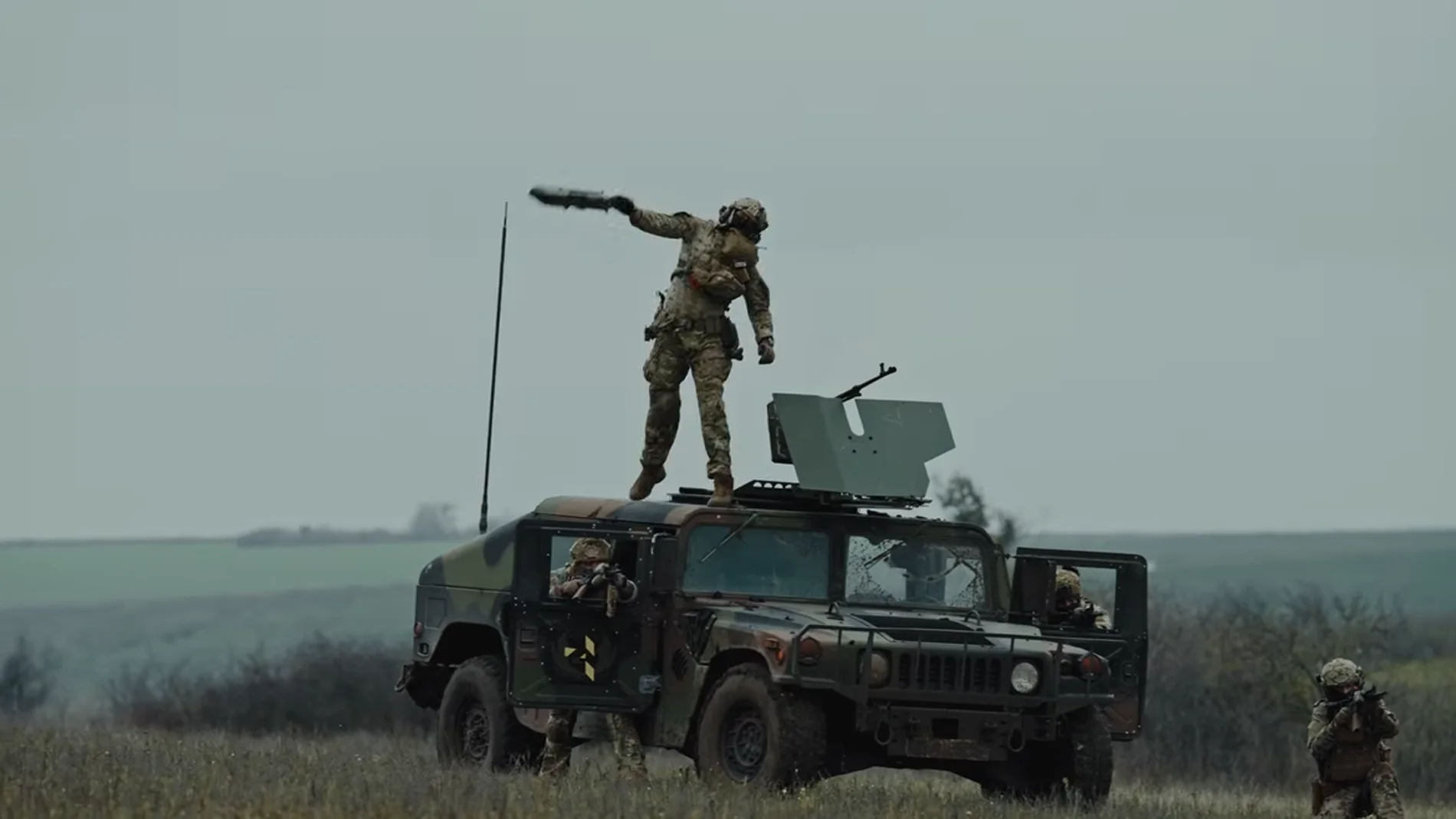
What if a soldier could have his own attack drone without the need for catapults, launch pads or specialized equipment? That is the idea pursued by the American company XDOWN with STUD, a small unmanned aircraft designed to be carried in a backpack and deployed directly by hand. The company has just carried out a demonstration in which the device takes off from the arm of a soldier, flies towards a target and reaches it. It is an important step for the project, although it does not yet amount to a complete military evaluation or its incorporation into the equipment of the armed forces.
The test was carried out in Eastern Europe, with the collaboration of company partners, and was presented through a video broadcast by XDOWN. According to its CEO, Alexander Balan, the test made it possible to verify the joint operation of the aircraft, the launch system, the flight controls and its ability to carry out a kinetic attack against a designated target. The company assures that the prototype accumulates more than 500 flight hours during its development.
STUD belongs to the category of small unmanned aerial systems, known as UAS, and is designed to operate at the level of an infantry squad. Its main difference compared to other tactical drones is that it does not need a ramp or a catapult: the military can take it with them and put it in the air in less than a second, according to XDOWN. The company claims that a fighter can carry up to eight units in a backpack and that a pallet can hold around 120 devices, depending on its configuration.
“The biggest advantage is immediate availability – explains Balan in an interview -. Traditional systems of Unmanned attacks may require launch rails, catapults, specialized equipment or other deployment infrastructure. STUD was designed to eliminate much of that burden.”
According to specifications reported by the South Korean news agency Yonhap, STUD has a length of 44.5 centimeters, weighs 2.36 kilograms and reaches a maximum speed of 305 km/h. Its operational range is 64 kilometers, with an autonomy of up to 25 minutes. The development posed technical challenges. A device small enough to be carried in a backpack must balance weight, autonomy, speed and carrying capacity. XDOWN claims to have worked on resistant materials and a two-stage safety mechanism to prevent accidental activations. Still, these features will have to pass broader evaluations and testing under demanding operating conditions.
The company plans expand its industrial capacity from 2027, with production plans in the United States and Eastern Europe. The schedule, however, depends on financing, commercial agreements and corresponding authorizations. Before STUD can reach the armed forces it will still have to pass new military tests and evaluations.