
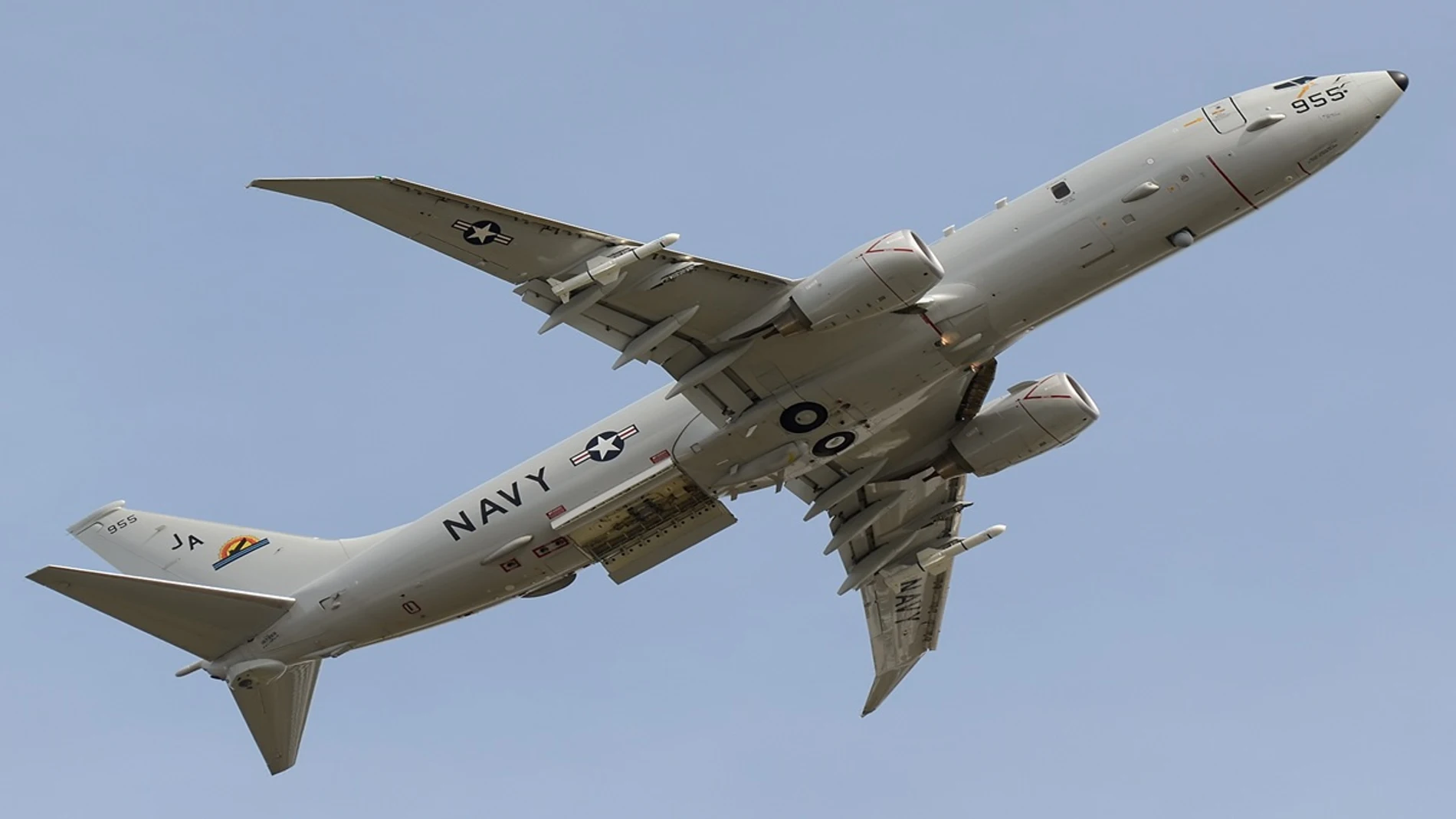
Beneath the ocean’s surface, a submarine can become one of the most difficult targets to locate. It does not need to emit radio signals or maintain visual contact with other vessels. Its main defense is to disappear in an environment where sound travels much further than light. To find it, naval forces use acoustic sensors, radars, intelligence systems and aircraft capable of covering huge areas of sea. The United States has just taken a new step to reinforce one of those instruments: the P-8A Poseidon.
Boeing has received a $119.65 million contract modification from the US Navy to manufacture nine modernization kits for these maritime patrol aircraft. Seven correspond to American aircraft and two to the Royal Australian Air Force. The agreement also includes the installation of four kits on Navy aircraft. Work will be carried out primarily in Jacksonville, Florida, with an expected completion date of May 2030.. The update is part of the Increment 3 Block 2 programone of the most important transformations that the Poseidon has received since its entry into service. In April 2026, the US Navy declared initial operational capability for this configuration, after completing its testing.
The P-8A is built on the Boeing 737 platform, although its resemblance to a commercial airliner largely ends in the fuselage. It is designed to carry out long missions over the sea, detect threats, collect information and coordinate combat operations. Its best-known function is anti-submarine warfare, but it also performs maritime surveillance, reconnaissance and tracking of surface ships. The modernization package incorporates new avionics components, antennas, sensors, wiring and combat systems. Its improvements include greater computer processing capacity, a reinforced security architecture, broadband satellite communications and additional acoustics and communications systems.
One of the most relevant elements is contact management. In an anti-submarine mission, detecting a noise does not mean having found a submarine. The system must determine if the signal is coming from a threat, identify it, calculate its position and maintain tracking. The new architecture allows this information to be integrated and organized so that the crew can make decisions more quickly.
The Poseidon uses several tools to search for his adversary. Among them, sonobuoys stand out, small sensors that are launched from the plane and that, once in the water, record underwater sounds. Some work passively, listening to the environment; others emit acoustic signals and analyze the returning echoes. The information can reveal patterns compatible with the operation of a submarine, although ocean noise and maritime traffic complicate the task. The aircraft also has electronic support measurement systems, capable of detecting electromagnetic emissions, and radars that help locate ships and other elements on the surface. The combination of these instruments allows us to build a more complete image of the maritime environment.
Improving communications is equally important. The P-8A is part of a network of platforms that can share information with ships, other aircraft and command centers. The modernization seeks to reinforce this integration and make it easier for the data obtained during a mission to be used by other units. The importance of these aircraft has increased with the increasing activity of the Russian and Chinese submarine fleets. Nuclear-powered submarines can operate for long periods and travel long distances, while conventional submarines equipped with air-independent propulsion systems can remain submerged for longer periods without resorting to the surface. In this context, detecting and tracking a threat before it approaches a critical area is essential for naval forces.
Australia also participates in the program. The inclusion of two kits for their P-8A reflects the cooperation between both countries in maritime surveillance of the Indo-Pacific, a region where distances and strategic competition make ocean control a priority. The contract does not mean that the Poseidon will be invulnerable or that it can locate any submarine. Underwater detection continues to be a complex task, conditioned by temperature, salinity, currents and environmental noise. But the reinforcement of its processing, communications and contact management systems points in the same direction: improving the ability to transform scattered signals into useful information for a naval operation.
In submarine warfare, the advantage does not always belong to the one with the most powerful weapon. It is often the case who manages to listen first, better interpret what is happening underwater and maintain contact with the opponent. That is the mission that the United States wants to reinforce with the new generation of modifications of the P-8A Poseidon. And it would do so in two physical media, water and air, where information is transmitted at very different speeds. That is the challenge.