
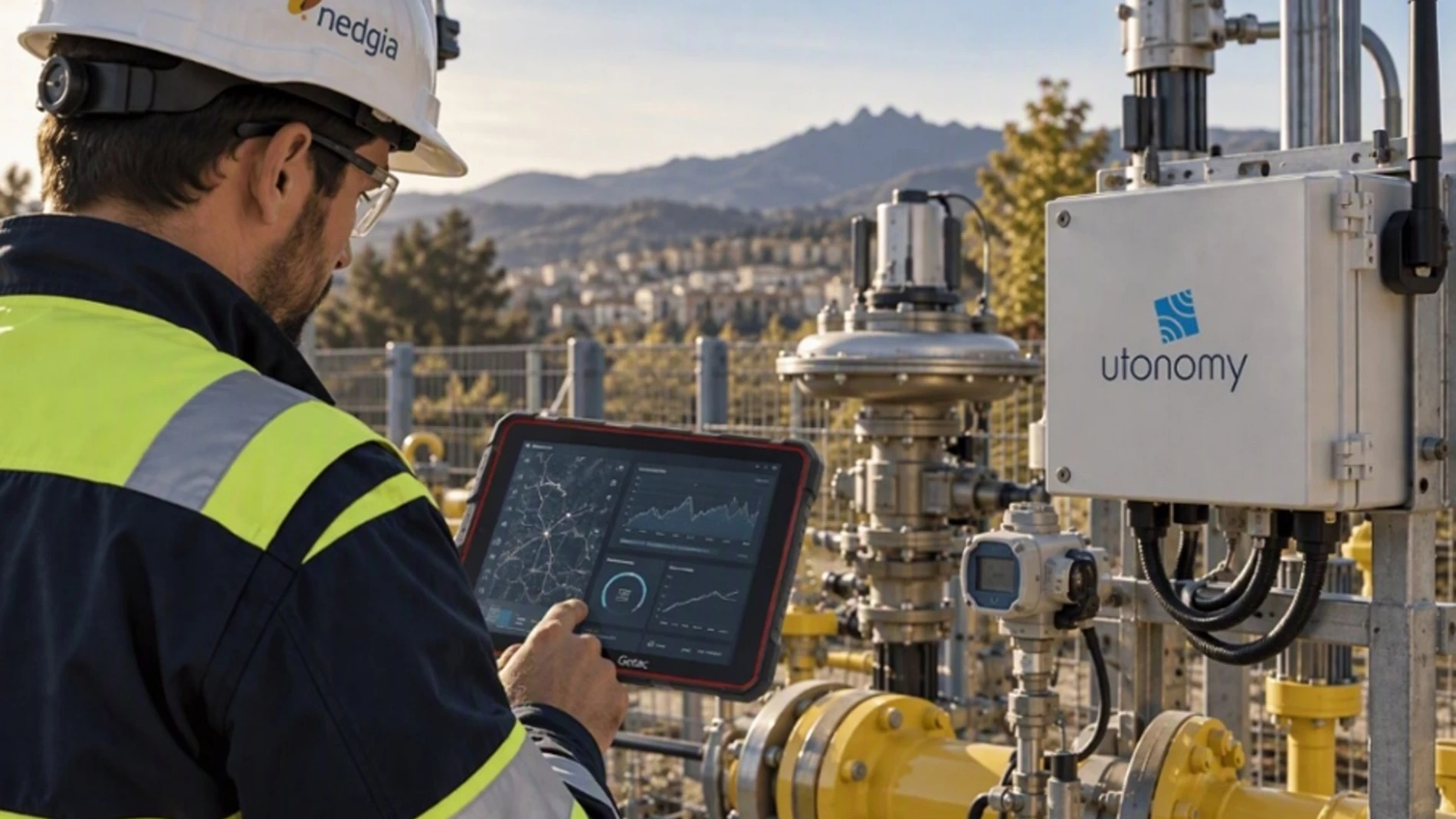
For decades, gas distribution networks have been managed with the premise of maintaining sufficient pressure so that the supply reaches the last point in the network under any circumstances. This safety margin guarantees the servicealthough it is not always the most efficient. For many hours of the day the network works with more pressure than necessary and this has a small energy and environmental cost.
Digitalization is changing that situation. The combination of sensors, remote communications and artificial intelligence allows the network to stop operating at a fixed level and continuously adjust to what consumers really need.
How the network works
The demand for gas is not constant, it falls at dawn, rises early in the morning and varies with the outside temperature. If the network pressure accompanies these oscillations, it can be reduced for a good part of the day without putting the supply at risk.
The key is in anticipation. When faced with a cold wave, the system raises the pressure before peak consumption arrives, instead of reacting when it has already occurred. And since the technology is installed on existing equipment, it does not require replacing infrastructure.
The interest in this technology goes beyond daily operation. Distribution networks operate under strict safety and maintenance protocols, but all infrastructure of this type registers small diffuse emissions. As methane has a high short-term climate effect, reducing it is one of the sector’s priorities.
The first experiences
In the United Kingdom, the distributor SGN and the British technology company Utonomy completed a six-month trial between October 2024 and March 2025 in five regions in the south of England. The system allowed the regulators’ pressure to be reduced by up to 31%, with a projected average reduction of 16% in methane emissions from the equipped sections. In Stockholm, the operator Gasnätet Stockholm reduced the average nighttime pressure from 15 to 12 millibars, equivalent to a 20% cut in losses, and has extended the contract to five more stations. In Romania, Delgaz Grid installed the first phase in its Reșița medium pressure network a few months ago, with the intention of later incorporating a pressure scheduler based on machine learning.
Naturgy, pioneer in Spain
Spain now joins that list of countries around us. Nedgia, the Naturgy group distributor, has launched a pilot project in Igualada (Barcelona). To carry out the project, the Spanish energy company has signed an agreement with the British company Utonomy specialized in the automation and intelligent optimization of gas distribution networks. The collaboration agreement is jointly promoted by the Nedgia innovation team and the Naturgy Corporate Innovation unit. The city of Igualada has been chosen to launch the project.
Digitalization and artificial intelligence can help build more efficient, flexible and future-proof networks
With this project Nedgia wants to evaluate two specific benefits, the reduction of emissions associated with the operation of the network and more agile management thanks to automation. José Manuel Pérez Tejada, head of Innovation at Nedgia, frames the project as another step in the digitalization of the network and has stressed that it will allow the technology to be tested in real operating conditions. If the results are satisfactory, the distributor will study extending it to other pressure levels.
The potential scale is important since Nedgia controls around 70% of the Spanish gas distribution market and, according to its sustainability report, it manages more than 54,000 kilometers of network and some 5.4 million supply points.
As the Spanish energy company itself assures, innovation does not always consist of deploying major transformations immediately. In many cases, it begins with pilot projects that allow new technologies to be tested in real conditions, learn from their behavior and evaluate their potential before taking the next step.
That is precisely the objective of initiatives such as the one being developed in Igualada, to better understand how Digitalization and artificial intelligence can help build more efficient, flexible and future-proof networks. And perhaps therein lies one of the greatest opportunities of the energy transition, using innovation so that networks not only transport energy, but also learn to manage it increasingly better.