
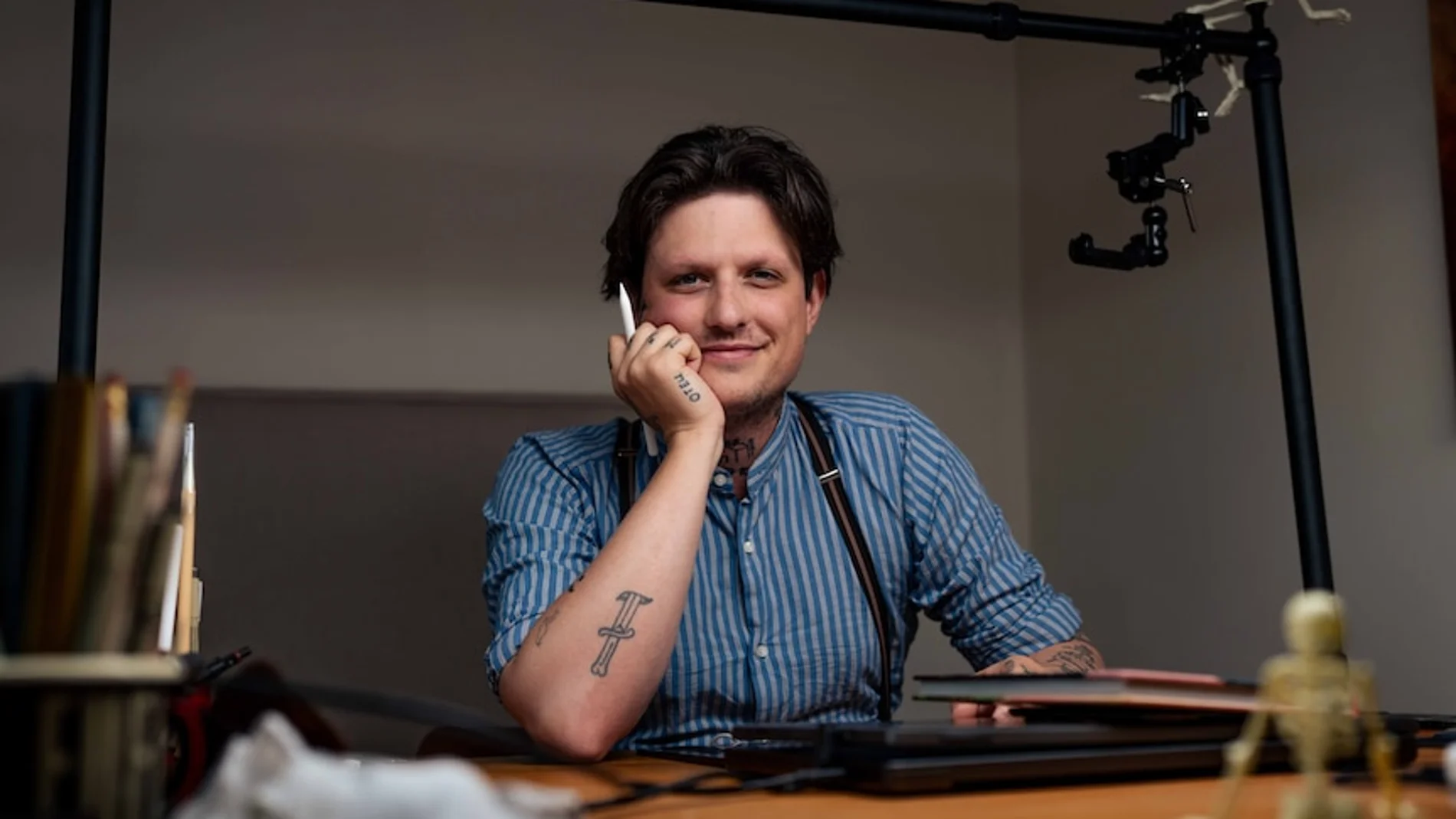
Christian Watson draws skeletons on videos recorded with his family and paints the backgrounds of each scene. This is how he created Mr Skelly, an animated character, of his own @1924uswhich talks about loss, love and everyday life. Now, the artist assures that your handmade drawings are reused through artificial intelligence and that some platforms go so far as to point out their own originals as AI-generated content.
Watson exposes both situations in a recent video. According to him, other people put their work through filters to alter the character, add voices and sell products with those versions. At the same time, he states that your original posts receive AI tags although he retains evidence of how he did them. The video does not identify those responsible.
This double situation is especially frustrating for him due to the way he works. “All my work is drawn, painted and animated by hand,” Watson says in the video, in Spanish translation. For your pieces, the movement is based on real recordings which he then turns into small illustrated stories.
From family video to animation
A short recording serves as a guide to draw a skeleton of each movement, as documented ABC Australia in his Tasmanian studio. The landscapes are born from photographs and are digitally painted by hand; The team then puts together images, sound and text. His family participates in those recordings and his wife, also an artist, collaborates on the project. This method explains why Watson insists on showing the work behind videos that can last just a few seconds.
When he denounces that they alter Mr. Skelly with filters and give him new voices, Watson talks about a character he created and developed with your team. His concern about adding voices is not limited to the visual result: he also claims that these versions are used to sell items. The video does not provide details of those sales.
In a previous interview with ABC Australiathe animator had already distinguished between the possible benefits of artificial intelligence in areas such as medicine and its use in artistic creation. There he explained that he was concerned that artists’ works could be used to train models without their consent. The authorship of his work It is part, as he said, of his identity as a creator.
When the original has to explain itself
The other complaint about the video is directed at the platforms’ labels. Watson maintains that, after publishing a piece he wrote, he has encountered notices that present it as artificially generateddespite being able to show how it was produced.
He puts it this way: “Instead of AI having to prove that it is real, reality has to prove that it is not AI.” According to Watson, respond to false accusations and reporting accounts impersonating yours takes away hours you’d rather spend creating. It does not specify how many publications received those labels.
Watson calls for changes so that those who create and publish original works do not shoulder that effort alone. In your case, the time spent reporting impersonations It is subtracted from what I would like to use in drawing and animating. Despite this, he encourages other artists to continue creating when these experiences are discouraging.