
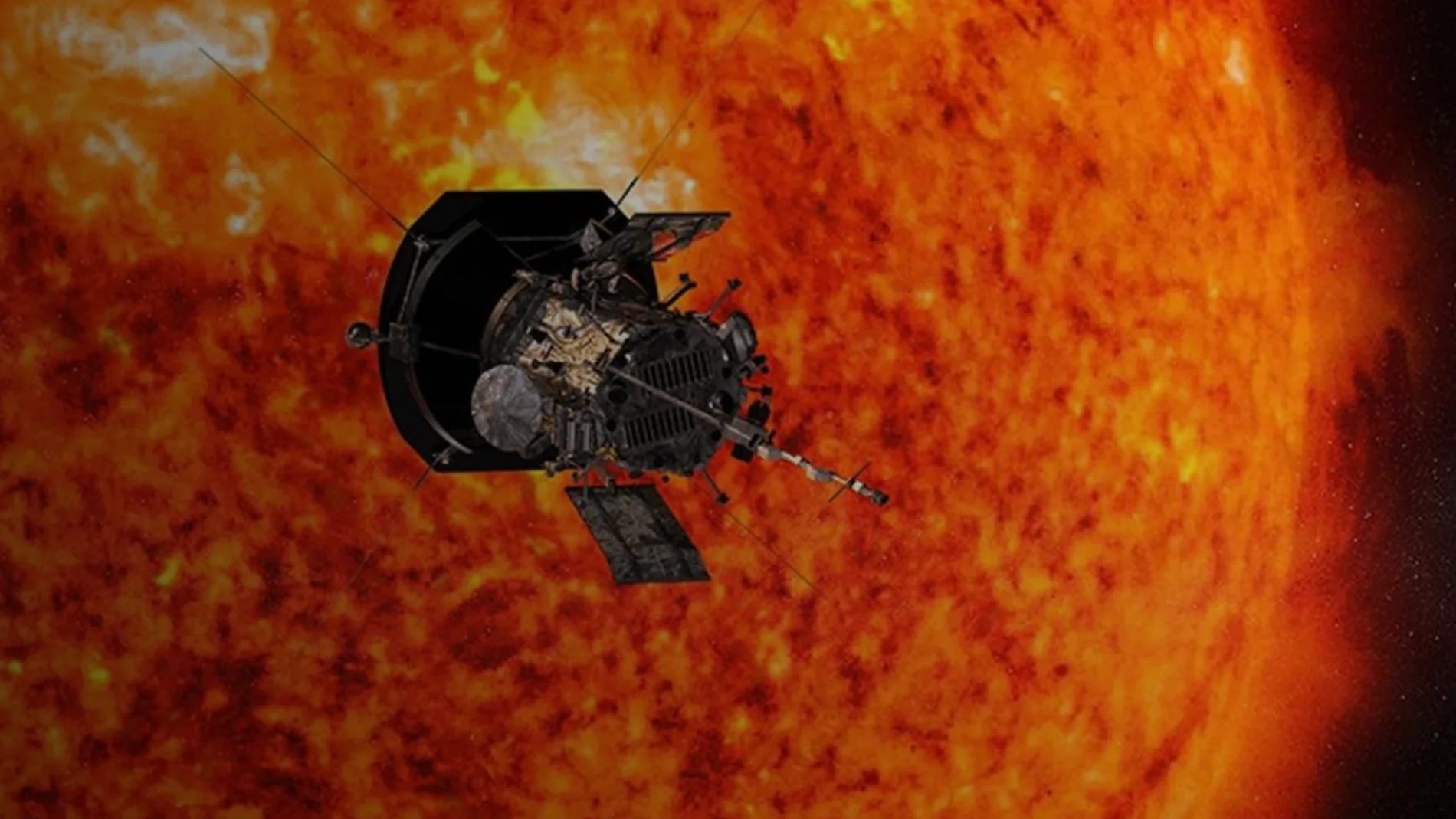
The Sun’s magnetic field does not remain still. Their lines twist, stretch, reconnect, and can shoot out into space, dragging with them plasma, the extremely hot, electrically charged gas that makes up the solar wind. But among the structures carried by this wind there are some that are especially disconcerting: sudden folds in which the magnetic field deviates from its usual direction and then returns to it, as if a space highway made a sudden zigzag.
Scientists call them switchbacks (something like “foldings” or “turns”) and have become one of the most intriguing pieces of solar physics. The Parker Solar probe discovered that they are extraordinarily common near the Sun, but for years a fundamental question remained open: Are they formed in the solar atmosphere itself or do they appear later, during the journey of the solar wind through space?
Now, a team led by Jesse Coburn, from the CNRS and the Plasma Physics Laboratory, has used Solar Orbiter to follow one of these structures to its birthplace. The ship passed through one of these switchbackan especially large one when it was approximately halfway between the Earth and the Sun. Its Solar Wind Analyzer (SWA) instrument allowed directly analyze the particles that formed that structure. And those particles carried a “chemical memory,” as explained in the study published in Nature.
Scientists found a specific combination of oxygen and carbon ions that can only be produced under certain temperature conditions of the solar corona. Its composition pointed to an origin in hot magnetic loops located near the surface of the Suna region where the field lines are closed and keep the plasma trapped.
“When the probe Solar Orbiter crossed the switchback we were able to study particles that are rarely observed in these structures and that contain telltale traces of their origin” explains Coburn.
The explanation that fits these traces is a process known as magnetic reconnection by exchange. To understand it, just imagine two types of magnetic lines. Some are open and extend from the Sun into space, like highways that allow plasma to escape. Others form closed loops that return toward the star itself and can hold trapped material, such as roundabouts.
When an open region comes into contact with a closed one, their magnetic fields can reconnect. A part of the lines then changes configuration and the plasma that was enclosed in the loop can escape into space. This process generates the magnetic disturbance that ends up traveling with the solar wind. The result also resolves an apparent contradiction. ANDThere were two large families of explanations for the switchbacks. One placed its origin in reconnection processes near the Sun. The other attributed its appearance to waves and turbulence that act on the solar wind during its movement.
“There are two main competing theories to explain how a switchback and, by extension, how the solar wind is formed“Adds Coburn. According to the results of the study, the composition of the particles constitutes the decisive evidence in favor of reconnection by exchange as a formation mechanism. But waves and turbulence are not left out of history. Coburn’s team also found signs of these processes, although they probably act later…
“Once he switchback has abandoned the Sun, waves and turbulence take over and govern its movement – says Stephanie Yardley, co-author of the study -. Despite this, the two mechanisms do not contradict each other: The reconnection creates the structure and the waves and turbulence then help to modify it during its journey..
The importance of the discovery goes beyond solving the mystery of a magnetic curiosity. The switchbacks They are part of the environment in which the solar wind is born and moves, and understanding their origin helps explain how the corona heats up and how the particles acquire the enormous speeds with which they leave the Sun. Besides, The study shows that plasma retains information about its place of origin. By measuring their particles from millions of kilometers away, scientists can reconstruct part of the history they followed from the corona to interplanetary space.
“The solar wind connects the Earth to the Sun, and understanding its dynamics has important implications for our ability to keep the planet safe from extreme space weather events – concludes Daniel Müller, co-author of the study -. “The better we understand how the solar wind is generated and evolves, the better we can anticipate the consequences of solar storms on satellites, communications and other technological infrastructure.”
Solar Orbiter has thus achieved something similar to following an invisible thread: has taken a magnetic alteration in the middle of the trip, has read the composition of the plasma that accompanies it and has used those traces to return to its origin in the Sun. It’s not just a new photograph of our star. It is a way to reconstruct how its magnetism transforms the solar surface into an environment that can affect the Earth.