
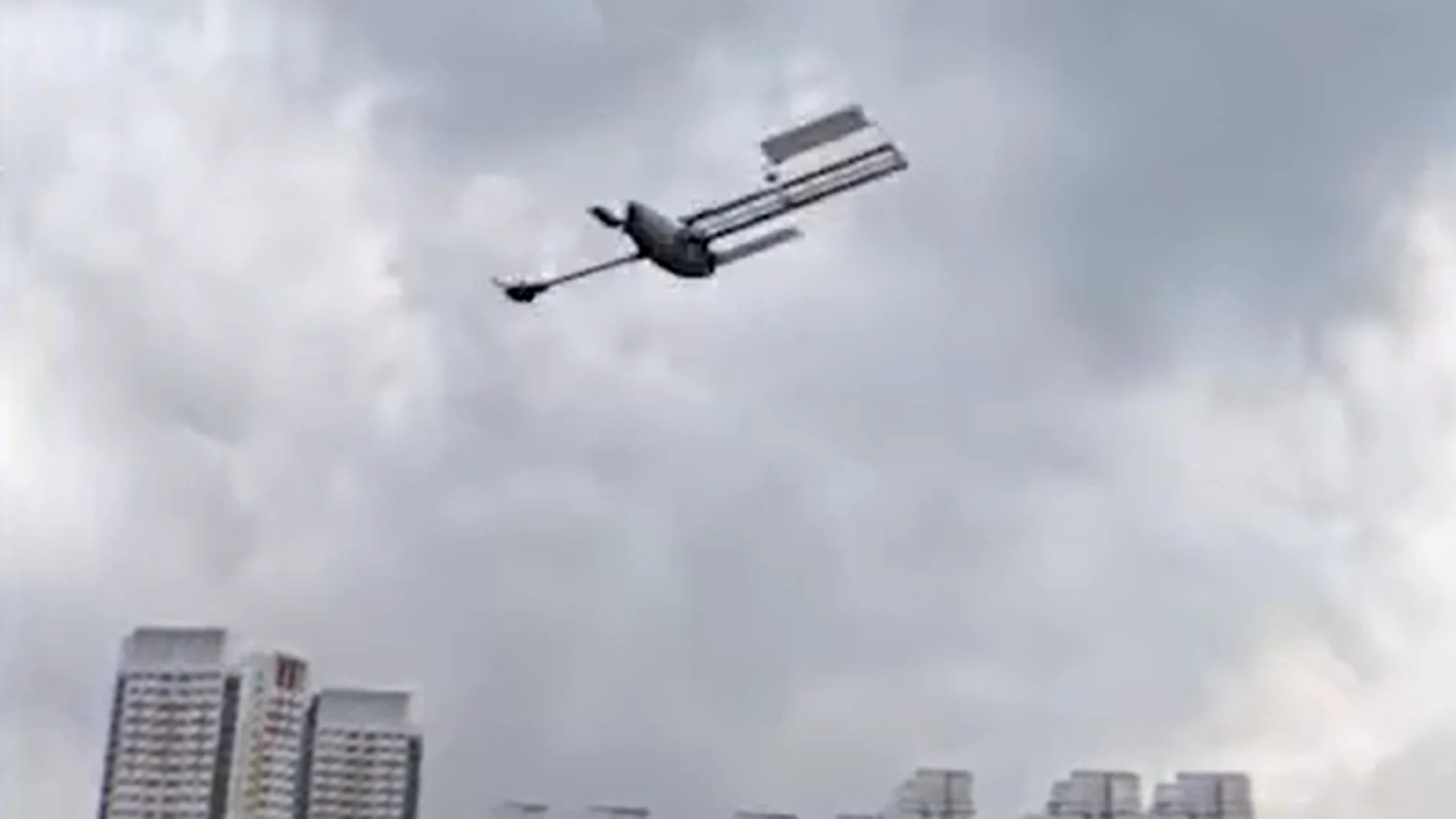
The Maple seeds have a simple strategy for traveling away from their tree: when it falls, it turns on itself and turns the fall into a kind of flight. A team of engineers from the Singapore University of Technology and Design (SUTD) has borrowed that mechanism to create a robot that does something much stranger. ALBATROSS can be released from the airautorotate during the descent, land on the water and, once there, become an autonomous sailboat.
The name is an acronym for Aerial lander with self-rotating and floating navigation sensorbut its operation is easier to understand if you follow its journey. First fall. Then it floats. Finally sail. And it does so by trying to carry with it as few motors, mechanisms and electronics as possible. The need behind the design is practical. Oceans, lakes and other bodies of water need sensors to monitor algal blooms, pollution, waste, marine fauna or environmental variables. In emergency situations, furthermore, it may be necessary to get them quickly to an area that would take too long for a ship to reach: an oil spill, flood, hurricane, or the aftermath of another disaster. Current systems typically rely on ships or platforms that must travel to the site, while launching a sensor from an airplane poses another problem: impact with water.
ALBATROSS attempts to solve both obstacles with a single architecture. When released, its two rigid wings function as aerodynamic surfaces and cause the robot to begin to rotate during the fall. This autorotation reduces the speed of descent and allows smooth entry into the water. Once there, the same structure stops behaving like a wing and starts acting like a sail. The center of gravity and weight distribution also mean that the robot can recover the correct position by itself if it falls on its side or ends up upside down. You don’t need an engine to make that transition.
Biological inspiration also appears underwater. Its long, narrow rudder resembles the tail fin of a fish and can oscillate to produce thrust. Thus, the wind provides most of the propulsion, while Rudder movement helps especially when the wind is weak or when the robot needs to maneuver against it.l. The result is a hybrid machine that uses the same components to solve completely different problems.
And there is probably one of the keys to the design. ALBATROSS works with three actuators and three main sensors for basic navigation functions. Compared to other robots capable of moving through air and water, which need independent motors and mechanisms for each environment, researchers have tried to make each component do more than one job.
Tests showed that the concept works outside of the computer. The robot was launched from a drone to 150 meters highentered autorotation, landed on water, righted itself, and then navigated between different points on a route. The experiments were carried out in two reservoirs in Singapore. In navigation tests it reached a maximum speed of about 0.82 meters per secondequivalent to about 3 km/h, and was able to maintain autonomous navigation for about three hours while recording environmental data.
Energy autonomy is another consequence of the strategy. During navigation, The average consumption was about 3.98 watts, with peaks close to 8 watts during maneuvers that required greater rudder movement. In one of the three-hour tests, the main battery retained half its charge at the end. The ALBATROSS recorded humidity, heat flow and wind direction, variables that allow studying exchanges between the water surface and the atmosphere. The study authors, led by Shane Kyi Hla Win also tested a control system based on reinforcement learning in simulations. The result was comparable to the conventional controller, but did not surpass it; That is why machine learning appears in the study as a proof of concept and not as the essential piece of operation.
The importance of this design is, therefore, less in having built a drone that navigates than in having found a different way of combining two machines into one. ALBATROSS does not need to fly once it hits the water. This renunciation allows us to increase the space available for sensors and simplify the system. The authors estimate that The platform could cover deployment distances greater than 100 kilometers depending on the aircraft that transports it and that its payload capacity can exceed 35% of its weight, although these figures are part of design estimates and comparisons, not a real ocean mission. The idea summarizes one of the most interesting teachings of biomimetics: It is not necessary to copy an entire organism to take advantage of evolution.