
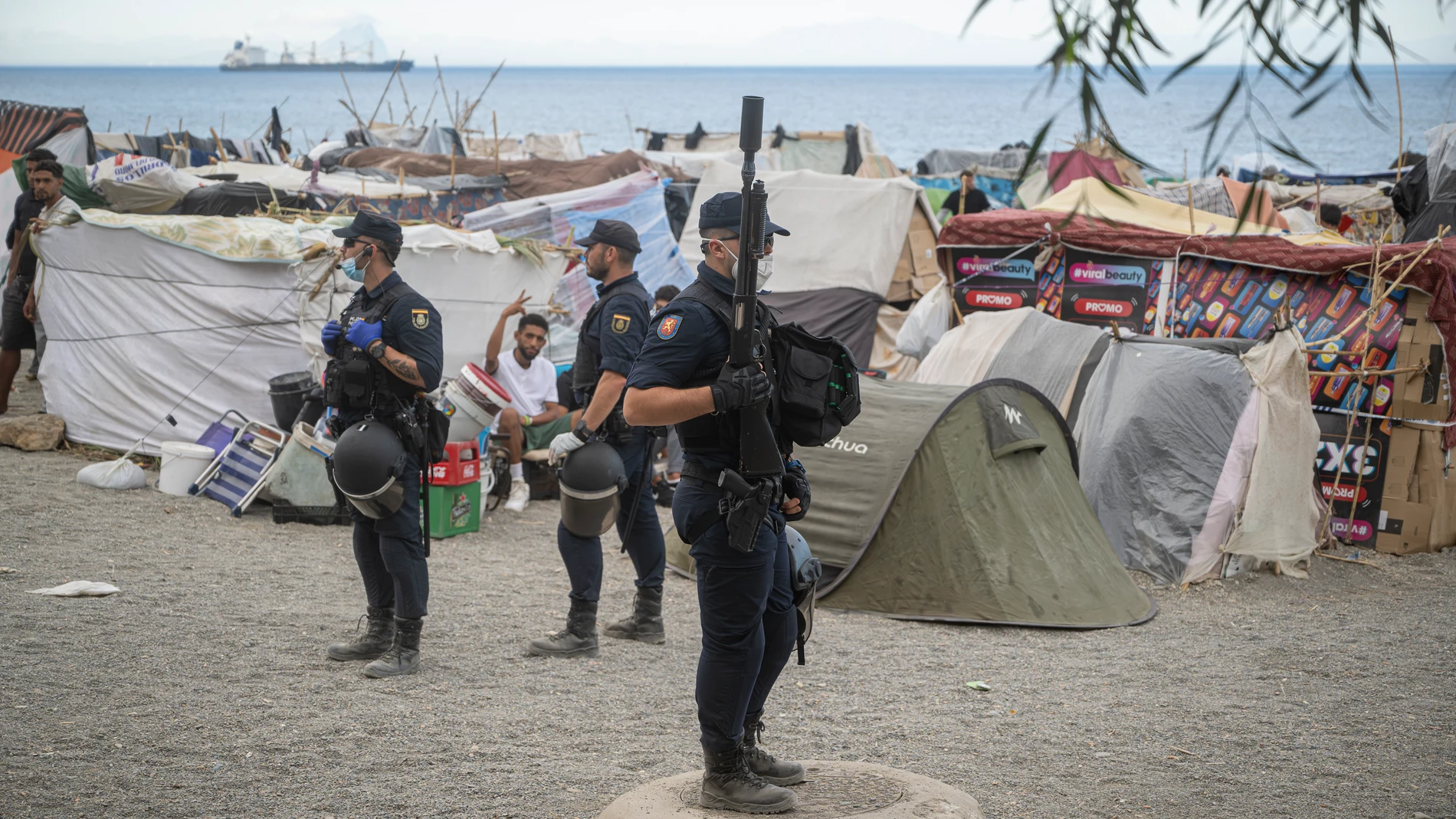
Spain has a serious problem regarding a new massive assault on Ceuta or Melilla that may occur in the future. Beyond the limited capacity to accommodate tens of thousands of people at once, the police denounce that they could not “do anything.” They feel “tied” hand and foot because they do not have legal security to act in the face of a human avalanche that enters from the other side of the border with Morocco.
The migration crisis at the end of July, when between 75,000 and 85,000 people entered at once in two days, according to the calculations of the National Police, has shown the whole world the seams of Spain’s security, information and intelligence systems. If the declassification of communications by the Government left the National Intelligence Center (CNI) sold by showing its communication channels, the deployment of riot police on September 23 in the face of a new massive entry shows that, on paper, the agents cannot do anything beyond “laying down the body”, as the police unions denounce.
“If 50 or 50,000 enter, the problem is the same, that we don’t know what we can do,” explains a commander. The issue lies in the Immigration Law, which despite being 26 years old, has yet to be developed. Approved in 2000, it has undergone various modifications throughout this time, especially focused on asylum, reception and returns to Morocco. But nothing about how Police and Civil Guard agents can act when immigrants manage to enter Spain irregularly.
One of the main complaints during these 60 days of crisis by the agents is the “lack of clear orders.” “There are no orders because there is no protocol, the law has not been developed,” summarizes another source. This means that the legislation does not specify what defenses they can use or when. «If 40,000 enter, can we use firearms? Probably no one would think of it, although the law says that we have to avoid these entries. And the rubber balls? And the extendable defenses? Can we stop them? How do we do it? That’s the problem for us, we don’t know what to do or when to do it. And what the bosses tell us is that it depends on each situation.
Faced with this legal limbo, the majority of police officers are clear that they will not act beyond guiding the crowd to safe places, avoiding traffic jams so that no deaths occur. «Of course they are going to enter. To return them at the moment, Morocco must accept them, we are at their mercy. I can open the door on our border side, but if they don’t open it, they won’t come back. “They can’t stay in the middle.”
The agents are also clear that they are not willing to face a criminal process that would lead them to the dock. And they speak with knowledge of the facts in reference to the 16 Civil Guard agents who in 2014 were accused of causing the death of 15 sub-Saharans when they were trying to enter Ceuta through, precisely, Tarajal beach, where the mass entry by swimming took place. “I have a family, I’m not going to risk going through that ordeal like what happened to the guards.”
In February 2014, when a group of immigrants tried to enter Ceuta, the Benemérita agents who were at the border crossing used riot control material – specifically rubber balls – to dissuade them from their intentions. The Tarajal tragedy claimed the lives of 15 people who drowned in the sea, and the agents faced a long and high-profile process for their actions.
Different NGOs even requested between 28 and 56 years for officials, depending on their hierarchy that day. The sentence, which was not known until 2020, ended with the acquittal of everyone. According to the order of the Court of Cádiz, there is no “causal relationship” between the actions of the agents and “the deaths due to drowning and injuries” that were intended to be attributed to them, and beyond some “shade of abnormality”, there was no “indication of deviation or excess” in their behavior. Still, no police officer wants to be in that situation again.