
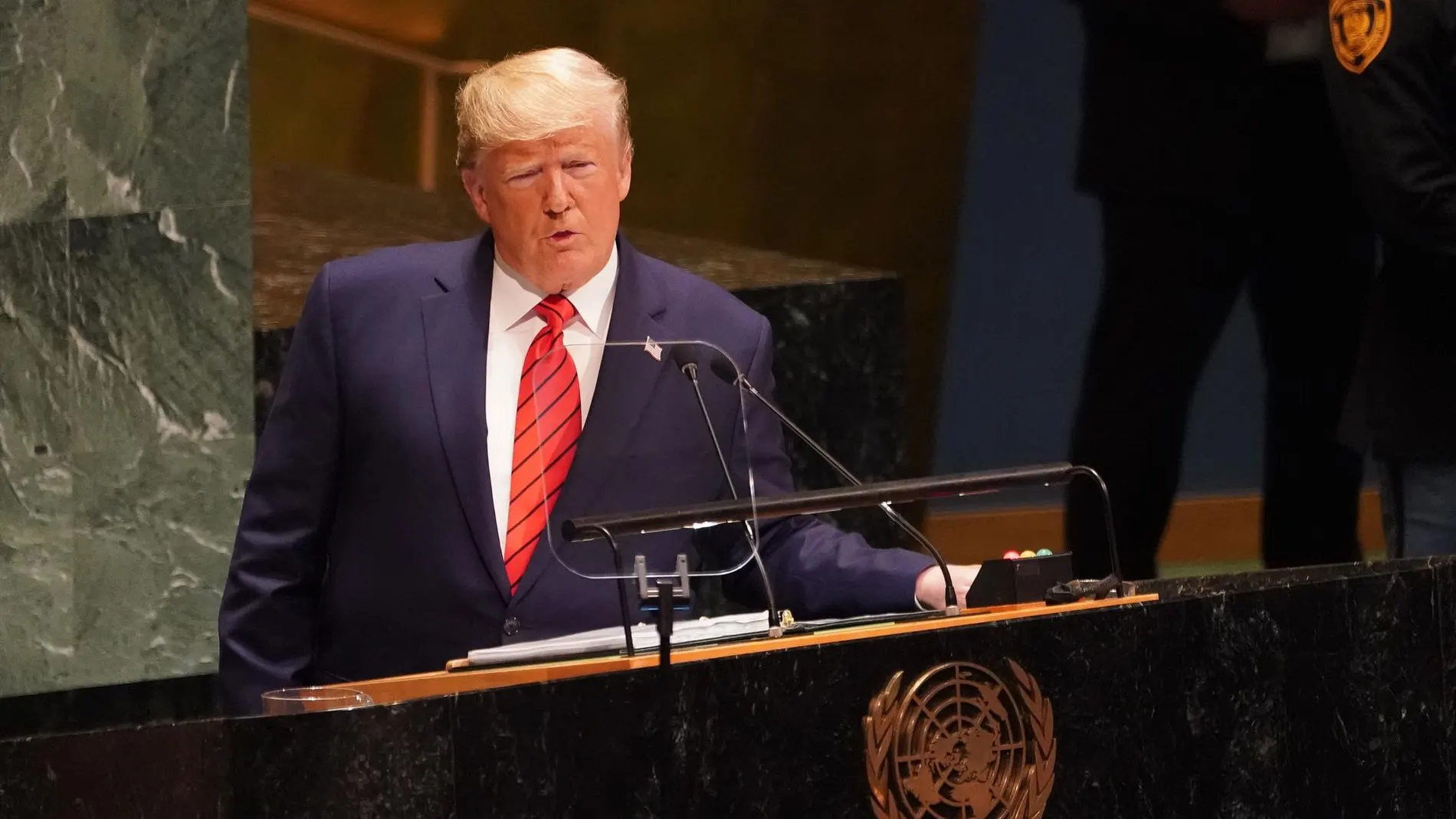
During the Cold War, and paradoxically, the United Nations General Assembly (UNGA; United Nations General Assembly) was the center of world diplomacy. The meetings on the margins of the plenary constituted a hive of contacts that were very difficult to organize for small or medium-sized countries in an era without instant communications. In the corridors, offices were improvised, while the most powerful met discreetly, with all the means at their disposal, in their permanent missions or in the residence of their ambassador. That Assembly served a purpose. The one that has just held its 81st session in New York, under the motto “Restoring trust, managing transformation”, has served above all to measure how much it has degraded.
The speeches
António Guterres, in his last high-level week before leaving office on December 31, called for a world built on interdependence and reminded superpowers that their power is not so “super”; Just an hour later, Donald Trump offered the opposite reading: that he has not promised strength, but has used it. The US president threatened to “annihilate” Iran if there is no agreement, an agreement that he himself predicts for after the legislative elections in November, accused the Organization of imposing the far-left agenda of globalist bureaucrats and attacked the International Criminal Court (ICC; International Criminal Court, International Criminal Court). The only tangible diplomatic news of the week was that His envoys met for three hours with Iranian officials on the sidelines of the Assembly. On the margins, as in the Cold War; not in the plenary session, which is no longer useful for that.
The exception, unanimously praised as the best speech of the session – for the level of the session, it should be specified – was that of the President of Finland, Alexander Stubb. He quoted Kofi Annan (“whatever our differences, we stand or fall together”) and framed the dilemma as a choice between cooperation or conflict. He asked for a refoundationa new moment San Francisco: at least two new permanent seats for Africa, two for Asia-Pacific and one for Latin America; that no State alone has the right of veto; and that any member of the Council who violates the Charter will have his vote suspended. Laudable, but asking the five permanent members to renounce the veto is like asking them to amputate both arms. We will return to that.
The quality of the former political elites, today simple political classes, is one of the causes of the worsening. Let’s imagine the hallways of the UN and the bilateral meetings with figures of the stature of Adenauer, De Gaulle or Eisenhower, and closer to our time Kohl, Mitterrand, Felipe González or José María Aznar. Come on, just like today.
A crisis of origin
The crisis of the United Nations is of origin, although not stable: it was born in San Francisco with the veto system for the victors of the warand it’s been downhill from there. Harry Truman himself recognized it when closing the Conference on June 26, 1945: the Charter, like the American Constitution, “will be expanded and improved with the passage of time,” since no one intended it to be a definitive or perfect instrument. Eighty-one years later it is still practically intact.
Added to this congenital defect the growth of the institution in members, powers and specialized agencies: a true labyrinth of crossed responsibilities and competition between organizations, and between their leaders, motivated by ambitions and egos that are not infrequently excessive. The Secretary General is not the head of the heads of State – and thank goodness – but the administration he directs with fairly omnipotent powers is, at best, which is also the majority of cases, mediocre in its functioning if not simply incompetent. own Guterres admitted to the Financial Times in August that the Security Council is “virtually paralyzed” by vetoes, especially from the United States and Russia. Difficult epitaph for ten years in office.
What it costs and what is done
Regarding the cost of the Organization, figures circulate for all tastes, and it is advisable to organize them clearly. The regular budget of the Secretariat – what States pay for mandatory fees – has been cut by 2026 up to about 3,240 million dollars, 15% less than in 2025, with a reduction of 18.8% in jobs, because, in the words of the secretary general, The UN is in a “race to bankruptcy” if the States do not pay on time; Only the arrears at the end of 2025 amounted to 760 million. Of that regular budget, approximately 70% is payroll and the remaining 30% is buildings, technology, security, conferences, translation and travel. Put simply: the administrative heart of the UN is a salary machine, with a small remainder of overhead costs.
It is a mistake, however, to deduce from this that the UN spends 70% on bureaucracy and 30% on aid. Humanitarian aid, refugees, food or vaccines do not come from that budget, but from the voluntary contributions that finance the funds and programs. If you look at the entire system, Annual spending is around $67 billion, and almost half is humanitarian assistance. The problem, therefore, is not that the Organization is grossly expensive – the UN’s regular budget is lower than that of many European cities – but that the money from the fees is allocated almost entirely to a structure that duplicates functions, that is fought over competitions between agencies and whose effectiveness no one audits with results criteria.
What is essential to emphasize is that There are agencies that carry out exemplary workwith local officials and employees who are true unsung heroes and they risk their lives in some of the most dangerous places in the world: UNHCR (United Nations High Commissioner for Refugees), WFP (World Food Programme) and even the field missions of UNICEF (United Nations Children’s Fund), WHO (World Health Organization) or UNDP (United Nations Development Programme). The contrast between these people and the corridors of the Secretariat in New York is the best proof that the problem is not the idea, but its architecture.
Reform the veto without asking the impossible
This is where Stubb’s speech, for all its nobility, crashes against the Charter. Abolishing the veto requires amending Article 27.3, and Article 108 establishes that any amendment requires two-thirds of the General Assembly and ratification by two-thirds of the Member States, including all permanent members of the Council. That is to say: the five would have to ratify their own beheading. The same occurs with the suspension of voting for anyone who violates the Charter: Article 5 already allows suspending a State, but only upon recommendation of the Security Council, that is, subject to veto. Russia would easily veto itself.
What some of us have been asking for for years is more modest and, precisely for that reason, possible. First, the incorporation of new permanent members—India and Japan without discussionperhaps Germany, along with African and Ibero-American representation. There is precedent: in 1963 the Assembly approved resolution 1991 (XVIII), which expanded the Council from eleven to fifteen members; The Soviet Union and France voted against it and the United States abstained, but the five ended up ratifying it in 1965. It is the only amendment that the Council has known and it shows that the big ones accept what they cannot block politically.
Second, transform the absolute veto into what we could call a weighted vetowhich is almost a contradiction in terms but has a precise legal translation. An attempt would be made to add to article 27.3 a special rule for decisions adopted under Chapter VII of the Charter—those that concern international peace and security, the only ones that are mandatory—: they would be deemed approved with the affirmative vote of nine members unless two or more permanent members cast a negative vote. A single veto would no longer be enough; a veto partner would be needed. That does not eliminate the privilege of the five, but it makes it a power of coalition and not of whim, and would force Moscow to look to Beijing, or Washington to look to London or Paris, every time it wanted to block a resolution on Ukraine, Gaza, Sudan, the Sahel or approve new sanctions against Russia or Iran.
It wouldn’t be as revolutionary as it seems. Article 27.3 has already been reinterpreted without touching a comma: The International Court of Justice, in its advisory opinion on Namibia in 1971, confirmed that the voluntary abstention of a permanent member does not amount to a veto, contrary to the strict letter of the text. From 2022, in addition, Assembly resolution 76/262 requires that any veto be debated and justified before the plenary session. The practice has been eroding the veto; The only thing missing is for the Charter to reach it.
A lean balance and a consolation
He The balance of this Assembly is meager: none of the wars that dominated it – Iran, Ukraine, Gaza, Sudan, the Congo – left the building closer to its endthe Secretary General said goodbye describing his own helplessness and the average level of speakers would not have withstood five minutes of comparison with those of 1955 or 1985. Guterres’ succession, with six candidates in the running and no decision this week, will be resolved where it always is: between the five.
Dag Hammarskjöld said in 1954 that The United Nations was not created to take humanity to heaven, but to save it from hell.. With that yardstick, and despite all its serious defects and shortcomings, it must be said bluntly: if the UN did not exist, we would have to invent it. But we would invent it with fewer buildings and more Blue Helmets, with fewer secretariats and more UNICEF kitchens, and with a Security Council in which a single State could not hijack the peace of the world.
*Gustavo de Arístegui is a diplomat and was ambassador to India, Bhutan, Maldives, Nepal and SriLanka (2012-2016) gustvodearistegui.substack.com