
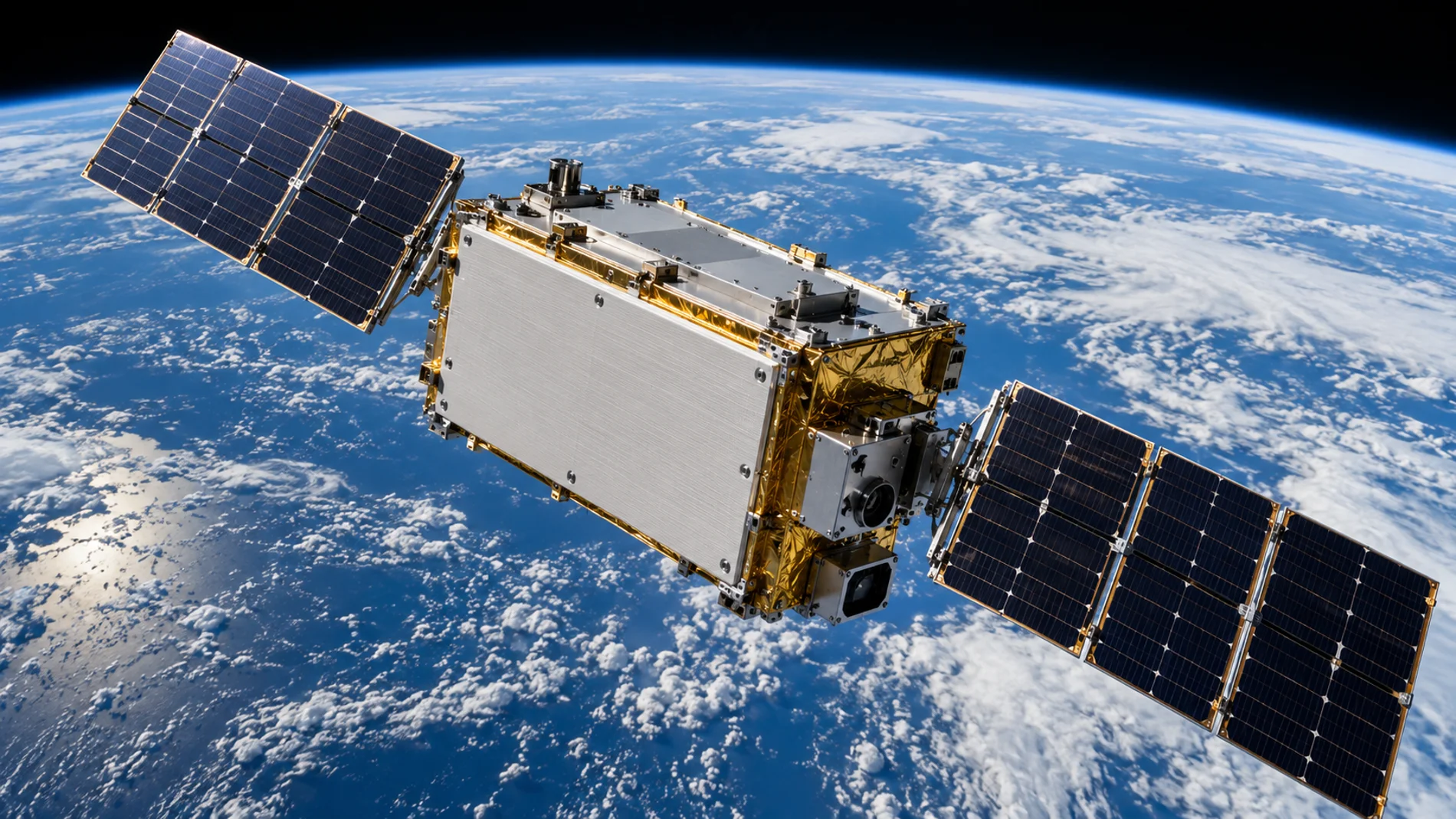
Google will launch its first satellite for artificial intelligence computing on October 1, a step forward from Project Suncatcherthe project with which you want bringing AI data centers to space. The satellite, called MVP and the size of a refrigerator, will take off from Vandenberg, California, in a Falcon 9 of SpaceXwithin the shared mission Transporter 18.
Suncatcher is Google’s bet to see if computing in space can alleviate the pressure that terrestrial data centers put on electricity, water and land. The idea takes advantage of the fact that a solar panel in the right orbit generates up to eight times more energy than on the surfacealthough the final design, with dozens of satellites connected by laser, remains a distant horizon.
A ‘borrowed’ satellite
The MVP itself is not actually a satellite built by Google from scratch, but one that Planet Labs already had preparedthe satellite imaging company with which it collaborates in Suncatcher, and which the company took advantage of to advance the test instead of waiting for the two custom-made satellites planned for 2027. Its solar panels, in fact, barely supply around one kilowatt, a power similar to that needed by a microwave or a hair dryerreports Ars Technica.
The four chips that travel in the MVP are TPUacronym for tensor processing units, designed by Google to train and run its artificial intelligence models and belong to the same family, Trilliumwhich use Gemini models in their terrestrial data centers. They had never before left an air-conditioned building with a stable power grid behind them..
The challenges of taking the same chips that are used on the ground into space
This jump raises, above all, a heat problem that is easy to solve on Earth. A computer cools down because air dissipates heat, but in the vacuum of space there is none and that pathway disappears. The heat can only leave the ship if it is conducted, through internal aluminum and copper tubes, to external plates that, when heated, release it outwards in the form of infrared radiation.. Google has already tested it on the ground, inside a chamber that imitates a vacuum, although this flight will be the first real test.
That cooling system marks, in fact, the most striking limit of the mission. As explained Travis Bealsproject manager, the chips will only be able to work in batches of about 15 minutes before stopping to let the system catch its breath. This is a very narrow margin compared to what is expected from a terrestrial data center, designed to operate without interruptions. This limit is precisely what Google wants to measure with this first flight in order to design the next generation of satellites.
Before that, the hardware has to survive the launch itselfwith intense vibrations and an acceleration of up to ten times the Earth’s gravity, and peaks that in some components exceed fifty or one hundred times that force, something that Google has simulated on the ground before the mission. Added to that space radiationcapable of altering the operation of a chip, which the company has recreated with a proton beam at the University of California at Davis, where its TPUs withstood a dose greater than that of a five-year mission.
Google is ahead in the race with Elon Musk and Jeff Bezos
Google is not the only technology company looking up in search of space for its servers. Elon Musk has said that SpaceX will build orbital data centers that will use the laser links from its satellites starlinkand Jeff Bezos speaks of centers with capacity of several gigawatts in a few years. No one has yet specified a date or a definitive design. Google, for now, is the one who has real hardware on its way to the launch pad.
If everything goes as planned, Google will keep the satellite operational about a yearalthough it could remain in orbit for up to six years before its trajectory degrades. That margin will give you time to see how the chips perform under different conditions. The next step, scheduled for 2027, will be to launch two satellites that communicate with each other using lasersthe first real test of the network that Google imagines on a larger scale.
For now, the only certainty is that Google will not know if the experiment has gone well until the satellite has been in orbit for some time. Those responsible for the project have presented it as a learning missiondesigned to find faults rather than to demonstrate results. If the satellite responds well, the company will have real data with which to design the next generation of space hardware. If not, you’ll know exactly what to fix before trying again.