
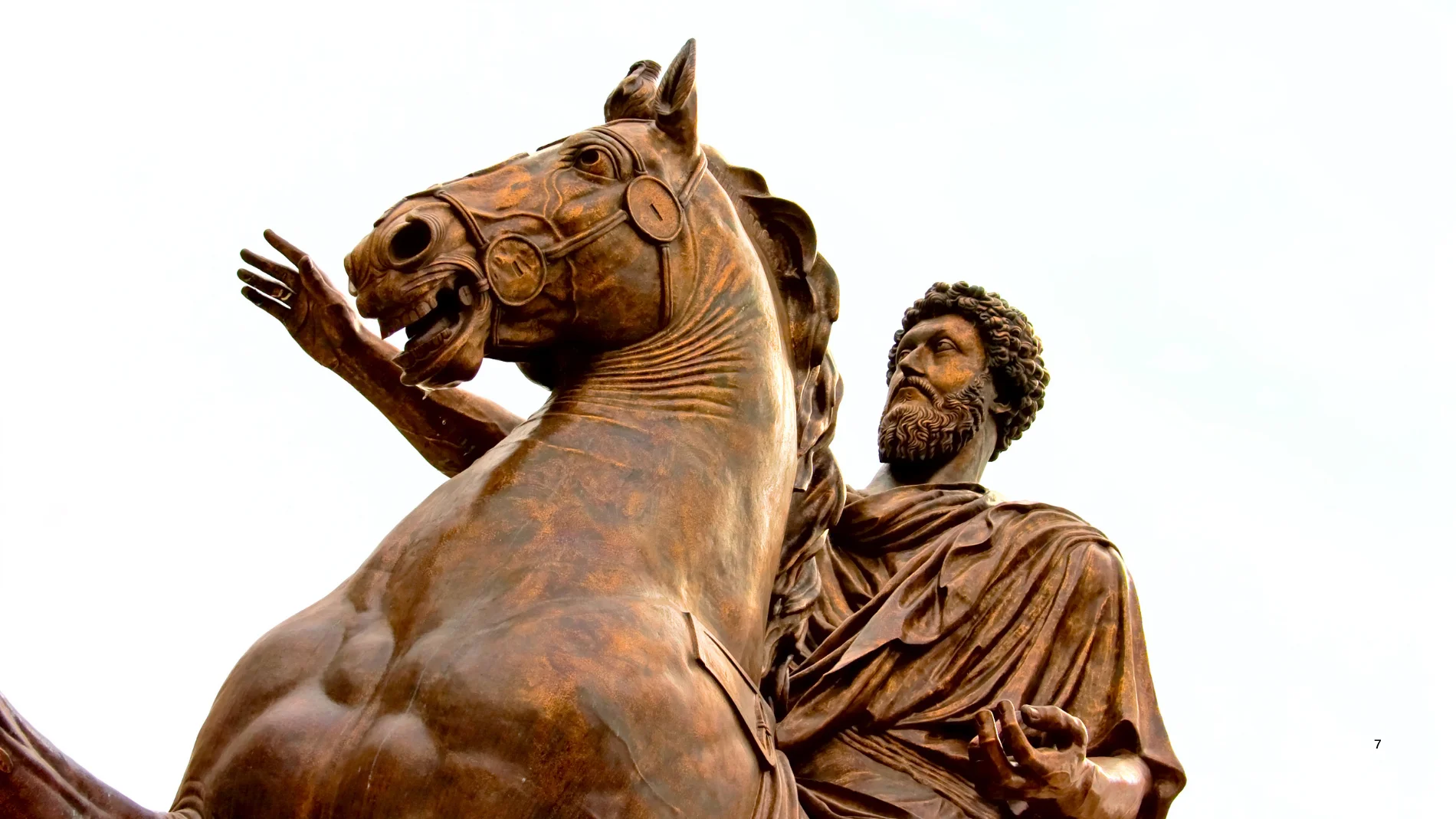
He Stoicism of Marcus Aurelius It continues to find space almost two thousand years after the death of the Roman emperor. His reflections on self-control, honesty and the way to confront what is beyond our control continue to circulate as some of the most recognizable maxims of this philosophical current.
Among them appears a reflection attributed to his Meditations that summarizes a good part of that way of understanding life: “If it’s not appropriate, don’t do it; if it’s not true, don’t say it. Be master of your inclinations”.
Marcus AureliusRoman emperor between 161 and 180 AD. C., did not resort to philosophy solely as a theoretical question. His writings functioned as personal reminders with which he tried to control his own reactions, maintain integrity, and act in accordance with what he considered right.
What does this phrase from Marcus Aurelius mean?
The maxim brings together three ideas closely related to the stoicism. The first has to do with our actions. If we know that something is not appropriate, the response should be not to do it, even when it is comfortable, beneficial or tempting.
The second transfers the same requirement to words. “If it’s not true, don’t say it” Turn honesty into a personal discipline and remember that we are also responsible for what we decide to communicate.
The closing of the sentence look inside. Being “master of your inclinations” means trying to ensure that desires, fears, anger or impulses do not automatically determine our behavior.
Self-control, one of the great ideas of Stoicism
One of the bases of Stoic thought is to distinguish between what depends on us and what is outside our control. We cannot always decide what happens around us, but we can work on it. How do we respond to it?.
Marcus Aurelius returned to this idea again and again in his Meditations. For him, governing oneself required observing one’s own reactions before allowing oneself to be carried away by them.
That does not mean eliminating emotions or becoming an indifferent person. The purpose is to introduce some distance between what we feel and what we do to prevent an immediate reaction from ending up making decisions for us.
Think before acting and before speaking
Reflection can easily be transferred to everyday situations. An argument, a decision made in the heat of the moment, or a comment made without thinking can change if we first stop for a few seconds to evaluate what we are doing.
In that sense, Marcus Aurelius’s phrase proposes three simple filters. Ask ourselves if an action is correct, check if what we are going to say is true and observe if we are acting with our own criteria or simply following an impulse.
The The simplicity of these questions explains part of the validity of Stoicism.. They do not require extraordinary circumstances. They can appear at work, in a personal relationship, in a family argument, or even before responding to a message.
The ‘Meditations’, the personal diary of an emperor
Much of the thought that we today associate with Marcus Aurelius comes from his Meditations, a collection of reflections written during different moments of his life and reign.
They were not conceived as a treaty intended for the public. The emperor wrote for himself, using philosophy as a tool to remember how he should behave in the face of difficulties, power, illness, loss or conflict.
This intimate character explains the direct tone of many of his maxims. Marcus Aurelius does not so much try to convince a reader as to Constantly remind yourself what kind of person you wanted to be.
Marcus Aurelius and a philosophy designed for daily life
Stoicism defended that virtue should be reflected in the everyday acts. It was not enough to know what was right. We had to try to put it into practice even when the circumstances were adverse.
For this reason, in the sentence the action, word and personal mastery. What we do, what we say and the way we respond to our impulses are part of the same discipline.
For Marcus Aurelius, a life guided by reason required coherence between these three areas. Acting in one way while thinking another, lying for convenience or continually allowing oneself to be dominated by passions meant moving away from the Stoic ideal.
A reflection that is still recognizable almost two thousand years later
The distance between the Rome of Marcus Aurelius and current life is enormous, but the dilemma posed by the phrase is easily recognizable. We all continue to face moments when we know what would be the right thing to do and yet we are tempted to choose something else.
We also know the difficulty of holding back a response when we are angry or of recognizing that something we want to say is simply not true.
Almost two thousand years later, Marcus Aurelius’s message retains precisely that simplicity. Do not do what we know we should not do, do not say what we know is not true and do not surrender our decisions to the first impulse that appears..