
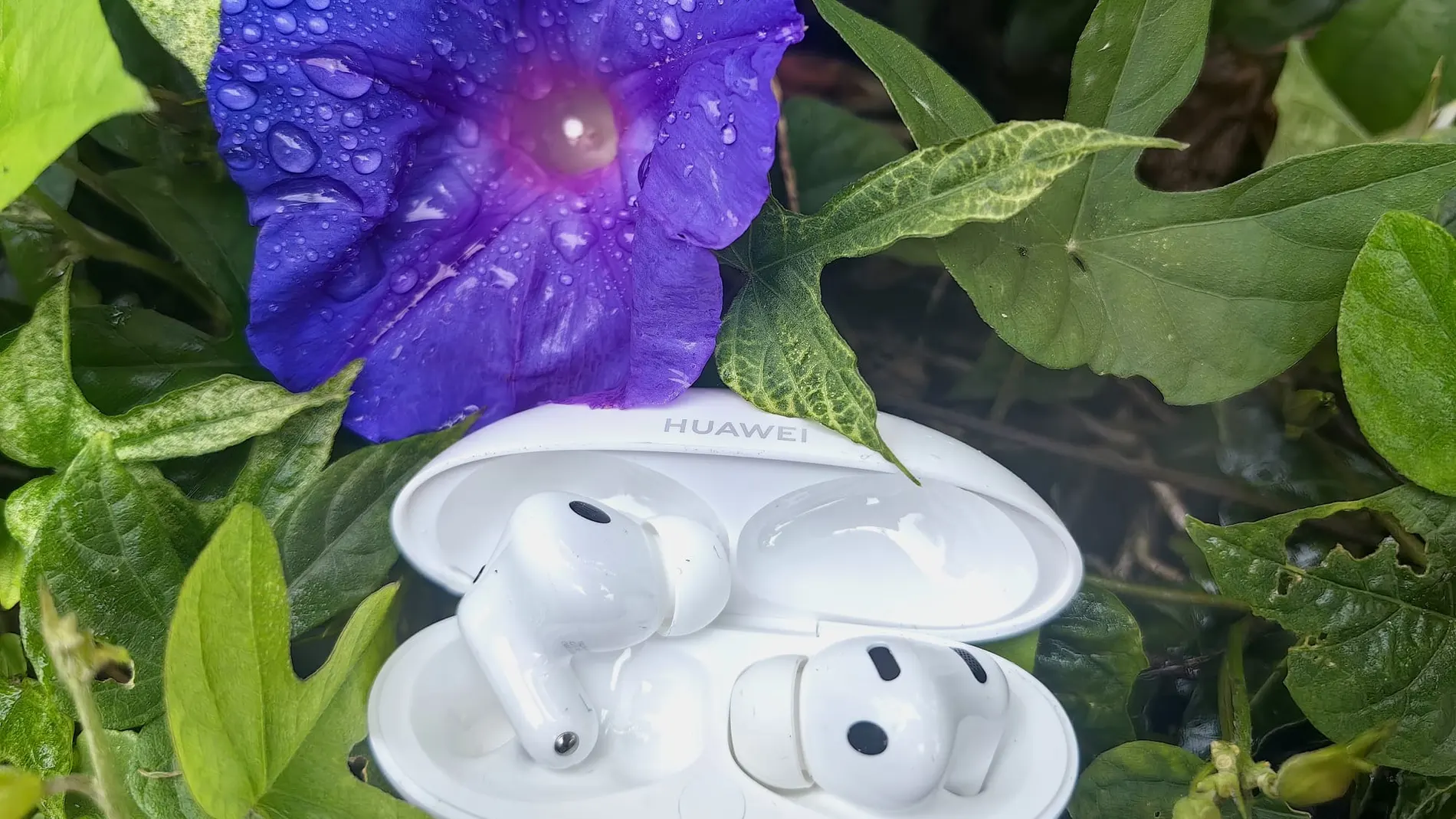
The FreeBuds Neo seek something more difficult to impress: to become those headphones that you put on and stop remembering that you are wearing. They are, in a sense, the reverse of the paradox of sound in a forest (if a tree falls and no one is there, does it make sound?). The FreeBuds Neo propose the other side of the dilemma: if we don’t feel them in our ears, why do we continue listening to music?
With 4.8 grams each, a compact in-ear design and a shorter neck than other models from the brand, they barely protrude from the ear. Huawei claims to have studied more than 10,000 ear samples to find a geometry that best distributes pressure and keeps the center of gravity balanced. On paper it may seem like a marketing figure; but after wearing them for more than 7 hours straight the conclusion is that either Huawei has a mold of my ear or it is not marketing and it is comfort. Although I wouldn’t recommend them for running, for example.
Of course, despite its size, it manages to meet the fundamental benefits. And more. Each earbud incorporates an 11-millimeter dynamic driver. This piece is responsible for transforming the electrical signal into sound and, although the saying “big donkey walks or doesn’t walk” does not always apply, Having a driver of this size in a headset as minimal as this is surprising… but logical considering the sound quality.
The frequency range that it handles (the spectrum that allows reproduction) is from 10 Hz to 48 kHz, more than double what we are usually able to hear, which explains why we are sometimes surprised when we hear a song we already know and we perceive something that “wasn’t there before.” And this is particularly noticeable in the bass. What I liked the most is that I didn’t have to change the equalization depending on the content I was playing, be it a podcast, music or video games.
ANC section: active noise cancellation (the aforementioned ANC) is probably its most striking feature. Huawei uses a dual-channel adaptive ANC system capable of analyzing ambient noise up to 400,000 times per second and advertises a cancellation depth of up to 30 dB. In practice, it works especially well with constant, low-pitched sounds: traffic, public transportation, or the continuous rumble of an airplane. They are not designed for complete insulation, but considering that their price is below 130 euros (100 with the introductory offer), it is the best cancellation on the market in that range.
Another important detail is that they are designed to live outside of a desk. They incorporate Bluetooth 6.0 and simultaneous connection with two devices, so that they can go from the computer to the phone without forcing us to start over, even if the operating system is not the same. Controls are carried out using gestures: two taps to play or answer a call, three taps to change songs, swipes to regulate the volume and a long press to change the cancellation mode. They also allow you to use head movements to accept or reject calls. Although this has been a bit confusing for me considering that I live with pets and small children and they are constantly hunting and capturing strange movements in the periphery.
For calls, Huawei combines three microphones with a bone conduction sensor and noise reduction algorithms. I don’t know if it’s the microphone, the algorithm or the connectivity, but the calls are made and received perfectly, sometimes they have heard me better with the headphones than without themespecially in somewhat noisy environments.
Finally, the battery, another feature that also does not seem to have paid the price for miniaturization. The FreeBuds Neo offer up to 6.5 hours of playback with active cancellation turned on and up to 10 hours without it; With the case, the total autonomy reaches 40 hours. The case charges via USB-C and does not have wireless charging, it has not bothered me, I would highlight the size of the case more, taking into account the small size of the headphones. The focus of the FreeBuds Neo is on size, comfort and sound quality. Well, also in the price. But, mainly in the tree and the forest at the beginning: we don’t know they are there, until we think about them.