
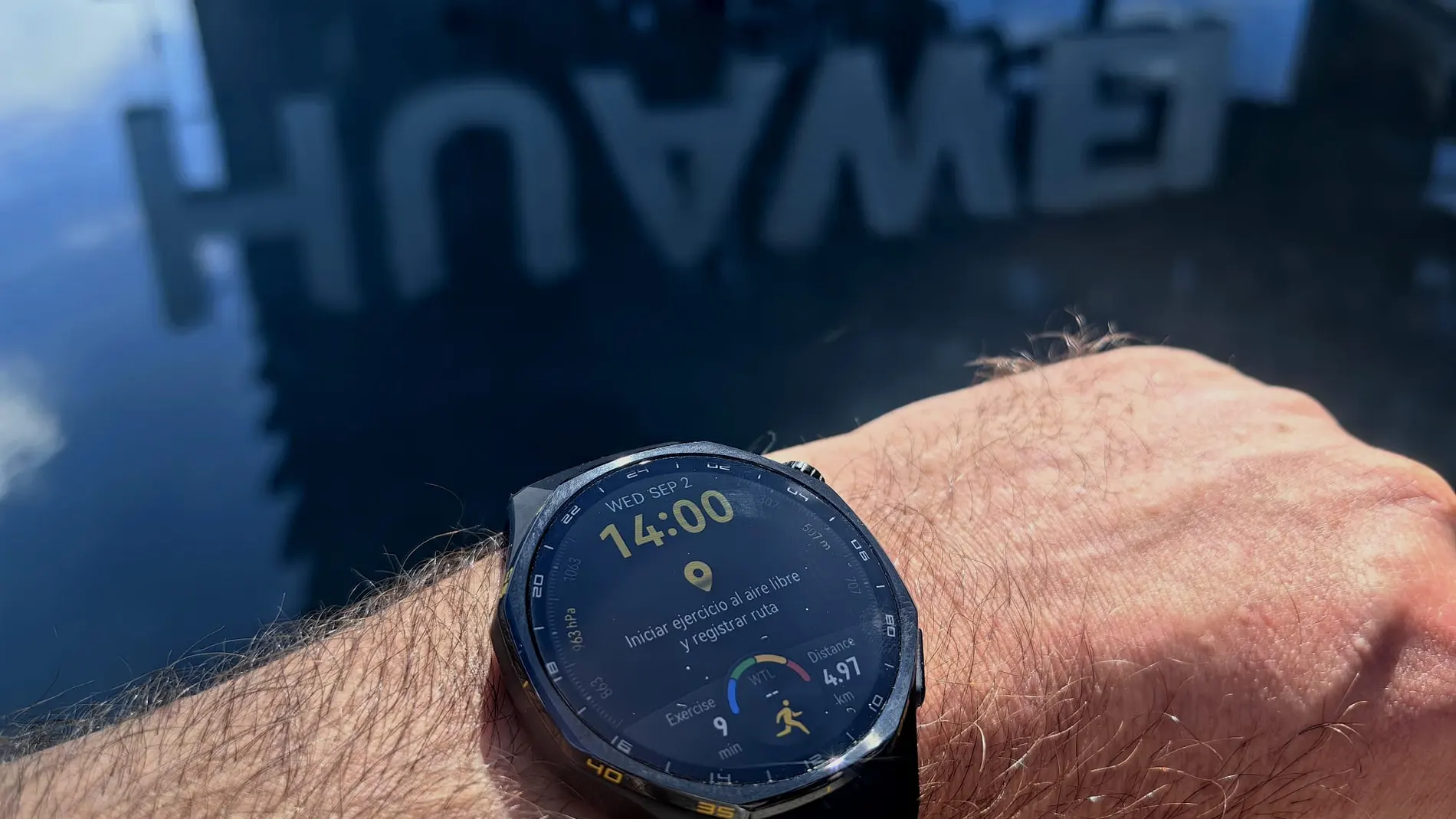
There are cities that seem to have sport incorporated into their architecture. Munich is one of them. In 1972, the Bavarian capital hosted the Olympic Games that left a mark that can still be recognized in its landscape, from the Olympic Park to that undulating roof that became one of the symbols of the city.
Perhaps that is why it is not strange that Huawei has chosen Munich to present its new generation of smart watches worldwide today. The Huawei Watch GT 7 arrives accompanied by an idea that fits well with the spirit of the city: a watch that does not want to limit itself to counting steps or measuring heart rate, sino accompanies the user when they leave home and turns the outside world into their training track.
To understand what the new generation proposes, it can be imagined as a small technological version of the five Olympic rings. Five circles that do not represent countries or disciplines, but five ways the Watch GT 7 tries to expand what we expect from a smartwatch: sport, orientation, safety, health and autonomy.
First ring: skiing, even when there is no snow
There is something especially striking about the new Watch GT 7: it can record a ski or snowboard session even when there is no GPS signal. The watch uses its sensors to detect changes in posture and altitude and recognize that the user is practicing one of these activities. From there you can record variables such as distance, speed and accumulated descent, in addition to distinguishing descents from rest periods or time spent on lifts and conveyor belts.
Technology thus attempts to solve one of the problems of any sports record: not everything that happens during a session is exercise. Sitting on a chairlift should not be counted the same as going downhill. And when the time comes to go out into the mountains, The watch can store maps of more than 3,000 ski resorts around the world through Huawei Healthh. The maps include information about the difficulty of the slopes, so they can be used both to orient yourself and to plan routes.
But the most curious function appears during the descent. The Watch GT 7 incorporates rotation detection capable of counting them and calculating their radius, in addition to measuring the G force associated with them. It’s a way to transform something as intuitive as leaning and turning in the snow into data with which to analyze your technique.
Second ring: the bicycle is no longer a line on a map
In cycling, knowing the distance traveled is only part of the story, perhaps the simplest. But A route can be ten kilometers uphill or ten kilometers practically flat, and both figures tell a very different story.. The Watch GT 7 tries to incorporate that context. Before starting a route, it can generate a profile of the planned climbs and, during the climb, display information such as the slope and the distance to the top.
You can also warn through haptic and voice signals when the cyclist approaches a sharp curve at a high speed (above 35 km/h). It is a function that moves the watch slightly from the field of sports recording to that of assistance during the activity. In this sense, it is as if cartography (flat, two-dimensional and distant) changed for a holography that allows us to anticipate the landscape.
Then comes the analysis. The training function based on Artificial intelligence summarizes the main data of the session and helps interpret the evolution of performance. The idea is not to accumulate figures for the sake of accumulating them, but to convert them into information that allows you to know when to train more and when it may be appropriate to slow down.
Third ring: the body also has memory
Perhaps the most important change in a sports watch is precisely to stop thinking only about training. The Watch GT 7 incorporates a Health Insights function that brings together health and well-being data and converts it into an easier reading of the user’s status. Among its new features is Physical Readiness, a score that combines indicators such as sleep quality, heart rate variability, emotional state and active calories.
The result is expressed in five levels of daily recovery. It’s an interesting idea because it changes the question. A traditional sports watch can answer “how much have I trained?” A physical preparation system tries to answer another question: “How am I today to face what I want to do?” or “How to reach this goal in good condition?”
It is not a minor distinction. The body does not start from scratch every morning and it does not always recover at the same rate. Sleeping poorly, accumulating effort or going through a period of stress can change our ability to face a new session, even if the calendar says it’s time to train. The Watch GT 7 attempts to turn that scattered information into a kind of personal weather report.
Fourth ring: when the clock also watches for you
Wearable technology has a paradox: the more invisible it wants to be, the more useful it can be. During a ski route, for example, the Team-Up function allows you to know in real time the location and certain performance metrics of other members of the group. In cycling, alerts for sharp curves can anticipate a risky situation before the user reaches it.
They are functions that do not require the owner to constantly look at the screen. Rather, they intend that the clock can intervene when there is a reason to do so. That difference is important. A good sports device shouldn’t turn a mountain, a road or a ski slope into another screen to constantly refer to. Its ideal role is to accompany without claiming prominence. And that is one of the great assets of Huawei’s seventh GT series: establishes differences with the competition and its predecessors.
Fifth ring: forgetting to charge it
There is one last characteristic that, paradoxically, has little to do with sport and a lot to do with being able to practice it. The Huawei Watch GT 7 Pro and the 46 millimeter version of the GT 7 offer up to 21 days of autonomy in certain conditions of moderate use. Huawei attributes this improvement to the use of stacked batteries with a high silicon content.
Autonomy becomes especially important precisely when the watch is used for activities that last hours or even several days. A long route, a trip to the mountains or simply a week of Training loses some of its meaning if you have to continually interrupt tracking to look for a charger. And here perhaps the most beautiful detail of this new generation appears: the watch tries to disappear from routine.
Not only because it can accompany a bike ride, a day of skiing or a training session, but because it aspires to be available when needed and not demand too much attention when it is not needed. The new series too incorporates contactless payments through Curve Pay and is compatible with both Android and iOS, so his role does not end when the training ends.
The design, for its part, follows that same philosophy of trying to make technology not necessarily seem technological. The Watch GT 7 will be available in sizes of 46 and 41 millimeters and in different color combinations. In the Pro version, Huawei opts for a scratch-resistant nanotech ceramic bezel and a titanium alloy central body.
Five rings, five ways to understand a watch
But perhaps the real change of the Watch GT 7 is not in any of them separately. It is intended to unite them. Sports, mountains, navigation, safety, health and autonomy are no longer independent functions and become different ways of accompanying a person. In a city that more than half a century ago turned sport and architecture into the same image, Huawei thus presents a watch that tries to do something similar in a small way: unite technology and movement. Because perhaps a sports watch no longer has to limit itself to measuring how much we have done. It can also help us decide how much we can do tomorrow.
We are used to using watches to measure time, activity or life in a linear and quantitative succession, what we know as Cronos…, but the Huawei Watch GT 7 also brings Kairós, the one responsible for signaling the right moment, the valuable moments. And, for the first time, we can wear Kairós on our wrist, not just Cronos.