
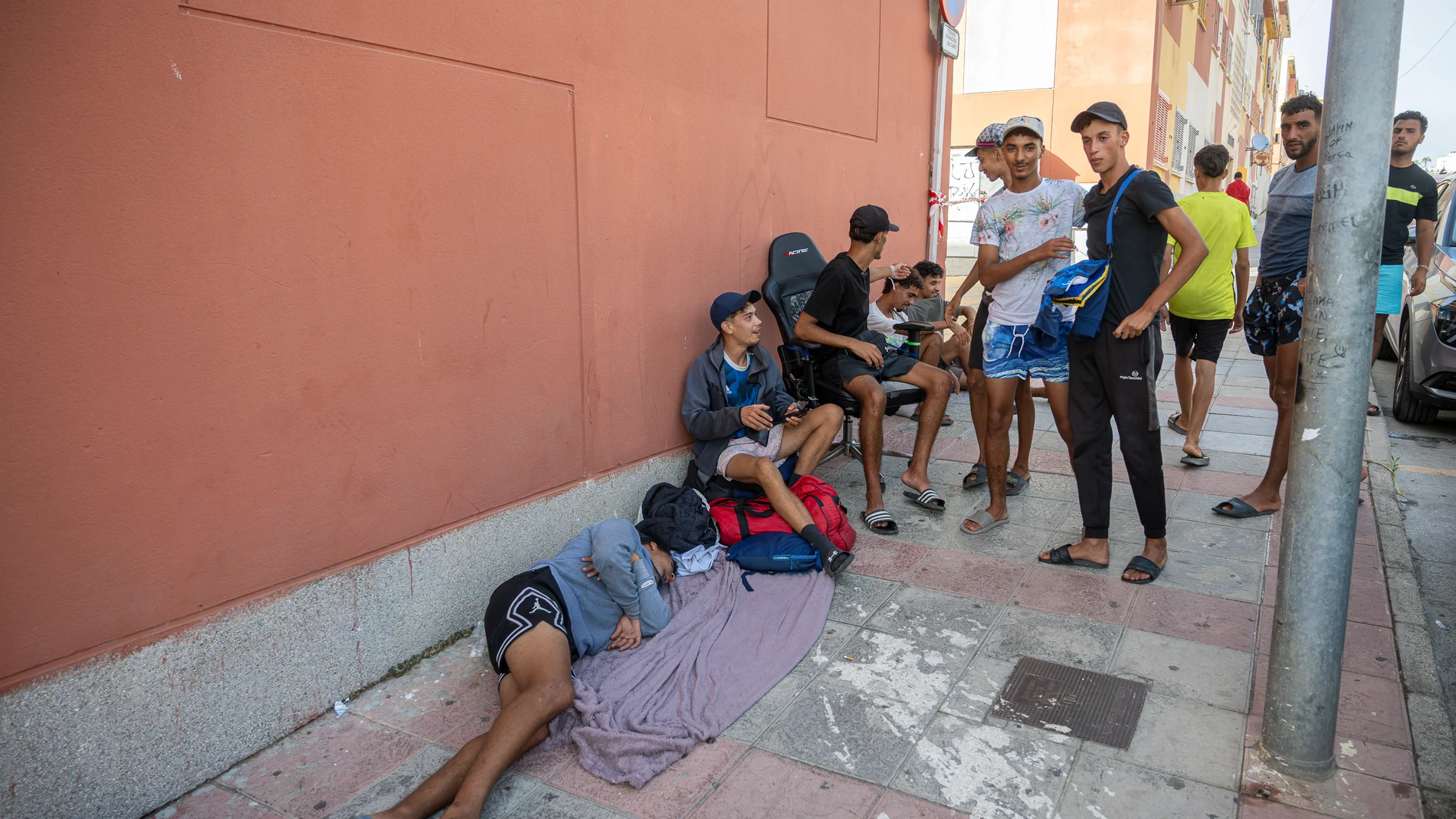
Moncloa redoubles its offensive against the Royal House. This Monday, Pedro Sánchez returned all the pressure to the King in the midst of the Ceuta crisis. The President of the Government tried to spin the story about the head of state’s next trip to the autonomous city.
This summer, Zarzuela conveyed Felipe VI’s desire to visit the people of Ceuta and left the Government with the uncomfortable question of when he would politically allow the trip. The truth is that The King wants to visit a city hit by a crisis that the Executive has not yet managed to close. But it is the Government that must consider the consequences that this gesture may have in Morocco.
Sánchez decided to respond to the King’s desire to set course for the two autonomous cities. The socialist leader reproached the Monarch for not having yet traveled to Ceuta and Melilla. What’s more, Sánchez revealed that he himself has conveyed to the King the convenience of doing so and presented himself as the president who has visited the two cities the most times. As LA RAZÓN has learned, the president’s intervention felt bad in Zarzuela. Although official sources decline to make any assessment.
A source with knowledge like few others about the functioning of the King’s House interprets the words of the Chief Executive as a deliberate response. The sequence is especially significant because until now the problem was not convincing the King. It was finding the time for it to be. Felipe VI had made known his willingness to travel to Ceuta since the beginning of August, in the midst of the migratory crisis.
The president of the city, Juan Jesús Vivas, left an exceptional audience with the Monarch in Marivent on August 6, assuring that the head of state was “committed” to the visit. “The King keeps his commitments,” he said then. Although he didn’t set a date. At that moment, the pressure shifted towards Moncloa. Zarzuela’s position was known:
Felipe VI followed the crisis with concern – he even demanded that the State ensure that it did not happen again in a strong statement released by Zarzuela. The King wanted to make clear his desire to visit the city and was willing to do so when it was institutionally appropriate. But a visit by the head of state to Ceuta is not an innocuous move. Much less in the middle of a migration crisis of enormous magnitude and with Morocco observing every gesture on the other side of the border.
The Government cooled for weeks any possibility of an immediate displacement. Government sources even considered “absolute” the impossibility of Felipe VI attending this September 2, Ceuta Day, as some sectors of the city have claimed. Moncloa defends that the trip should occur when the appropriate circumstances arise and in coordination with the King’s House. But Sánchez changed the direction of the pressure this Monday. And he took another step.
The president not only limited himself to confirming that the trip will occur. He publicly confronted the King with the need to do so. “I think there are sufficient arguments and reasons for the head of state to finally visit Ceuta and Melilla,” he said. What’s more, he added an unusual revelation: his conversations with Felipe VI. “That is what I have shared with the head of state and that is what is going to be done,” he concluded. The president claimed to be the acting head of the Executive who has visited Ceuta and Melilla the most times.
And he began to compare himself with Felipe VI himself. In fact, he even spoke of “20 years” of Felipe VI’s reign without a visit to the autonomous cities. And the account does not add up, because the King was proclaimed in June 2014, the same summer in which Sánchez was elected general secretary of the PSOE for the first time. The two decades, in reality, correspond to the time that has passed since the last visit of a head of state to Ceuta and Melilla, starring Juan Carlos I and Queen Sofia in November 2007, as explained in Ferraz. «The dates have danced. “Sometimes it happens,” exonerates a close collaborator of the president.
In any case, Sánchez attributed almost two decades of absence of the Crown in the two cities to Felipe VI. And that is precisely what has caused discomfort in Zarzuela. Not only did Sánchez enter the realm of the Monarch’s agenda, but he also used a private conversation with the head of state to publicly construct a comparison that leaves the King in an uncomfortable position.
During August, Moncloa and Zarzuela maintained a discreet battle over the story of the role that Felipe VI should play in the crisis. In the Council of Ministers there were those who raised, as a measure of pressure on Zarzuela, the possibility of the King calling Mohamed VI. The sources consulted frame Sánchez’s statement in a much broader political strategy “that is not going to stop.”
According to his reading, Sánchez is interested in fueling a controversy with Felipe VI that allows it to displace part of the pressure that the Executive endures due to its own problems and shift the focus to an institution that can hardly respond to it. The source highlights a circumstance that turns any dispute between the two into an unequal fight: Sánchez can argue with the King; The King cannot argue with Sánchez.
Felipe VI is obliged by his constitutional position to preserve the neutrality of the Crown. He can maintain private offices with the president, transfer his institutional positions to him and exercise the functions attributed to him by the Constitution. What he cannot do is go out publicly to respond to the Chief Executive every time he reveals a conversation, questions a decision or introduces the Monarch into the partisan combat.
Sánchez plays like this with an advantage that Zarzuela knows perfectly well. And this asymmetry is even more significant because the president has chosen Ceuta to increase the pressure. Until now, Felipe VI has maintained a position of maximum prudence despite personally following a crisis that directly affects the territorial integrity of the State. The Royal House has avoided interfering in the Executive’s response and has conditioned any movement by the Monarch to being useful for the general interests.
But tension between the two most important palaces in the country is skyrocketing. Government sources are angry when they justify that the King was not invited by the Government to the National Security Council that analyzed the situation in Ceuta last week. Although it is true that the Monarch is not part of it, and that it is up to the head of the Executive to preside over it, the sources consulted maintain that “it would not have hurt” to do so in a situation so serious that the Monarch himself Before going on vacation, Sánchez defined it as “a violation of territorial integrity.”