
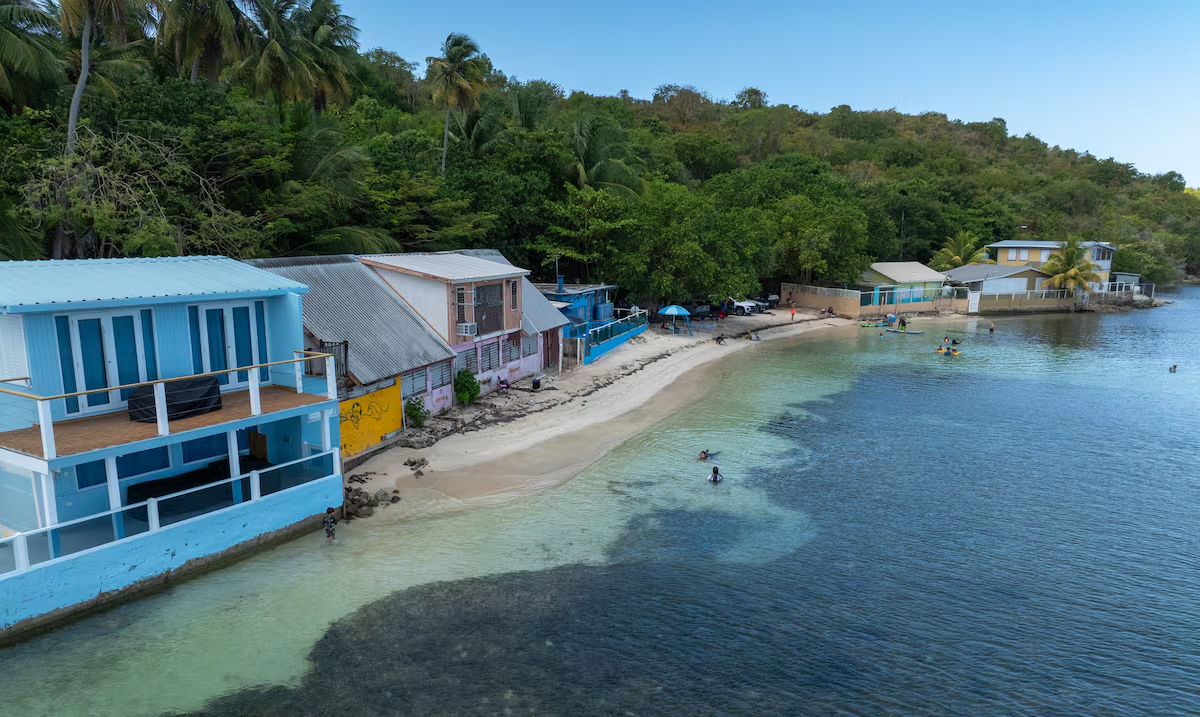
Red Cape – Sitting on the spot where his grandparents’ huts were built, a fisherman remembers a bay of Anchovy which was overflowing with sardines, oysters and other mollusks. There, where since he was 5 years old he would roll up his pants and throw a string into the cove, he still keeps his fishing boat, but trips to the sea do not bring the same prosperity as before.
Jimmy Creitoff Vargas He usually left early and returned with fresh sardines and “40 or 50 pounds” of fish. The oysters were so abundant that they could fill five or six buckets. Today, the capture of an afternoon in the sway of the waves can be counted on one hand.
“There was an abundance of all that here. And all that has been diminishing, everything”narrates.
The fisherman, merchant and retired teacher has witnessed the advance of coastal erosionof the hardness of the droughtsthe replacement of trees with cement, the disappearance of a salt production area – or “saline” – and changes in the behavior of the sea. But it has also seen positive things, such as the recovery of the pristine water of the bay, which for a long time received discharges of used water.
“We are tired of so much cement everywhere; and it knocks down the trees, and it knocks down the trees.”he expresses.
What the 71-year-old man, from southwest Puerto Rico, describes is not just a story about fishing; It is a window into a region that has changed for decades and now faces new pressures on its coasts, watersheds, ecosystems and water resources.
“The west concentrates some of the country’s greatest development pressures: the expansion of luxury tourism and hotel projects, the privatization and appropriation of access to beaches, construction in the maritime-terrestrial zone (ZMT), the pressure on agricultural land and ecologically sensitive areas, as well as proposals for energy and industrial infrastructure,” he stated. Hernaliz Vazquez Torresdirector of Sierra Club Puerto Rico.
In other towns in the west, such as Rincón and Isabela, they are repeated, among more than a dozen environmental leaders, neighbors and scientists interviewed by The New Dayconcerns about coastal erosion, public access to beaches, development pressure on sensitive ecosystems, water security, and habitat fragmentation and loss due to urban sprawl.
With 13 municipalities – Aguada, Aguadilla, Añasco, Red CapeGuánica, Hormigueros, Isabela, Lajas, Mayagüez, Moca, Rincón, Sabana Grande and San Germán – and around 429,000 inhabitants, the west covers around 17% of the surface of Puerto Rico.
It is also an area with exceptional ecological diversity. The list includes the duneswhich provide protection against storm surges; the wetlands and mangroveswhich assist in buffering and water quality; he karstwith aquifers that provide water to more than half a million people; the forestskey in capture and filtration; and the reefswhich offer coastal protection and tourism economy.
“Cabo Rojo is the driest place in Puerto Rico. Isabellaits characteristic is that it faces the Atlantic Ocean with all the force it brings, with more than 5,000 miles of air flow without interruption from land. And there are the largest dunes in Puerto Rico, which Puerto Ricans have decimated in their desire to build and use the sand to pour cement. and in Cornerthere is a very interesting oceanography, because there are many effects. With the Mona Channel and the Dominican Republic so close, they greatly affect the behavior of the sea in that region,” explained the ecologist. Ariel Lugo about the towns that The New Day visited as part of this special series.
The result of this diversity is a natural mosaic that sustains not only diversity, but the economy, life and even the identity of those who inhabit the area.
1/12 | Isabela Dunes: historical destruction due to illegal sand extraction and human development. Isabela is the municipality with the highest concentration of dunes in Puerto Rico. (Photo provided by Manolo González) – Supplied
“People come to the west to look for sand, beach, sun, forest, because we have forests, we have rivers. And (the community) has understood that, if we lose that, if we lose the coasts, we are going to lose that economic value that we have and that attractiveness.”. “(With excessive development) you are risking Puerto Ricans and future generations to lose everything, even their identity, because you are taking away the resource that makes us Caribbean, that being from a tropical country and living in the Caribbean gives us, which are the beaches, the coasts, the sand, the dunes, the mangroves, this whole set of ecosystems,” he said. Hector “Tito” Varelaleader of Surfrider Foundation Puerto Rico.
Coastal erosion is one of the most significant environmental problems. For Carola Acumcoalition spokesperson Responsible WalkAdded to the impacts of coastal erosion is the lack of knowledge of citizens and the government about the magnitude of the situation.
“It is important that the areas be visited, evaluated and physically looked at so that they can realize that, in recent years, (the advance of erosion) has been exaggerated. And right now we have coasts full of ruins, with very little access to beach areas, and it is a risk for public safety,” he stated.
In the Rincón Spa, the retreat of the coast is evident. There, a study of United States Geological Survey (USGS, in English) identified the point of greatest erosion recorded in western Puerto Rico. The Municipality built a cement wall – in ZMT – to protect the gazebos and showers.
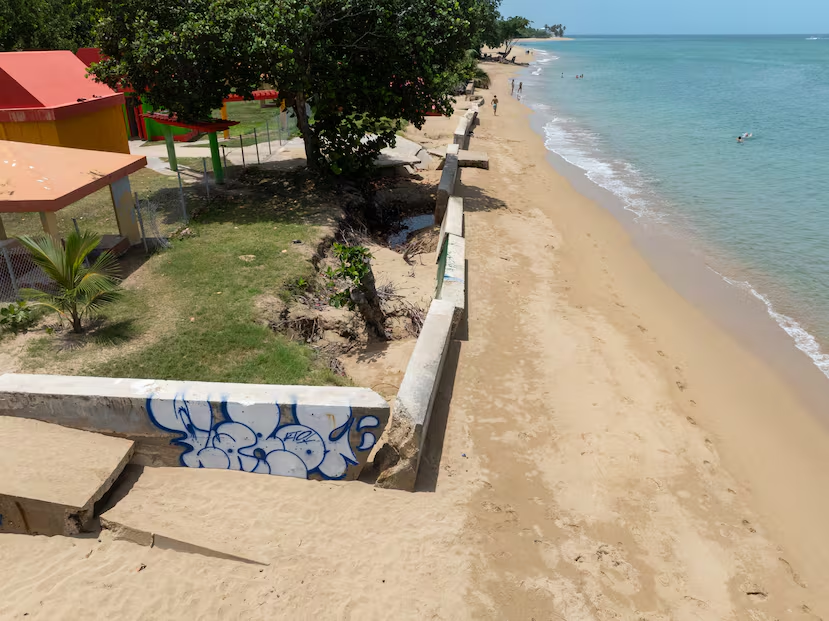
“The mentality was, ‘we are going to protect gazebos and showers to prevent water from reaching’. But the technique that should have been used was planting mangroves, restoring dunes… do not put cement. What this is going to do is make your problem worse. When it erodes and water enters, the rods come out, the gabions come out. “It is completely risky for bathers,” said the planner. Ramon Diaz Zambranawho is part of the organization Friends of Tres Palmas.
Neighbors of this town fear that the city council has plans to erect another wall. The mayor Carlos Lopez Bonilla He did not respond to multiple interview requests from this newspaper.
In the area of Corsicaalso in Rincón, the advance of erosion has caused the collapse of structures and the exposure of remains of cement, fences and rods to the waves. Other cases in the region include Punta Sardinain Isabela; Crash Boat and Punta Borinquenin Aguadilla; and Combatin Cabo Rojo.
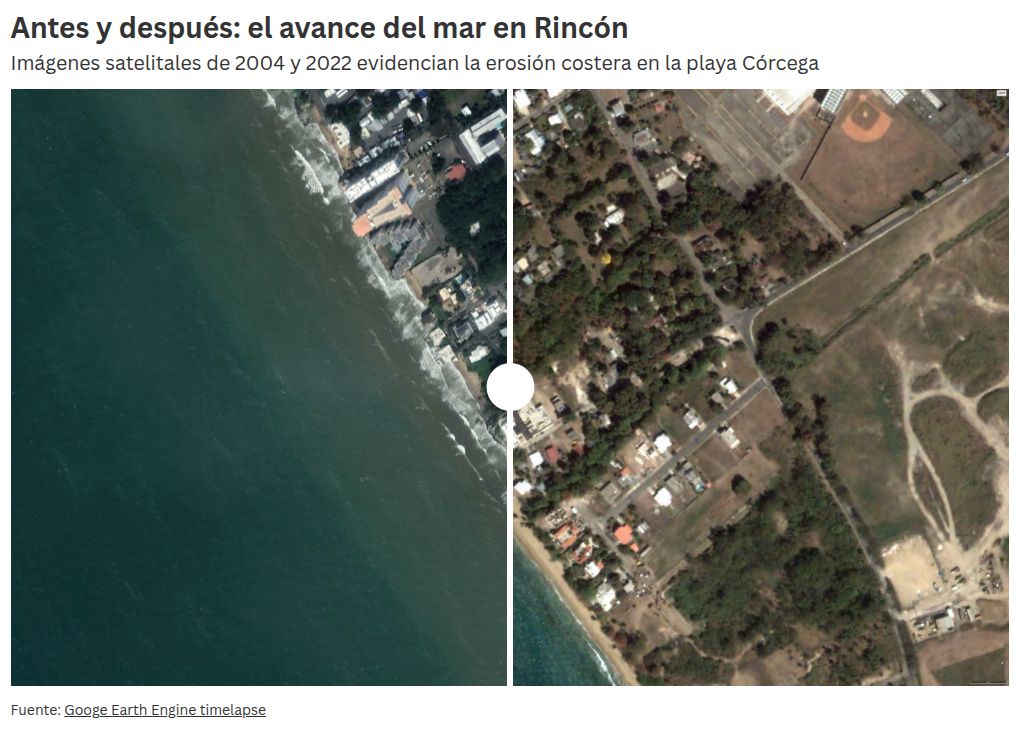
“The biggest change I have seen is the coasts. The coast of Rincón is very impressive, the coast of Isabela is also very impressive. “These changes (add to) the aggressiveness of wanting to build more buildings in the sea, knowing that the sea is getting closer to the coast.”he indicated Carlos Torresdeputy director of the western basin of For Nature.
As of August 14, the Department of Natural and Environmental Resources (DRNA) was evaluating 42 demarcation requests – the procedure through which the limits between one or more properties adjacent to the maritime public domain are determined – in the towns of the west coast, from Isabela to Lajas. Cabo Rojo (11), Aguada (10) and Isabela (8) lead the list.
The DRNA did not clarify how many of the cases are related to properties that contemplate development, but it highlights situations in which the State is having to determine the limits of the ZMT in a region increasingly marked by construction and development, according to those interviewed.
In Cabo Rojo, a concern among residents is the proliferation of “campers” due to the possibility of illegal emptying of used water from portable toilets, which can contaminate aquifers and natural soil, the ecologist warned. Hector Quintero.
The mayor Jorge Morales Wiscovitchwho estimated that in his municipality there must be between 3,000 and 3,500 “campers,” commented that they carry out a physical inventory to determine the exact number, since “many of them are violating the ordinance and are not registering these properties”. He added that he is not aware of any environmental damage caused by mobile homes.
Added to the physical pressure on the territory is another dispute: how the growth of the region is being planned and how much weight the instruments of territorial planning have today. In addition, it impacts a resource that several experts and leaders consider the main physical limit in the development of the West: water.
“We start, many times, from thinking that the west is an area that has not been significantly impacted and that there is no problem with continuing to use more spaces, when we are far from that.. In other words, if you look at the spatial development of land use in that entire western area, especially in the northwest, you will see that there is a gigantic spread of construction and that the areas that remain natural or not impacted are very few. So, I think we have to clarify that, because if not, one does not realize that we are talking about that the little that is being impacted or that we want to impact is precisely the little that remains,” he said. Fernando Lloveras San Miguelpresident of Para la Naturaleza.
In requests addressed to the Permit Management Office (OGPe) and the Puerto Rico Tourism Companythis medium requested data on active location inquiries and the number of tourist residential and “high impact” residential projects – above the Federal Housing Administration limit, according to the Law 101 of 2025– that are in some stage of the permitting or construction process, and on the exemptions or endorsements for new hotel, residential-tourist and condo-hotel projects in the municipalities that make up the western region, respectively.
At the time of going to press, Tourism did not respond. Meanwhile, the OGPe responded that “the information available in the system does not allow such projects to be identified or counted under that criterion”; It also did not provide the number of active location queries.
For fisherman Creitoff Vargas, loss is not measured in ropes or soil classifications; It is measured in the fish that no longer return to the bay he calls home and in the Puerto Ricans – including his two daughters – who abandoned their land in search of something better.
“Look, selling to Puerto Rico is not viable. I think they are making a mistake trying to do tourism projects of this magnitude, something so big.”as much as Essence like other projects, when youth here lack housing. Hey, when are we going to do projects with low-cost houses so that young people who are leaving universities, those who are getting married, can arrive and acquire these properties? “We are going to have to create a country for Puerto Ricans, for humble people, for those who live here not to leave. Hey, when are we going to make a better Puerto Rico?”.