
There are climate phenomena that we have known about for decades and that, precisely for this reason, we run the risk of considering normal. El Niño is one of them. It appears every few years, It anomalously warms the waters of the tropical Pacific and alters atmospheric circulation, triggering droughts, torrential rains, floods and other extreme phenomena thousands of kilometers away.
But a new study has just found something disturbing: El Niño episodes over the past four decades have been approximately 40% more intense than those that characterized the pre-industrial period. And, according to the reconstruction carried out by scientists at the University of Michigan based on corals from the Galapagos Islands, none of the El Niño recorded during the last 40 years has an equivalent among the approximately one thousand years prior to 1850. The results have been published in Science.
“We don’t see any time in the past when El Niño phenomena have been as intense as they are today,” says Julia Cole, professor and chair of the Department of Earth and Environmental Sciences at the University of Michigan and leader of the study. “We show that the intensity of El Niño changes in parallel with global temperature warming.”
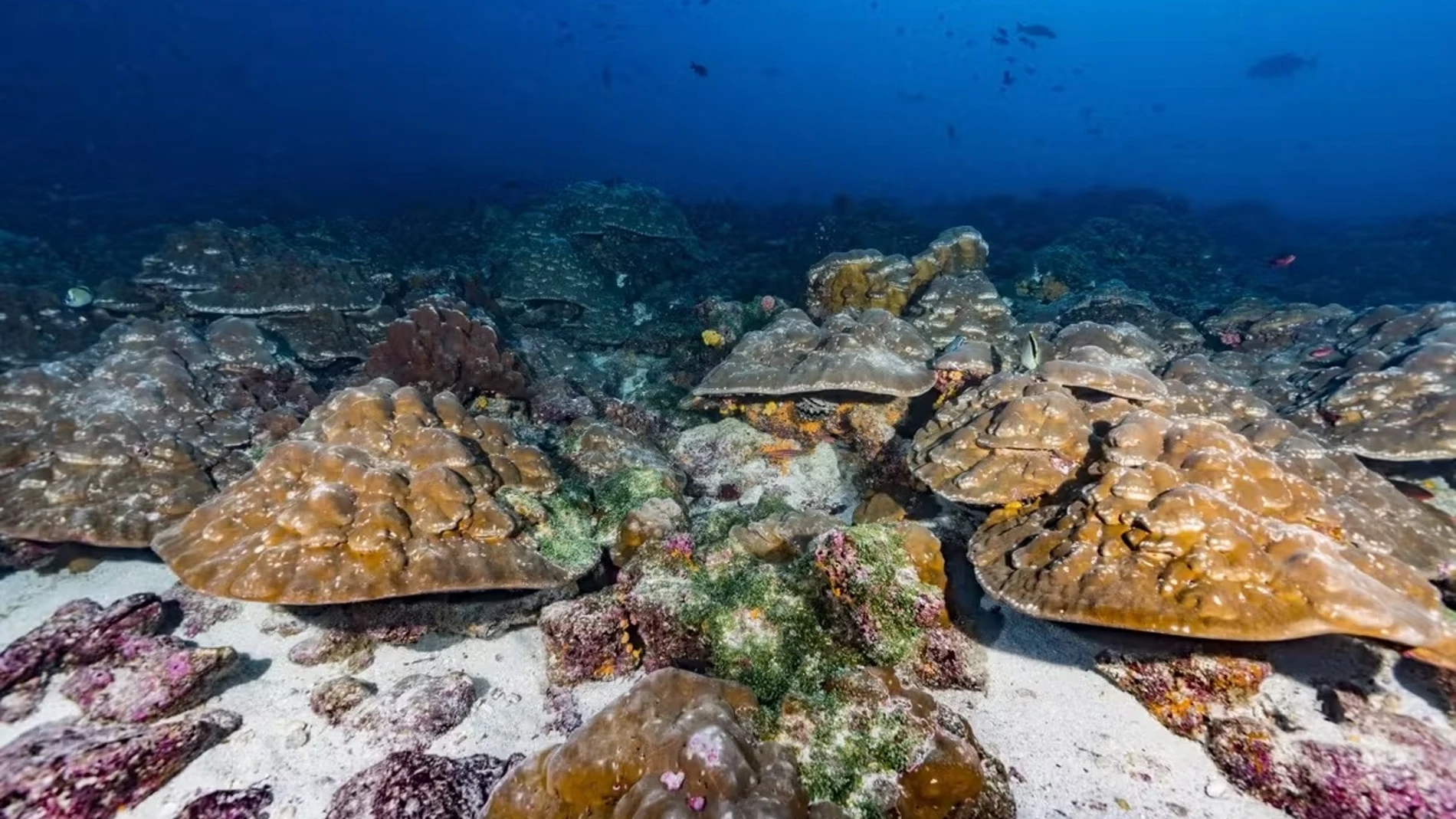
To reach that past that does not appear in meteorological records, scientists turned to something much older than any instrument made by humans: corals. Cole’s team obtained samples of 13 corals from the Galapagos, including live colonies and fragments of ancient corals. These animals build their skeletons by depositing calcium carbonate, layer after layer, approximately one to two centimeters a year. And in that structure the chemistry of the water in which they grew is recorded.
They then analyzed the skeletons millimeter by millimeter, measuring the ratio of strontium to calcium, which depends on the water temperature, and combined it with analysis of oxygen isotopes, another indicator of thermal conditions. The result was a kind of natural climate archive of the Galapagos, a region especially valuable because it is located in the eastern Pacific.precisely where El Niño produces some of its most intense effects.
Going back through that record, they found strong El Niño events over the last 40 or 50 years. But before that period, the pattern was strikingly different. Thanks to this technique it was possible to extend the comparison to approximately a millennium before 1850, when Human emissions of greenhouse gases began to significantly alter the climate system. And the conclusion was that the recent large El Niño clearly stands out compared to the variability recorded during that pre-industrial period.
And is this the fault of warming? Finding a coincidence between two phenomena does not in itself prove that one is responsible for the other. That’s why the team took an extra step. To try to answer this, they used climate models capable of reconstructing the conditions of the last thousand years taking into account known natural factors, such as volcanic eruptions and variations in solar activity. If these factors were capable of producing a change of the magnitude observed on their own, the intensification of El Niño could be explained as a natural fluctuation.
But the models did not reproduce a change of such magnitude. Thus, Cole’s team’s interpretation is that global warming is “enhancing” El Niño. And that matters because El Niño does not stay in the Pacific. Under normal conditions, trade winds move warm surface waters from the coasts of South America towards Indonesia and Australia. During El Niño, those winds weaken and warm water moves eastward, raising the temperature of the eastern Pacific. The atmosphere responds by also moving the precipitation zones.
The result can be drought in some regions and floods in others. In the United States, for example, storm tracks can shift southward, increasing precipitation in the southwest and reducing it in the northwest. In other parts of the world, El Niño can favor droughts, extreme rains, fires, agricultural losses and health problems. That is why greater intensity does not simply mean an ocean a few degrees warmer. It means potentially greater climate extremes.
“The question is not whether the current El Niño will occur, but how bad it will be and how severe its impacts will be – warns Cole -. This episode overlaps with global warming and will probably intensify the temperature increase that we would normally expect from greenhouse gases.” The study indicates that some forecasts place global warming during this episode at around 1.7 or 1.8 °C above the pre-industrial level, which would greatly exceed the previous record. AND This is where the most important consequence of the study appears.
“El Niño is a very important source of climate extremes – Cole points out -. If it is becoming more intense, the impacts are also more intense: droughts, floods, fires and food insecurity.” But also infrastructure destroyed by floods, damage to roads and railways and health problems arising from changes in the water cycle.
The corals of the Galapagos have made it possible to look back about a thousand years and discover that What we are observing over the past four decades does not fit well with the usual behavior of El Niño over the previous thousand years.
“We believe that global warming is enhancing El Niño – concludes Cole -. And, if so, we expect stronger climate extremes that will amplify ecological, human and infrastructure losses”.
The problem, as the study recalls, is that no country has sufficient resources to completely protect itself against all of these impacts. And maybe that’s why The story that the corals tell is not just a story about the past. It is also a warning about how far a natural phenomenon can go when the planet that hosts it is changing.