
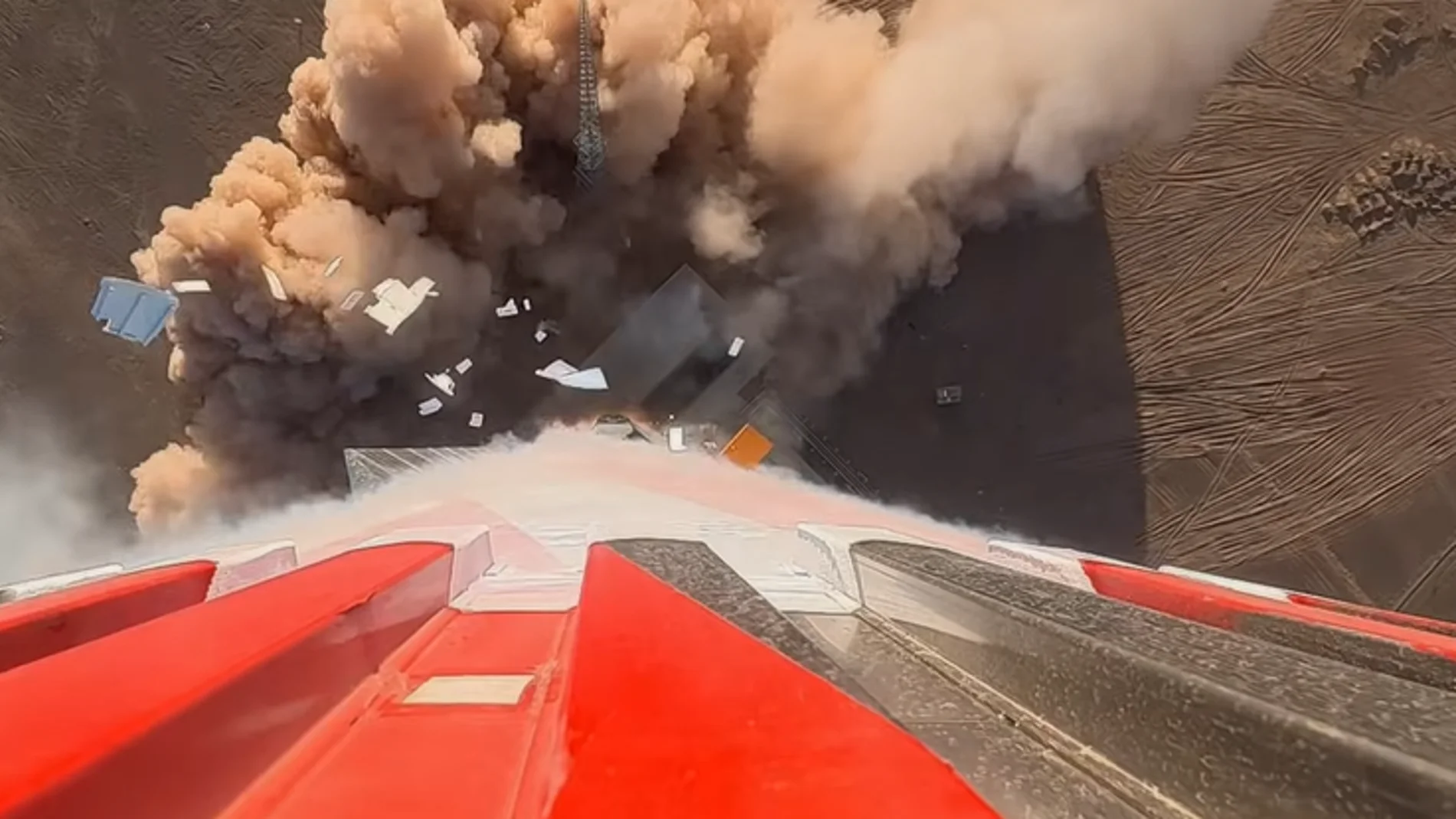
An action camera is designed to accompany us in situations in which a mobile phone would probably not survive: underwater, during a fall, on a mountain bike or while playing sports. But there is a resistance test that is very far from any of those scenarios: attach it to a space rocket and make it travel out of our atmosphere and then return and land hundreds of kilometers from the launch site.
That is precisely what happened with twelve units of the DJI Osmo Action 6. The cameras were installed in different points of the first stage of Zhuque-3, the reusable rocket developed by the Chinese company LandSpace, and They recorded their journey from takeoff to vertical landing. The most striking thing is that, according to DJI, these were commercially produced cameras without special modifications inside.
The flight, furthermore, was historic in itself. Zhuque-3 took off from the Dongfeng Commercial Innovation Test Area in northwest China. About 137 seconds later, their two stages separated. While the second stage continued the flight to place the Honghu-03 satellite into orbit, the first stage began its return and ended up landing vertically in a recovery area located in Gansu province. It was the first ground recovery using landing legs of a Chinese orbital vehicle. The cameras were on board to record precisely that process and the conditions they had to endure are not too similar to those of a conventional camera.
During atmospheric ascent and return, aerodynamic heating raises the rocket surface temperature to approximately 400-500°C. At the same time, The engines and the flight itself generate continuous vibrations of high frequency and intensity. During the descent, the strong accelerations and maneuvers necessary to orient the first stage and return it to the landing point are added.
500 ºC does not mean that the sensor or the camera electronics reached that temperature. The figure provided by DJI corresponds to the surface of the rocket. The feat consists, therefore, in that the cameras were able to survive an environment in which the vehicle that transported them was subjected to surface temperatures of hundreds of degrees, enormous vibrations and large dynamic loads, thanks to the integration and protection system used to install them on the rocket.
And there was another problem: During the return, the rocket crossed a communications blackout zone. When a spacecraft enters certain conditions during atmospheric return, communication with the outside world may be temporarily interrupted. For a camera that depended on sending live images, that would mean losing some of the most interesting moments of the flight.
The solution was much simpler: do not transmit the images; save them. The Osmo Action 6 recorded directly to its internal storage. When the first stadium returned to land, the files could be recovered along with the cameras. In this way, the communications blackout did not affect the recorded material. The result is especially spectacular because it allows you to observe the journey from the rocket itself: the takeoff, the ascent, the separation of the stages, the darkness of space, the maneuvers of the first stage during its return and finally the landing.
But the images are not only spectacular. For LandSpace engineers, having cameras placed at different points in the first stage provides visual information about the behavior of the vehicle during recovery: the state of its structure, the movements of the aerodynamic surfaces and the different phases of the maneuver. DJI notes that the images can be used to review the recovery process, evaluate the condition of the first stage, and help reproduce the results in subsequent flights.
There was also a purely photographic challenge. The camera had to continue recording in extremely changing lighting conditions: from intense sunlight at high altitude, to backlighting during descent, and finally to dust and illumination on the Earth’s surface. The Osmo Action 6 incorporates a 1/1.1-inch CMOS sensor, up to 4K recording at 120 frames per second and a dynamic range of up to 13.5 steps.
Its electronic stabilization also had to face a very different scenario than that of a bicycle or a race. During launch, the rocket experiences intense vibrations and high accelerations, while during return the first stage rapidly changes orientation to perform flight and landing maneuvers. DJI assures that The stabilization system made it possible to maintain coherent images during these phases.
It is not correct to say that the Osmo Action 6 is a camera designed to operate at 500ºC. It is not. But perhaps the story is even more interesting like this: a consumer camera, designed to record our adventures, ended up documenting from within one of the most demanding tests that a machine manufactured by humans can face.