
There are places in the solar system where darkness does not last a few hours, or a few days, or even a winter. There are craters on the Moon that have not been exposed to sunlight for billions of years. Inside, the temperature can drop to levels close to absolute zero and Any material trapped there may remain virtually frozen from the earliest stages of lunar history. China wants to enter one of them.
The Chang’e-7 mission, one of the most ambitious robotic endeavors in the Chinese lunar program, aims to explore the Moon’s south pole and search for water ice and other volatile compounds trapped in permanently shadowed regions. The mission was set to take off aboard a Long March 5 rocket from Wenchang.but Chinese media have just announced that the launch will not occur within the window planned for this year, after a security and reliability evaluation. The decision was made known when the ship was already in the launch area.
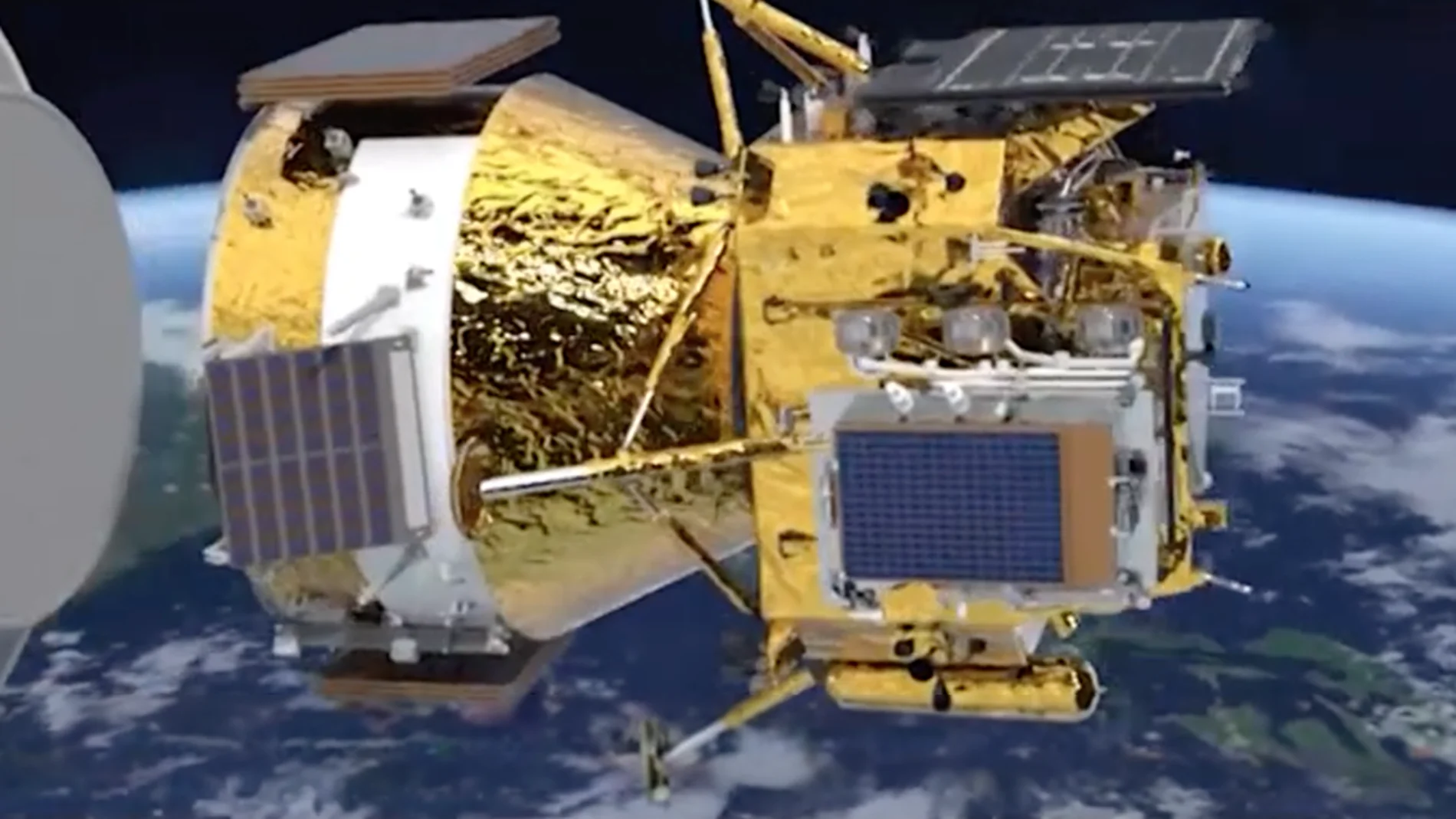
The delay does not change, however, the importance of the mission. Chang’e-7 is designed to do something no previous mission has attempted with this combination of instruments: orbit, land, move across the surface and jump to places that remain hidden from sunlight. The ship will consist of an orbiter, a lander, a rover and a small probe capable of moving by jumping. In total it will carry 18 scientific instruments designed to study the surface, the subsurface and the environment of the lunar south pole. Among them there will be cameras, a radar capable of penetrating the terrain and sensors intended to detect volatiles.
For a long time it was thought that the Moon was a completely dry world. But observations made in recent decades have changed that picture. There are craters near the poles. whose interior remains permanently in shadow due to the low height with which the Sun travels over the lunar horizon. Without direct light, ice and other volatile molecules can be trapped for extraordinarily long periods.
Precisely for this reason the south pole has become one of the most disputed places in lunar exploration. This is not just a scientific question. Water could become a strategic resource for a future human presence. If it exists in sufficient quantities and can be extracted relatively easily, lunar ice could provide water for drinking and growing food, but also hydrogen and oxygen through electrolysis. That is to say, could be turned into rocket fuel. A future lunar base would not have to transport every kilogram of water and propellant it needed from Earth. The Chang’e-7 mission aims to find out to what extent this possibility is real.
To do so you will have to face a peculiar problem. The places where ice could be found are precisely those where sunlight does not reach, and therefore are extremely difficult to explore with vehicles that depend on the Sun’s energy. Here one of the most striking elements of the mission comes into play: the small jumping vehicle. The probe will be able to move by jumping towards permanently dark areas. Once there, will use an instrument capable of analyzing water molecules and other volatiles and will carry out drilling and material extraction operations. Then you will have to return to a lit area to recover energy.
It is an almost paradoxical strategy: to search for water in the darkness, the ship will have to learn to enter and exit it. The chosen landing site will be near the Shackleton crater, a particularly interesting region because it combines two apparently incompatible conditions: areas of permanent shadow where volatiles could be preserved and elevated areas that receive much longer sunlight. The mission needs both. Vehicles require light to generate energy, but the scientific goal lies precisely where there is none.
The choice of the south pole is also not accidental from the point of view of future human exploration. China considers Chang’e-7 a piece of the fourth phase of its lunar program and a mission intended to provide information to help prepare a long-duration scientific presence. Chinese plans also include Chang’e-8 and, in the longer term, an International Lunar Research Station.
That’s why the real goal of Chang’e-7 goes far beyond finding a few ice deposits. The mission wants to determine what resources exist, where they are, how much there is and if they can be used. This information will be essential to answer a question that may define the next stage of space exploration: can we live off the resources of another world?
The answer might begin in a place that seems, at first glance, completely inhospitable. At the bottom of a crater where the Sun never rises, at temperatures that are among the lowest in the entire solar system, A Chinese probe will search for molecules that could one day become drinking water, oxygen and fuel. The Moon thus once again becomes more than a destination, it may be the first place where we learn to use the resources of another world to continue traveling.