
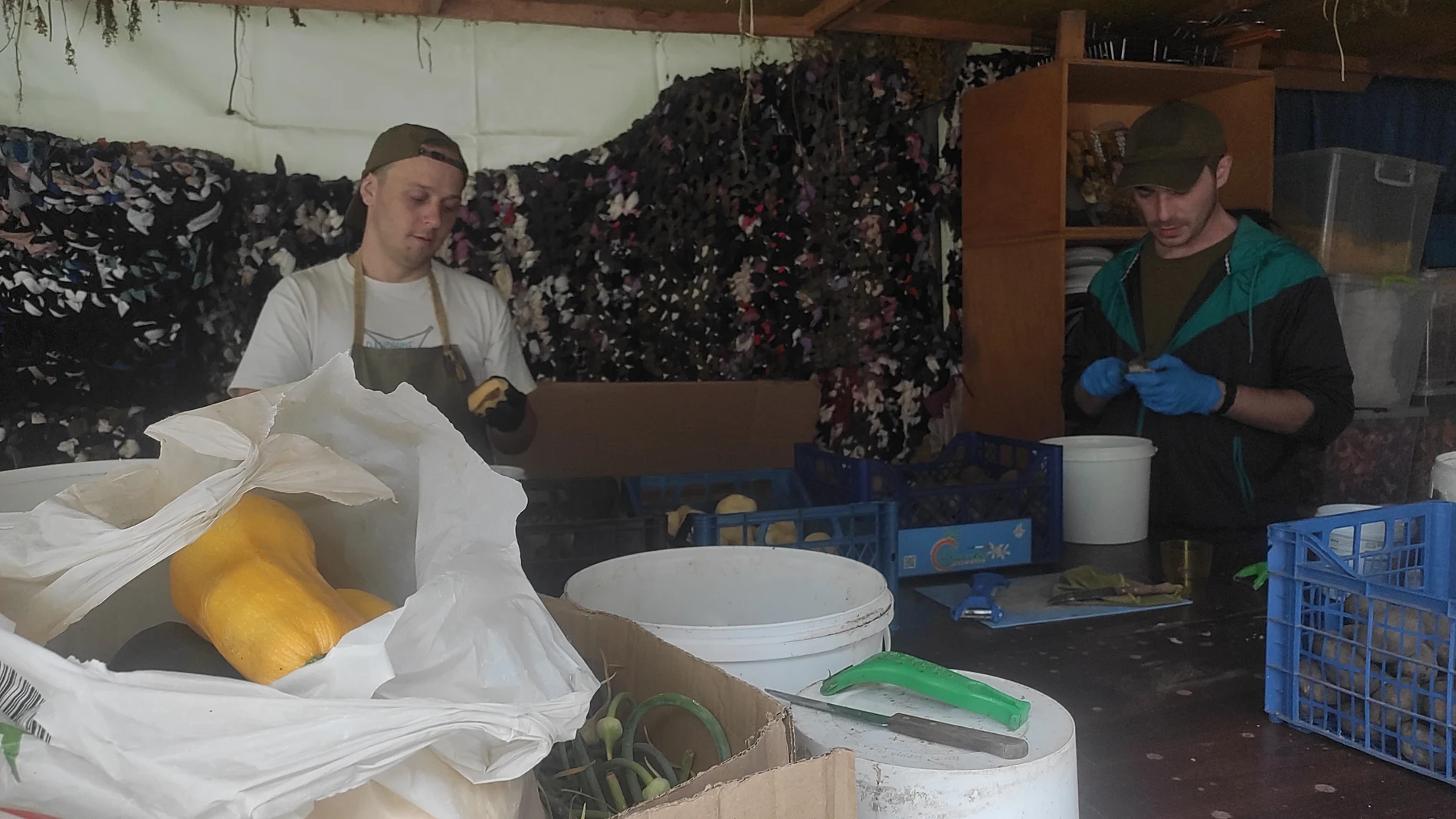
«It’s a little salty. “Sometimes it’s not easy to cook with ingredients that you don’t know that well,” says Alejandro as he looks at the large Spanish omelette he has just prepared for his fellow volunteers during a short break in their day. In the modest facility of the Volunteer Kitchen in Lviv (western Ukraine), the work never really stops. Dozens of locals and foreigners peel vegetables and fruits and prepare dehydrated meals with them that are sent hundreds of kilometers away, to the front, for Ukrainian soldiers.
Some just stop by for a moment to eat a bite of the tortilla and thank Alejandro, who gets up frequently to keep an eye on the pans that continue to cook. He speaks in English with the foreign team members, but switches to Spanish when addressing the locals.
Many are women between 50 and 60 years old, whose husbands or sons are fighting on the front and who do not speak any foreign languages, while Alexander only knows a few key words in Ukrainian. But, somehow they understand each other perfectly.
Recently retired as a special education teacher, Alejandro has been coming here every summer and winter for four years. Since his first trip to Ukraine, he says he wanted to make a difference. «Putin’s invasion bothers me a lot. Dictators like Putin make me very uncomfortable,” he emphasizes. The work matches your energy: the equipment never shuts down, and people continually come and go with boxes of ingredients or finished products ready to be shipped.
Now know the entire process inside out and show the different devices that dehydrate vegetables or chicken meat. The ingredients, donated by local businesses or purchased by the volunteers themselves, are processed and packaged into a variety of nutritious dehydrated meals. The key thing is that they can be cooked or consumed with minimal effort on the front lines, where supplies are routinely destroyed by Russian attacks and every move carries the risk of detection and attack.
«These little packages are the ones carried by the soldiers who are in the trenches. Then they take all this, fill it with water, make it hot and wait between five and ten minutes,” he explains amid the hum of the machinery. Some rations are already packaged in boxes that only drones can transport to those infantrymen who spend weeks or months in underground shelters, where aerial resupply is the only way to bring them food.
Alejandro has done all kinds of volunteer work both in Spain and abroad, including Latin America and the Balkans, and is no stranger to high-risk areas. Every time Lviv is attacked by Russian missiles and drones, he receives calls from his mother and other family members and friends who worry about him.
For now, attacks are less frequent here than in kyiv or in the eastern areas, closer to Russia and the front. The signs of war, however, are everywhere. From time to time, men are stopped on the street by recruiting patrols who check whether they have their documentation in order and escort those who do not have it to the army recruiting points.
Every year there are more and more men with amputated limbs in this city, which has become one of the largest rehabilitation and prosthetic centers in the country, and where new injured people arrive daily.
“The people here in Lviv, after four years, the truth is that they are quite tired of the war,” Alexander admits, consciously using the Ukrainian name of the city. “However, they have quite significant stamina and resilience.”
More than a dozen national flags lined the hallway of the volunteer kitchen make it clear that Ukrainians are not alone in their fight. Some volunteers arrive driven by curiosity; Others stay for months or even build their lives around this place, says Julien, from France. «Anyone can find something to help with. And it is beautiful to be here because you meet people who share the same values,” he emphasizes, pointing out that many come because they cannot stand idly by in the face of injustice. Next to it a small mound of peeled potatoes is forming.
In the bustling city center a semblance of normality is maintained thanks to the bars and cafes that remain open and where people who want to practice their Spanish meet every week. What was once Ukraine’s main tourist city now welcomes those who have sought refuge or come to help, and soldiers from countries like Colombia and Argentina can be seen on leave or in rehabilitation.
The kitchen volunteers are, however, an example of how civilians can also make a difference. Barbara, 72, from the US, comes here every summer to help in the kitchen and weave camouflage nets for the front.
He feels strongly that Washington, under both Democrat Joe Biden and Republican Donald Trump, has done far less than necessary to support Ukraine. She feels honored to be able to work side by side with those who have husbands, brothers or children risking their lives every day.
Alejandro, for his part, is proud of the support provided by Spain, especially in the field of air defense. However, he also believes that Europe could do more collectively to help Ukraine’s fight.
Their vision of the future is bleak: the war shows no signs of ending and Russia only intensifies destructive attacks against civilians. But the country demonstrates extreme ingenuity by innovating with drones and other means to stop a superior adversary with scarce resources.
“Of course Putin is going to have a hard time breaking the Ukrainian people,” he says. “It gives me a lot of joy and I feel very happy to be able to help the defense of Ukraine against the invasion of Putin and his army,” Alejandro emphasizes.