
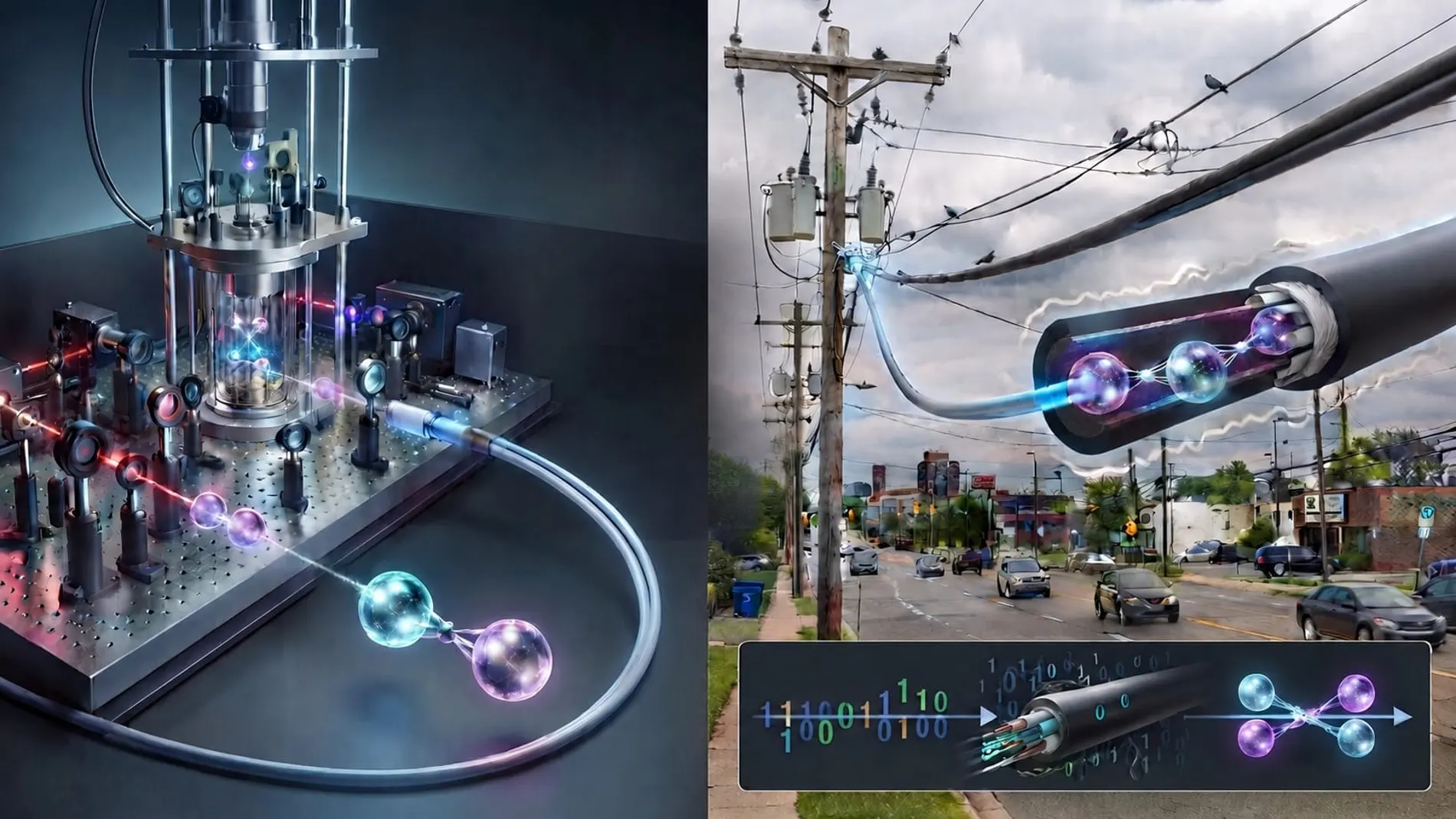
While the Internet that we all know and use transmits physical information (ones and zeros) through fiber optic cables as if it were sending letters that a hacker could intercept and copy, Its “quantum sister” uses the laws of physics to “teleport” the state of entangled particles called qubits; This means that the information does not travel along an intermediate physical path, and if an intruder tries to eavesdrop on the message, the particles immediately alter their state, destroying the information and making the network completely unhackable. That is its great advantage…
But the quantum internet has a problem. It’s not that we still don’t know very well how to build it. Not even that we need quantum computers capable of communicating with each other. The problem is something much more everyday: the cables. Photons that carry quantum information are extraordinarily delicate. A small disturbance can alter its state. And while a conventional internet signal can pass through an optical fiber without worrying too much about a vibration, a change in temperature or a slight modification of the polarization of the light, a quantum signal can lose precisely what we need to preserve.
Therefore, one of the biggest challenges in building a future quantum internet is not only about generating entangled particles. It consists of getting them to survive the real world. Now, a team of scientists from the National Institute of Standards and Technology (NIST), led by Thomas Gerrit, has just pass a particularly demanding test: he managed to distribute entangled photons through 62 kilometers of conventional optical fiber, a good part of it installed on poles and directly exposed to the environment. The results have been published in the Journal of Optical Communications and Networking.
It is not the greatest distance ever achieved with quantum entanglement (that record belongs to the Chinese, who used a satellite and more controlled environment). But perhaps it is one of the most interesting demonstrations in order to build a network that one day can leave the laboratory. The fiber used by Gerrit’s team connected NIST facilities with the University of Maryland. And it was not buried in perfectly controlled conditions. An important part of the route ran outside, suspended from posts next to the streets. That means the photons had to contend with vibrations, wind, temperature changes and traffic. Even the movement of birds can contribute to mechanical disturbances of an aerial fiber.
For conventional communication, many of these disturbances are practically irrelevant. For quantum communication, no. The information it carried was encoded in the polarization of the photons, that is, in the orientation of the electric field of light. And the fiber can slightly modify that polarization as it moves or changes its temperature.
The result is similar to trying to keep a compass perfectly oriented while someone constantly shakes the table on which it is placed. “It is a stress demonstration of quantum network systems – says Yicheng Shi, co-author of the study -. We put the system through an extremely noisy environment and it still worked.”
ButWhat exactly does it mean for two photons to be entangled?? Here appears one of the strangest ideas in quantum physics. Two particles can become entangled, so that their quantum states remain correlated even when they are physically separated. If we measure one of them, we obtain information related to the result that we will find when measuring the other. This does not mean that we can send messages instantly from one place to another. Entanglement does not allow the speed of light to be violated. But it does provide something that may be extraordinarily valuable for future quantum networks: a way to share quantum states between different places.
And that’s where the so-called quantum internet comes into play. The quantum internet is not intended to replace the internet that we currently use to watch a movie, send an email or make a video call. Your goal would be connect quantum computers, sensors and other quantum devices, allowing quantum information to be shared between them.
One of its best-known applications would be secure communication. The properties of quantum states can be used to generate and distribute cryptographic keys whose security is based on the laws of physics themselves. But there are other possibilities. Such a network could allow connecting quantum computers located in different places and, potentially, use distributed measurement systems that function as a single instrument.
Gerrits’ team points out, for example, the future possibility of connecting separate telescopes through quantum networks to carry out certain measurements in a coordinated manner. AND, For the first time, it has been achieved in conditions that those responsible could not control and that had the potential to ruin the experiment. But it worked. Classic bits have already learned to live with all the noise in our environment, now Gerrits’ team has taught qubits to do the same.