
There are places where electrification seemed especially difficult. Open pit mines are one of them. Some of the largest machines built by humans work there: excavators capable of moving hundreds of tons of material, trucks more than 8 meters high whose wheels can be taller than a person, and vehicles that spend a good part of their lives going up and down slopes with loads that would completely exceed the capabilities of a conventional truck. A battery in these vehicles was unthinkable until recently. And yet, Diesel is also beginning to disappear there. So much so that China has presented a new fully electric powered mining truck, designed to transport huge loads in mining operations.
The reason is not only environmental. In a mine, converting a diesel truck to electric can also mean reducing energy costs, simplifying maintenance and recover some of the energy that would normally be lost during braking and descents. And here comes the fascinating part: the larger the truck, the more interesting that recovery can be.
In general, the word “electric” usually makes us think of passenger cars, vehicles of about two tons, perhaps a three-ton SUV. But a mining truck plays in another league. These vehicles are designed to transport tens or even hundreds of tons of material on each trip. Some of the large Chinese models reach load capacities of 200, 240 or even 300 tons…in short: they could carry 100 SUVs.
That completely changes the rules. It is not enough to place a huge battery and an electric motor. It is necessary to ensure that the system is capable of delivering gigantic power for long periodswithstand steep slopes, operate on uneven terrain and, in addition, maintain sufficient autonomy so that the vehicle does not have to constantly stop to recharge.
Here there is an advantage of electric propulsion that is especially interesting in mining. Let’s imagine a loaded truck going down a slope. A conventional vehicle mainly uses the brakes to control that enormous mass. The energy associated with movement ends up being transformed fundamentally into heat; an electric vehicle, however, can use its motors as generators.. When the truck decelerates, some of the kinetic energy can be converted back into electrical energy and stored in the battery. This is what is known as regenerative braking.
While in a car this can be an aid to improve autonomy, in a mining truck weighing hundreds of tons that continuously performs cycles of raising, loading, descending and braking, the amount of energy involved is enormous. It does not mean that the vehicle can recover all the energy it has used to climb. Losses are inevitable. But it does allow us to take advantage of a part of the energy that, in a conventional vehicle, would end up being dissipated in the form of heat.
But China is not starting from scratch. In 2025, for example, China will put into operation a fleet of 100 autonomous electric trucks at the Yimin open-pit coal mine in Inner Mongolia. The vehicles belong to the 90-ton class and use 568 kWh batteries, a quantity that would allow a car to travel 3,000 km without recharging.
Zijin Mining, one of the large Chinese mining groups, has deployed hundreds of electric trucks. At its zinc mine in Xinjiang, the company had 250 fully electric trucks, which carried out around 80% of the exploitation’s transportation tasks, according to company data collected by International Mining. And now it is developing its own vehicles. Its LK220E model, for example, uses a 776 kWh interchangeable battery and has versions up to about 140 tons of mass.while the company has begun to market higher capacity models.
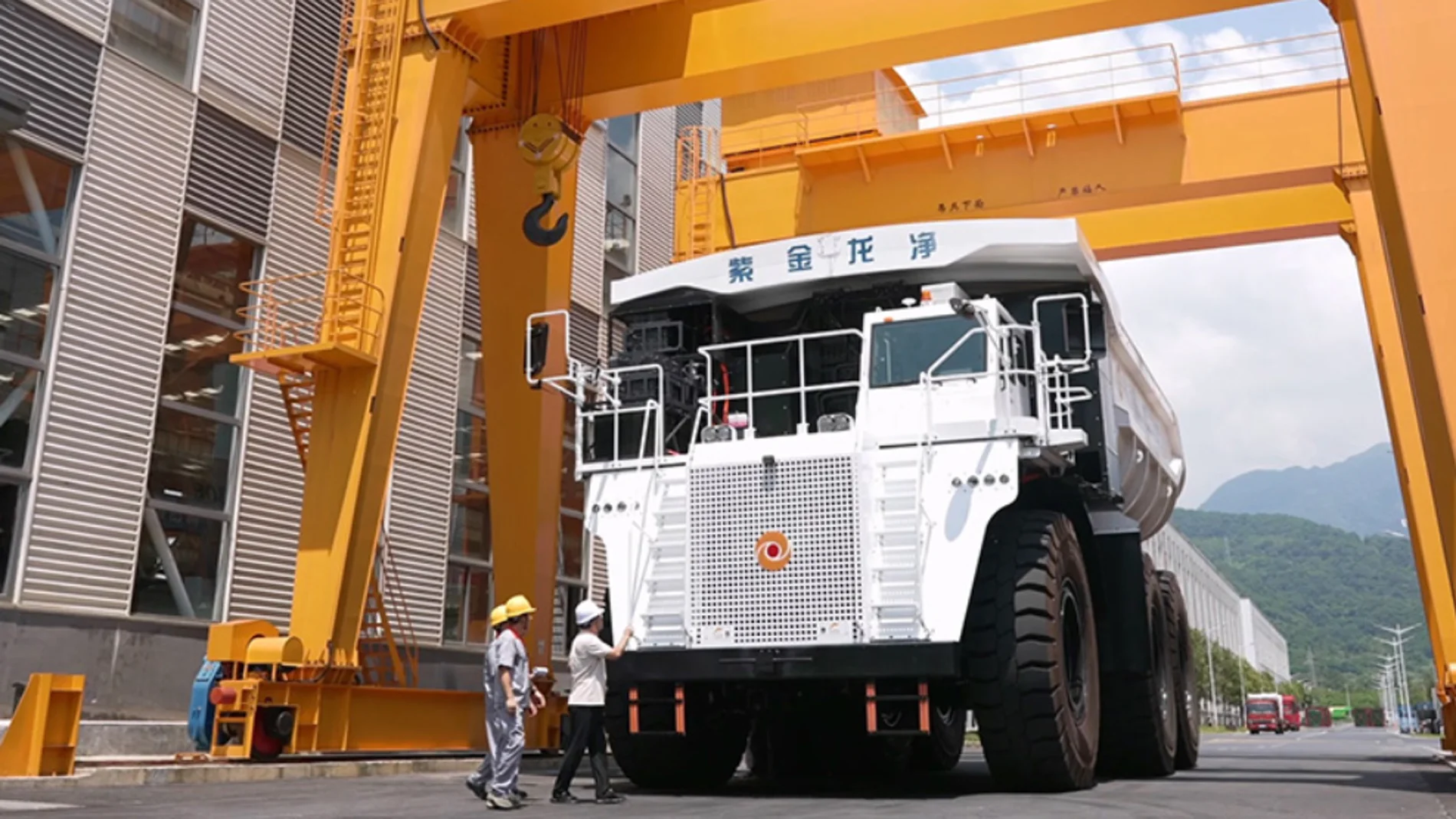
But what interests us is the new model, the largest mining truck to date: the ZL230E. A beast capable of transporting 350 tons of gross weight and a payload capacity of 230 tons and a cargo box of 125 cubic meters, this enormous vehicle combines high transport capacity with a zero-emissions design, built to operate in the most demanding mining environments. According to the statementhouses a 1400 kWh battery (a car could travel 8,000 km). The surprising thing is Charging speed: 90% in just 25 minutes. And this is just the beginning: in 2020 Zijin Mining had “just” 13 electric trucks in its mines. Now it is almost 1800.