
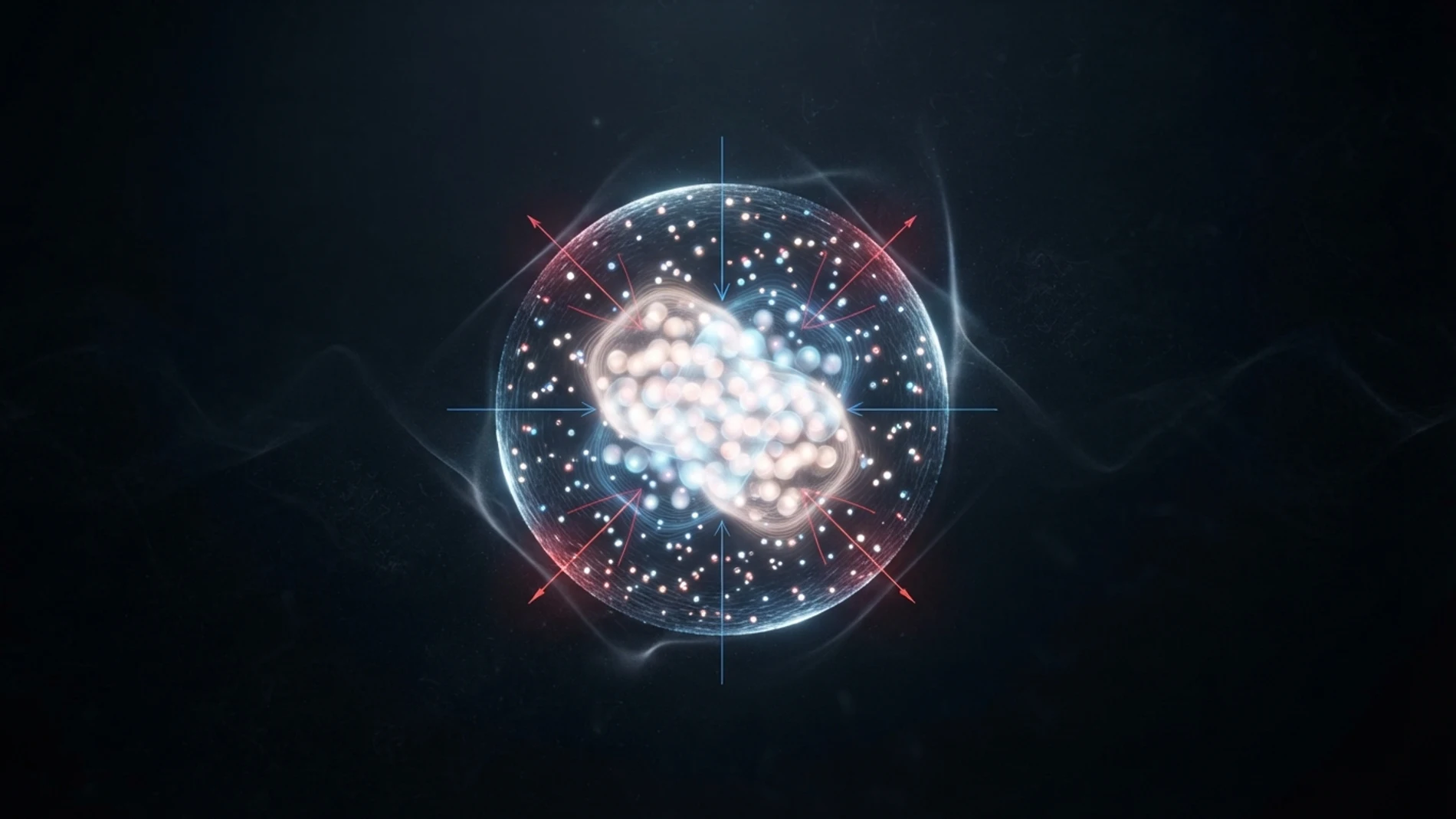
The first step is to imagine two substances that, like water and oil, do not seem destined to mix. The second is to take them to the quantum world and replace water and oil with two families of particles with radically different behaviors: bosons and fermions. Well, under certain conditions both can form something even stranger: a tiny drop of matter that holds itself together. This is the conclusion of a study published in Physical Review Letterspredicts the existence of these quantum drops in a mixture of bosons and fermions subjected to extremely low temperatures and very intense interactions. The calculations indicate that could appear when the attraction between both types of particles reaches a regime called resonant and is balanced by a fundamental property of fermions: the Fermi pressure.
To understand why the result is surprising, we must stop at these two families of particles. Bosons have an extraordinary characteristic: many of them can simultaneously occupy the same quantum state. When a boson gas is sufficiently cooled, its particles can behave collectively as a single quantum entity.forming a Bose-Einstein condensate.
Fermions, for their part, follow different rules. Particles such as electrons, protons and neutrons belong to this family and are subject to the Pauli exclusion principle: two identical fermions cannot occupy exactly the same quantum state. When you try to compress a fermion gas, this restriction generates a pressure that prevents the particles from further concentrating. In short: water and oil of the quantum world.
In the system studied by the authors, led by Sam Foster, something similar to a tug of war occurs. On the one hand, the interaction between bosons and fermions can become strongly attractive and cause the particles to stick together. On the other hand, the Fermi pressure prevents fermions from accumulating indefinitely in the same space. When both tendencies reach the right balance, Calculations show that a stable structure held together by its own forces can appear: a quantum drop.
The key to the study is precisely to explore a regime that previous models could not adequately describe. According to Sam Foster, a researcher at Monash University and lead author of the study, Previous theories were limited to systems in which particles interacted weakly. The new approach allows us to study what happens when these interactions become much more intense, right where the most interesting physics appears.
The researchers have also verified that there is no single possible configuration. The proportion and density of the particles can change the behavior of the system. If the density of fermions increases, for example, the drop may no longer be stable and phase separation may occur: a mixture of bosons and fermions on the one hand and an excess of fermions on the other. The calculations also reveal a behavior similar to that of a critical point between the liquid and gas phases.
This makes the proposal more than just a mathematical curiosity. The authors point out that theThe conditions necessary to produce these droplets could be achieved using ultracold gas mixtures which are already available experimentally, provided that the masses of bosons and fermions are sufficiently similar. That is, the prediction could be tested without the need to develop a completely new technology.
The result also reminds us that, on a quantum scale, familiar concepts such as liquid, gas or mixture stop behaving exactly as we expect. The predicted drops are not small versions of water droplets: they are collective states governed by the rules of quantum mechanics, in which the nature of the particles and the way they interact determine a structure that has no direct equivalent in our everyday experience.
“Quantum systems can behave in ways that seem impossible in our everyday world. Previous theories could only describe these systems when particles interacted relatively weakly,” explains Foster, in a statement -. Our approach allows us to explore what happens when those interactions become much stronger, which is where the most interesting physics arises. We have shown that these two very different types of particles can perfectly balance each other to create a stable droplet that holds together on its own.”.
If experiments manage to produce them, scientists will be able to directly study their properties and see how they change by modifying the interaction between bosons and fermions. The interest goes beyond this peculiar phase of the matter. Understanding how matter is organized under extreme quantum conditions can help develop new ways to control quantum systems and, in the longer term, provide useful knowledge for technologies such as quantum sensors or quantum computing.
For now, the drops exist on paper, not in a laboratory. But the prediction raises a fascinating possibility: that two families of particles subject to seemingly incompatible quantum rules could find a point of equilibrium and together form a small island of stable matter. ANDIn the everyday world, water and oil separate. In the quantum world, perhaps there are ways to convince them to stay together.