
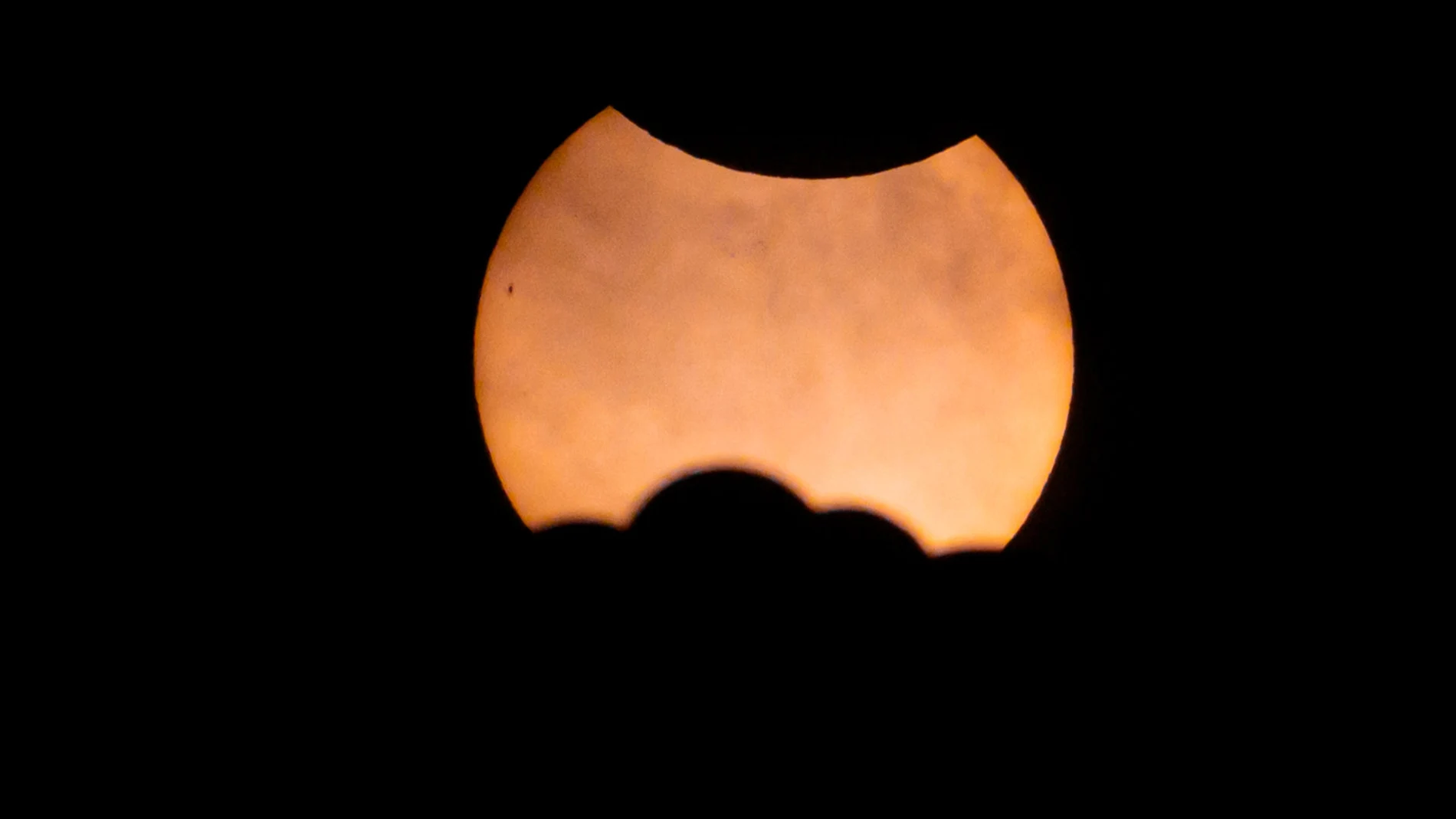
There is something almost cruel about living in Luarca on the day when a total solar eclipse passes through Asturias. For months we have talked about him. Of the shadow of the Moon crossing Spain, of the solar corona, of the stars that will appear in broad daylight and of those little more than one hundred seconds in which the light will disappear completely. And now comes the part that no astronomical calculation can solve: the clouds. Today’s weather forecasts point to complicated skies in Asturias, especially due to the possible presence of low cloud cover from the Cantabrian Sea.
That means there’s a pretty real chance that, when the time comes, we’ll look up and not see the Sun. But there is one consolation. The Moon will continue to pass exactly in front of the Sun. The shadow will continue crossing Asturias. And for a few moments, even if we cannot see the crown, the world around us will continue to change. Because an eclipse is not limited only to the sense of sight and a cloud does not stop the shadow.
When we think of a solar eclipse, we imagine the black disk of the Moon silhouetted against the Sun. But the truly extraordinary part of the phenomenon is another: the shadow. The Moon casts a shadow on the Earth that moves at high speed. In Asturias, totality will arrive around 8:27 p.m. and will last approximately between one and almost two minutes, depending on the location. In Oviedo, for example, totality will reach about 109 seconds. And that shadow does not stay above the clouds: it passes through them.
Therefore, although a layer of cloudiness prevents us from seeing the Sun, the ambient lighting will also change. The day will go out. The landscape will lose light. The horizon will take on another aspect. And maybe that’s when we discover that we had been looking at the eclipse from the wrong place because the eclipse also occurs in the clouds. These are part of the atmosphere and, therefore, also respond to the sudden disappearance of solar radiation.
A study published in Communications Earth & Environment analyzed using satellites and atmospheric models how clouds responded during three solar eclipses. The results were surprising: on land surfaces that were cooling, Some low cumulus clouds began to dissipate when solar occultation only reached about 15%.. This, unfortunately for us, does not mean that the eclipse will make the clouds disappear, I wish it were that simple.
But it does mean that the Moon’s shadow can modify the atmosphere long before totality arrives. The explanation is relatively simple. As solar radiation decreases, the soil receives less energy, cools and changes the circulation of air near the surface. The updrafts that help maintain some cumulus clouds may weaken and clouds begin to disappear. It is a small paradox: the shadow that prevents us from seeing the Sun may be modifying the same clouds that prevent us from seeing the eclipse.
But the change in light is not the only consequence. During an eclipse, the sudden reduction in solar energy can cause a drop in temperature and alter air movements. Scientists have been studying these effects for almost two centuries..
A scientific study led by experts from the University of Oxford analyzed 44 eclipses. The results showed evidence of atmospheric cooling and changes in local circulation. In some cases a phenomenon known as “eclipse wind”: a modification of the wind associated with the cooling caused by the lunar shadow. So, even if a cloud hides the corona from us, we can still observe something that those who chase an eclipse rarely see. Yes, here he who does not console himself is because he does not want to.