
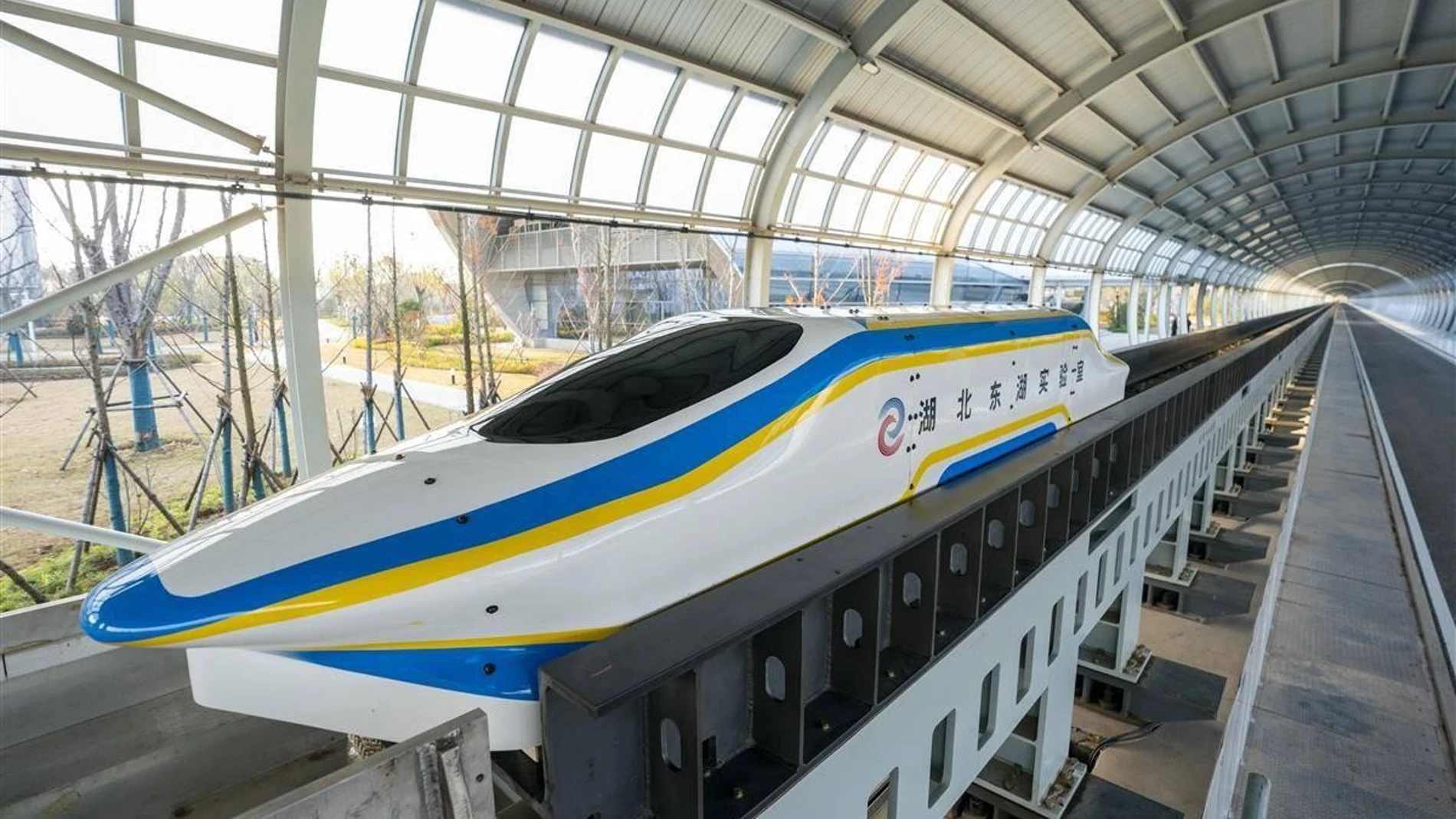
China has the maglev acceleration world record thanks to an experimental vehicle magnetic levitation who beat it three times in a period of five months. The model, developed by Donghu Laboratory of the province of Hubeiweigh 1,110 kilos and managed to accelerate from zero to 800 km/h in just 5.3 seconds on a test track of just one kilometer.
The first short-distance maglev acceleration world record came in June 2025, when the vehicle reached 650 km/h in 7.1 seconds. A month later the researchers raised the speed to about 700km/hbefore finally reaching the 800km/h last November. This enormous acceleration makes it clear that this is not the prototype of a future passenger train, but rather a a platform designed to experiment with electromagnetic propulsion technologies at extreme speeds.
800 km/h in just 5.3 seconds?!
China’s maglev test train just set another world record – and it did it without wheels.
The frictionless future is moving at full speed. #CoolChina pic.twitter.com/QrEK21jRo6
— CGTN (@CGTNOfficial) August 10, 2026
Maglev vehicles operate very differently than a conventional train because they do not need to keep the wheels resting on the rails while driving. A set of electromagnets produces the forces necessary to keep the vehicle suspended on the guide, while a linear motorwhich works like a conventional electric motor extended along the track, creates a moving magnetic field that propels him forward. When physical contact with the rail disappears, mechanical friction is eliminatedalthough at high speeds there is still significant aerodynamic resistance.
The Chinese platform has not been built solely to investigate future ultrafast trains. Its objective is to test systems of electromagnetic propulsion, levitation, position control and braking in extreme conditions. The same technologies could be used in electromagnetic sleds, industrial facilities, attractions or systems capable of accelerating a plane or rocket before it uses its own engines. The Donghu Laboratory also contemplates its application to future transports that circulate inside low pressure tubes to reduce air resistance.
China, South Korea and Japan already operate maglev trains
Magnetic levitation trains are not just an experimental technology and commercial services that transport passengers have existed for years. The best known is the Shanghai Maglevwhich connects the international airport of Pudong with the station Longyang Road in China. Although it circulated commercially in 431 km/hcurrently reaches a maximum of 300km/h and covers its 30 kilometers in about eight minutes.
China also has the Changsha Maglev Expresswhich works up to 140km/hwhile in Japan he Linimo of the prefecture of Aichi reaches 100km/h. Japan also develops SCMaglev for the future railway line Chuo Shinkansena technology that has already been tested at more than 500 km/h and is designed so that trains circulate commercially 500km/halthough the line has not yet entered service.
South Korea also keeps operational the Incheon Airport Maglevwhich resumed service in 2025 and currently circulates at about 40km/h with mainly tourist and demonstration use.
The absence of contact between wheel and rail does not make these systems less safe, although it requires extremely precise control of levitation, position and braking. Commercial experience also allows us to confirm this. The Changsha Maglev accumulated in May 2025 3,287 days of safe operationwhile a year later he had already surpassed 10.3 million kilometers traveled and 26 million passengers.