
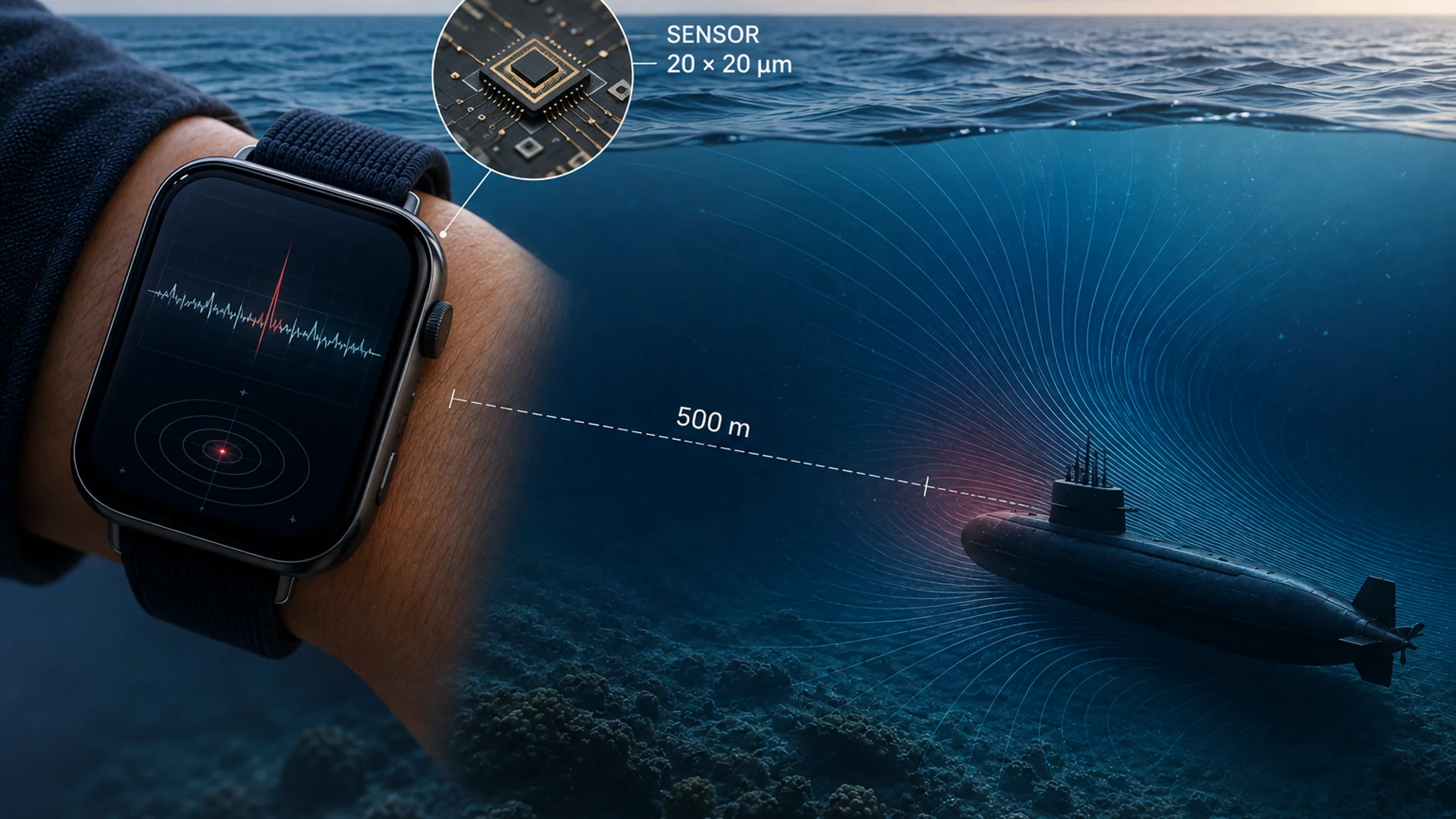
You are calmly fishing when your smart watch vibrates. A strange message appears on the screen: “Magnetic anomaly detected. Possible submarine at 500 meters.” It sounds like the plot of a science fiction movie. But A team of Chinese scientists has just developed a magnetic sensor so small and sensitive that, at least in theory, it could make something similar possible.
The device, developed by scientists from the Hefei Institutes of Physical Sciences and the Ningbo Institute of Materials Technology and Engineering, both part of the Chinese Academy of Sciences, uses a sensor based on the Hall effect and It has a size comparable to that of a grain of dust (20 x 20 microns, a micron is one millionth of a meter,according to the official statement). According to the authors of the study, led by Kang Wang, its sensitivity would allow the detection of extremely weak magnetic fields, including the signature that could be produced by a steel-hulled submarine located up to about 500 meters deep.
It’s not that a smartwatch has become a sonar. The thing is that a sensor that could fit inside one is beginning to be able to perceive extraordinarily weak magnetic signals. A submarine may try to hide from sonar. Can reduce the noise it produces, use materials that absorb certain acoustic waves and design its propulsion to be quieter. But there is something much more difficult to hide: its magnetism.
A submarine contains large amounts of metal and, in addition, its presence alters the local magnetic field. The movement of a metal structure through the Earth’s magnetic field can also contribute to generating small disturbances. We are not talking about a compass that suddenly starts spinning, the signal is much smaller. Precisely for that reason detecting these variations requires extraordinarily sensitive sensors and, above all, able to distinguish them from the noise that continually exists around them.
And this is where one of the keys to the study comes in: the Hall effect, a principle used by researchers with a history much older than submarines and smart watches. The Hall effect was discovered in 1879 by the American physicist Edwin Hall. When an electric current passes through a material and a perpendicular magnetic field is applied, the electric charges are deflected and a small voltage difference appears. This voltage allows us to know that a magnetic field exists and to measure it.
The principle is used today in a multitude of devices: position sensors, electric motors, automotive systems and also numerous electronic devices. The difficulty appears when we want to detect increasingly weaker fields. Because there is an uncomfortable rule in the world of sensors: the more we try to listen, the more noise we hear too. Typically, increasing the sensitivity of a sensor involves some kind of compromise. AND reducing their dimensions can make useful signals even more difficult to distinguish. The advance of Wang’s team consists precisely in trying to break this relationship between sensitivity and noise.
According to the study, the authors have developed a miniaturized Hall sensor capable of generating a minimal electrical signal without introducing the increase in noise that would normally accompany higher sensitivity. The result is a tiny device, but capable of detecting extremely weak magnetic variations. And this is where size becomes as important as sensitivity. Because an extraordinarily sensitive magnetometer that occupied an entire laboratory would have very different applications. Hall sensors are already present in everyday devices. The revolutionary thing would be to bring this much more sensitive magnetic detection capacity to devices that we already use constantly, such as a phone, a drone or a smart watch.
What the study does not indicate is what would happen if several smart watches were joined together or sensors were used in different locations. Taking into account the laws of physics, two clocks would not double the distance. But a dozen of them would reduce noise up to 5 times and, if they were located at different points, they could transmit more information about the detected object.