
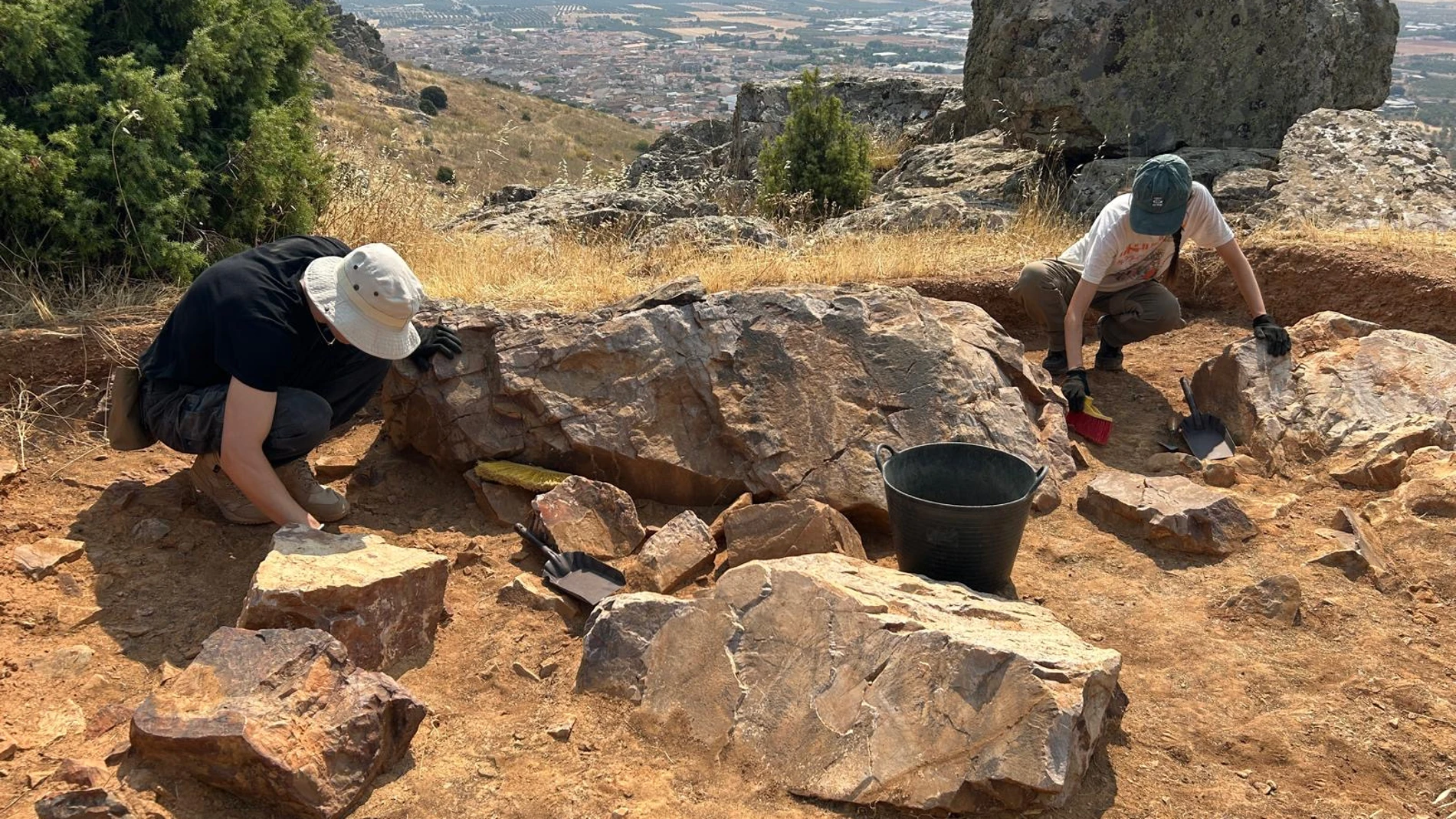
After announcing last July that excavations were resuming in the archaeological site of La Chorrera, in the municipality of Los Yébenesin Toledo, archaeologists have found a discovery that would demonstrate that the megalithic structure found, previously dated to 5,000 years ago, would actually be 6,000 years old.
As revealed by the latest excavations carried out within the ‘Entre Dos Tierras’ project, directed by Arturo Ruiz Taboadaarchaeologist from the University of Madrid, and financed by the Los Yébenes City Council and the Toledo Provincial Council, the remains found during his first campaign would correspond to a megalithic complex intended to serve as an area for rituals and meetings among the community.
Its age, 6,000 years, reveals that there were communities inhabiting the area much earlier than historians and archaeologists believed. A finding comparable to that recently announced by the University of Granada, in which it was discovered that the use of lead in the Iberian Peninsula predates the arrival of the Phoenicians.
This megalithic complex would have been used for 4,000 years
Specifically, this new campaign has revealed that it is a mound with a double megalithic ring, that is, a prehistoric funerary monument corresponding to the Neolithic and Chalcolithic, but which would have continued in operation until the Iron Age. This means that it was an essential complex, used by the communities in the area for approximately 4,000 years.
Its structure is characterized by the presence of a cromlechthat is, a circular formation of stones, also known as menhirs, which have been inserted into the ground. The diameter of this stone ring is 12 meterswith a two-meter menhir approximately 2 meters high in the center. However, this is not the only circle in the formation, as the first Cromlech was surrounded by a second.
The latter, according to archaeologists, would have served as an access corridor. According to Tesauros, the digital tool provided by the Spanish Ministry of Culture, these megalithic structures are related to both funerary functions and celestial phenomena with the aim of controlling the seasons of the year.
Archaeologists seek to determine the relationship between the formations found in the area
Archaeologists have found more similar structures along the Yébenes, which add to the shelters with schematic rock painting already recorded. All of this makes this site a unique space that reflects the behavior of the prehistoric civilization in the area, especially in terms of their rituals and beliefs.
As Ruiz Taboada explained, he and his team are “on the verge of making a discovery that could change the vision of megalithism in the Montes de Toledo,” reports “Toledo Diario.” Therefore, they will focus on discovering the role that this structure played for the community, as well as its relationship with the rest of the finds found in the area.
The main hypothesis is that the set of formations is part of a single ritual space, in which not only rituals and funerary practices were carried out, but it was also useful for the agricultural activities of the communities in the area.