
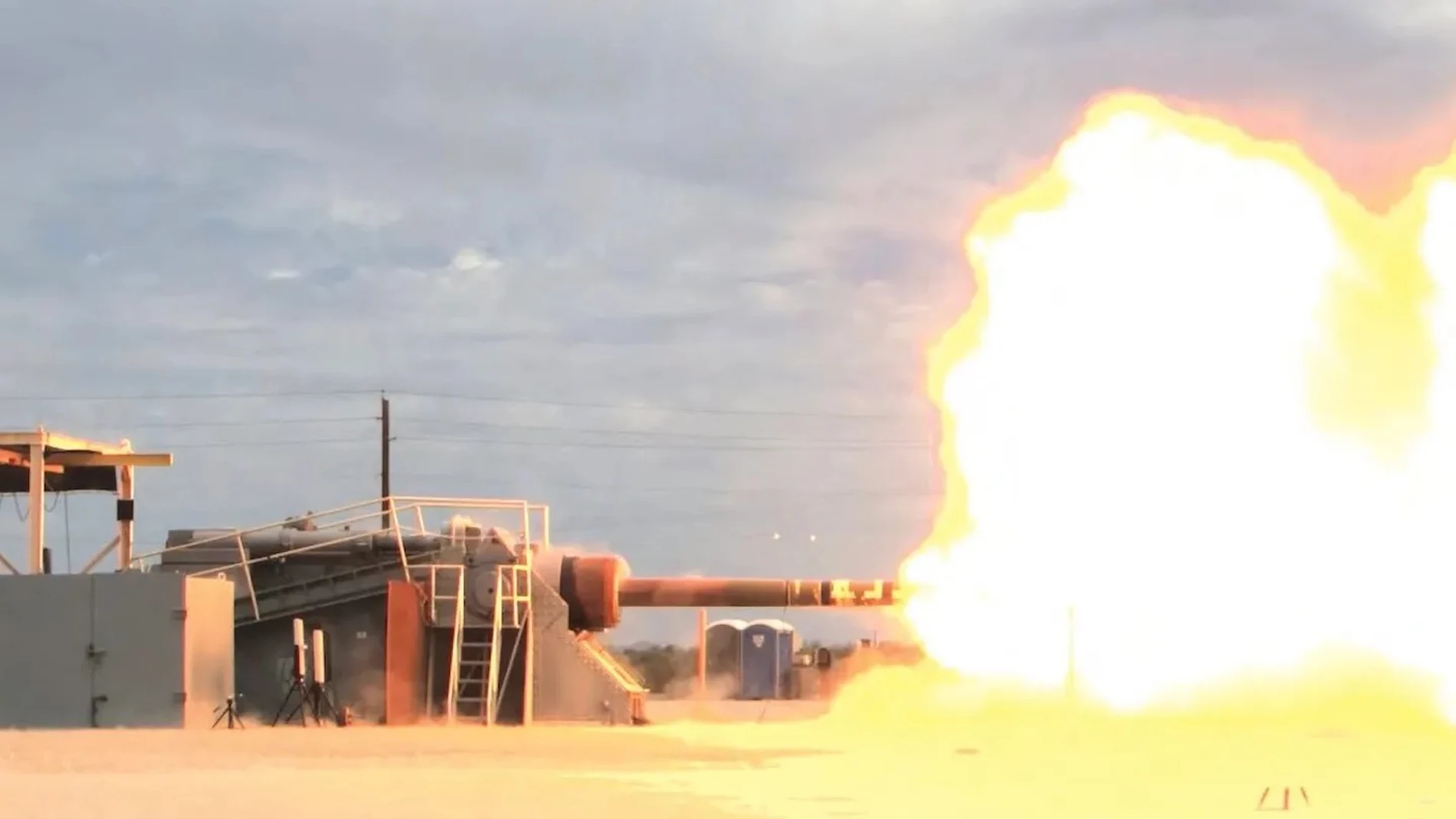
He United States Army has recovered a huge cannon from one of its canceled weapons programs to use as hypersonic warhead test platform. The system allows reproduce part of the conditions of a high-speed impact without having to launch a full missilewhich can considerably reduce the cost and time required to perform each test.
The test was carried out in the field of Yumain Arizonawhere the Army Successfully fired a full-size hypersonic warhead using the Heavy Artillery Test Systemknown by the acronym HATSor a modified version of this equipment. According to The Outpost, the official publication of these facilities, it is the first live-fire demonstration of its kind successfully completed. The HATS was developed as part of the Strategic Long Range Cannonan ambitious program with which the Army intended to build an artillery piece capable of reach targets located more than 1,600 kilometers away.
To achieve such a range, the cannon planned for the Strategic Long Range Cannon program had to use a large rocket-assisted projectile. The American Congress withdrew funding from the program in the fiscal year 2022 budgets, before the weapon could become an operational system. The Army then decided preserve part of the work done to use it in the development of other technologies.
TWZ has identified the barrel shown in the test images as the HATS from that program. Its reuse demonstrates that the supergun can still be useful, albeit with a very different function than initially intended.
A warhead is considered hypersonic when it travels at least Mach 5five times the speed of sound. The exact value varies depending on altitude and atmospheric conditions, but is approximately equivalent at more than 6,000 kilometers per hour. The new method allows launching the warhead at high speed against a target and studying its effects without having to use one of the expensive experimental missiles available.
Each full flight test can cost millions of dollars and requires the missile, its launch platform and extensive monitoring infrastructure. The canyon offers a cheaper alternative that allows for more frequent testing during the early phases of development and obtain earlier information on the behavior of the warheads during impact.
The project has required design a launch assembly capable of withstanding the brutal acceleration that occurs inside the tube. Researchers of the Lawrence Livermore National Laboratory and the weapons center DEVCOM The Army also incorporated an electronic safety fuze and analyzed the forces that would act on the warhead during firing.
Before using a real warhead, those responsible carried out an inert shot to check that the concept worked. An inert shot uses a projectile without an active explosive charge, so it allows the launch, the resistance of the components and the trajectory to be verified without causing a detonation. The results were used to introduce several changes to the design.
During the definitive testthe technicians first checked the instrumentation and prepared the target. They then positioned the launch assembly, assembled the fuze, and loaded both the warhead and the propellant charge. The personnel retreated to the protective bunkers while those responsible monitored the telemetry and the test director gave the order to fire, TWZ reports.
High-speed cameras made it possible to analyze the impact once the dust and debris raised by the shot had dissipated. The Army assured that The test met all the planned objectives and that several hypersonic programs are already studying using this same method in future campaigns.
The cannon cannot reproduce the entire flight of a hypersonic weaponincluding prolonged warm-up, maneuvering or aerodynamic loads. Its main utility is in the final phasewhen the warhead approaches the target and hits it. The speed achieved in the test has not been disclosed, so it remains to be determined to what extent the conditions obtained resemble those of a real weapon.