
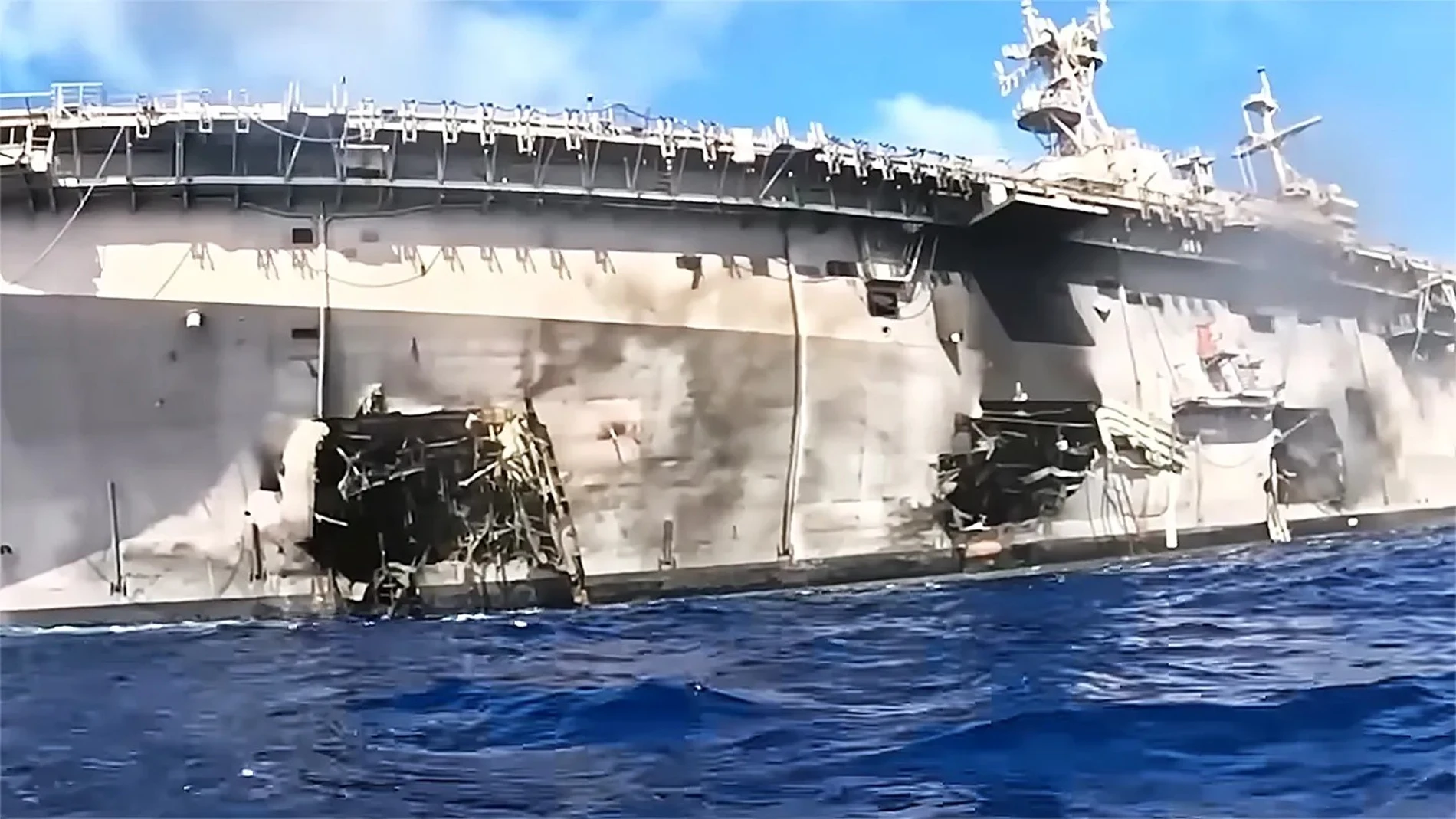
The Marine of the United States has tested its drone boat with live fire for the first time GARC as unidirectional attack weaponwhich is what military jargon calls kamikaze drones. One of these autonomous vessels hit the old port on July 17. USS Peleliu during RIMPAC 2026the largest international naval exercise in the world, held around Hawaii with the participation of 30 countries.
The attack was part of a SINKEXa test in which a retired ship is used as a real target to train coordinated attacks and analyze damage caused by different weapons. The Peleliu was hit by various means from Americans and allies before sinking, so not all visible damage can be attributed to the drone ship.
The class amphibious assault ship Tarawa USS Peleliu measured about 250 meters in length and 32.5 meters in widthwith a displacement close to 40,000 tons fully loaded. Its flight deck allowed it to operate helicopters and vertical take-off aircraft, which gave it an appearance similar to that of a small aircraft carrier.
According to TWZ, the exercise involved two GARC units. One autonomously completed the entire attack sequence and was destroyed when it hit the ship, while the second approached later to record the damage. The attacking vessel used Latticethe autonomy platform developed by Anduriland carried a payload of about 454 kilos. It is not known what part of that weight corresponded to the explosive head.
He Global Autonomous Reconnaissance Craft o GARC is an unmanned vessel manufactured by the American company BlackSea Technologies. has some 4.9 meters in length, displaces around 2.2 tons fully loaded and reaches a speed of about 41km/h. Its autonomy is around 1,300 kilometersa figure that allows it to operate at great distances without depending on a nearby support vessel.
Although its name refers to autonomous recognition, the GARC design allows adapt it to different missions. The RIMPAC test shows that the Navy also wants to use it as naval attack ammunitioncapable of locating a target, approaching it autonomously and detonating its charge upon impact.
The operation was carried out by USVDIV-32the Navy Unmanned Surface Vehicle Division 32. This unit was created earlier this year to operate, maintain and develop tactics with autonomous vessels. It also participates in exercises aimed at teaching U.S. and allied forces to detect and neutralize enemy drone ships.
Sarah Weinsteinfirst commander of USVDIV-32, said on LinkedIn that she was ‘honored that USVDIV-32 had the opportunity to execute the Navy’s first GARC live-fire exercise during RIMPAC 2026.’ The officer added that ‘it was incredible to see my team execute the operation with precision and We were excited to offer a perspective of the former USS Peleliu that is not usually captured during a SINKEX.’.
The test comes shortly after the United States began employing autonomous ships in real operations. A corsair of the company Saronic participated in the rescue of the two pilots of a helicopter AH-64 Apache knocked down in the gulf of oman in June. It was the first known case of an autonomous vessel recovering personnel during a search and rescue mission.
The Corsairs also starred the first combat use of kamikaze drone ships by the US Armed Forces. Several units participated in attacks against Iranian targets on July 12 during the military escalation around the Strait of Hormuz. Among the targets was a Ghadir-class diesel-electric mini-submarine.
The war in Ukraine has shown the impact these vessels can have on a conventional fleet. Ukrainian attacks with naval drones against ships, bases and infrastructure of the Russian Black Sea Fleet have forced Moscow to transfer a large part of its units from occupied Crimea to ports on the Russian mainland. The GARC test shows that the US Navy wants to add that capability to its future combined fleet of manned and autonomous ships.