
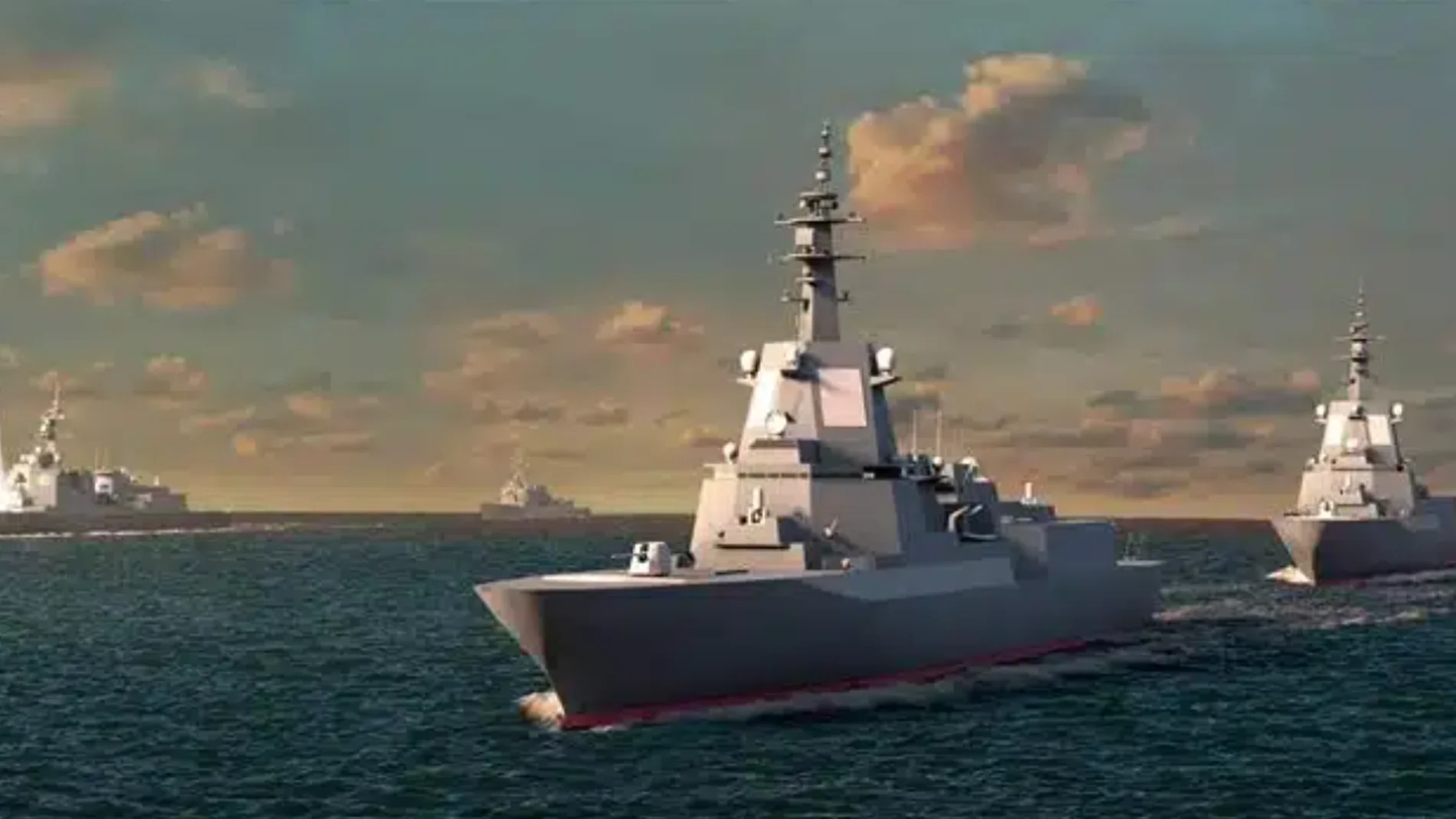
For much of the 20th century, the power of a warship was measured by the caliber of its guns. Then missiles arrived and the number of launchers became the new reference. Today, however, The true muscle of a destroyer is no longer in its weapons, but in something much less visible: its ability to see before anyone else.
That change explains why Japan has just launched construction of what will be the largest destroyer ever built not to fight classic-style naval battles, but to face a completely different threat: the ballistic and hypersonic missiles capable of traveling hundreds or thousands of kilometers in just a few minutes.
In short, Japan is building an immense floating shield more than a sword. The figures alone are impressive. Each of the two new destroyers It will displace about 14,000 tons, approximately double that of a modern frigate and a size comparable to that of some World War II cruisers. At around 190 meters long, it will be almost as long as two football fields placed one behind the other.
Although it retains the name “destroyer”, the ship is close in size to other much larger historical categories. The difference is that, instead of dedicating That space is occupied by enormous artillery turrets, with radars, computers, electronic systems and dozens of interceptor missiles. In its beginnings and by definition, a destroyer was the bodyguard of a fleet. Its mission was to detect submarines, shoot down enemy planes or confront other ships. Today that function has changed profoundly.
The threat can come from hundreds of kilometers away, in the form of a hypersonic missile that flies at more than five times the speed of sound and leaves only a few minutes to react. In that scenario, winning doesn’t depend as much on shooting first as it does on detecting first. Therefore, the most important element of The new Japanese destroyer will not be a cannon or a missile, but rather its SPY-7 radar system, one of the most advanced in the world.
Unlike traditional radars, whose antenna rotates continuously like a lighthouse, SPY-7 uses huge fixed electronic panels integrated into the ship’s superstructure. No need to move: Using thousands of small electronic modules, it directs the radar beam almost instantaneously to any point in the sky.
This allows it to simultaneously track hundreds of different targets, distinguish real threats from false alarms and provide real-time information to the combat system. In practice, radar becomes the eyes of an entire fleet and not a single ship. The main objective of the new destroyer will be to integrate into Japan’s missile defense system. His mission will consist of detecting ballistic and hypersonic projectiles during the first phases of their trajectory and coordinate their interception using specialized missiles.
It is no coincidence that the project, run by Lockheed Martin, arrives precisely. In recent years, the rapid development of hypersonic missiles by China and North Korea has forced Japan to rethink its defensive strategy. Faced with weapons capable of maneuvering at extreme speeds, having permanent surveillance platforms is much more effective than depending exclusively on ground facilities. An interesting question is Why are destroyers getting bigger? A hundred years ago, the size of a ship was determined by the weight of its armor and guns. Today it depends, above all, on the electrical energy it can generate.
New generation radars, processing systems capable of analyzing thousands of signals per second, encrypted communications networks and future laser weapons require enormous amounts of electricity. Modern ships need to carry much more powerful generatorsincreasingly complex cooling systems and space to incorporate technologies that are still in development.
Although there is still a lot of secrecy regarding its qualities and capabilities, the Japanese Ministry of Defense published a 60-page document that allows some logical deductions to be made. There are several details that seem especially striking to me. The first of them is that it will have a total of 128 vertical launch silos. The Spanish frigate F-100 has 48.
Another detail is that the radar will be placed much higher, above the command bridge. Increasing the height of the radar also increases the detection horizon, something especially useful against low-flying missiles. And something fundamental is that, according to the published documents, The destroyer has been designed with room to integrate future weapons systemsincluding new generation interceptors versus hypersonic vehicles.
But the most interesting thing is the origin of the project. The new Japanese destroyer was born because Japan canceled the Aegis Ashore system, which was going to be a fixed installation on land. Instead of building two huge stationary radars, he decided to poner all that capacity within a ship capable of traveling to any point in the Pacific.