
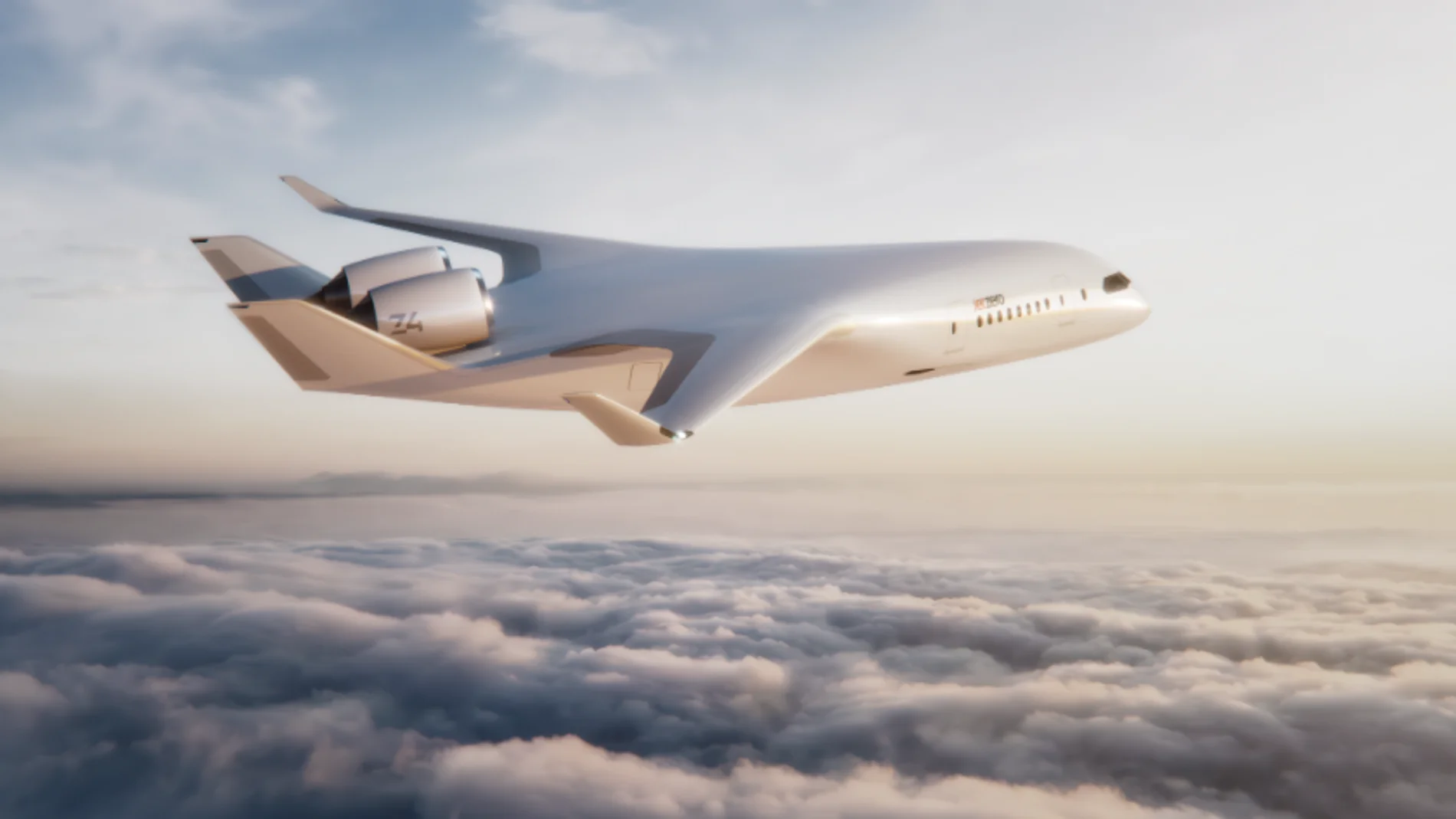
The aviation industry has been searching for decades for an alternative to the configuration that has dominated passenger aircraft since the beginning of commercial aviation. JetZero wants to replace the cylindrical fuselage attached to two wings with a structure in which the central body also generates an important part of the lift. His proposal is Z4a plane for some 250 passengers that promises to consume 30% to 50% less fuel than current models.
The Californian company presents the project this week at the Farnborough International Airshowwhich is celebrated in United Kingdom from July 20 to 24. Japan Airlines has also announced its incorporation into the program to collaborate in the definition of the aircraft and facilitate its future entry into service. JetZero aims to commercialize it at the beginning of the next decade.
The Z4 will have a planned autonomy of about 9,260 kilometersenough to cover a good part of the medium and long-haul routes. In terms of capacity, it would be located between the single-aisle airplanes with the greatest number of seats and the large double-aisle models. The company also ensures that will be able to use the boarding gates, taxiways and other infrastructure of current airports without requiring modifications.
The main difference is in its integrated wing configuration, known in English as ‘blended wing body’. In a conventional airplane, the fuselage carries the passengers and the wings produce most of the lift.. The Z4 will have a wide and flattened central body that progressively joins the wings until forming a continuous aerodynamic surface.
This shape allows the area designated for the cabin to also contribute to keeping the plane in the air. By distributing the lift over a larger part of the structure, aerodynamic resistance is reduced and, with it, the energy necessary to move forward.. JetZero combines that advantage with a lighter design to justify its forecast of reducing consumption and associated emissions by up to half.
The concept should not be confused with a flying wing like those used by stealth bombers B-2 and B-21. In the latter, practically The entire plane is a single wing and there is no distinct fuselage. An integrated wing configuration preserves a recognizable central bodyalthough its shape blends with the wings and also produces lift. It is found like this halfway between a conventional airplane and a flying wing.
JetZero is also not the first company to study this architecture. Boeingthe POT and the United States Air Force unmanned demonstrators tested X-48B and X-48Cwho completed more than a hundred flights to analyze stability and control at low speed. Airbus flew in 2019 MAVERICanother scale demonstrator whose configuration could reduce consumption by up to 20% compared to a single-aisle aircraft. None of these projects ever became a commercial passenger aircraft..
The Z4 is still in the development phase and a complete commercial aircraft does not yet exist. JetZero is currently building the Jet1a full-scale demonstrator supported by the US Air Force and manufactured together with Scaled Composites. Its first flight is scheduled for 2027. The results will be essential to validate the behavior of the configuration before facing the certification of the passenger model.
Japan Airlines will provide experience in flight operations, cabin service, maintenance and ground handling. Both companies will also evaluate the use of airport gates and study a maintenance, repair and overhaul system that can support airlines when the Z4 enters service.
‘This collaboration fits with our commitment to sustainable innovation and net zero emissions by 2050’has stated Takao Suzukihead of corporate strategy at Japan Airlines, in a statement. The CEO and co-founder of JetZero, Tom O’Learynotes for his part that ‘JAL is expanding its network sustainably while delivering a superior customer experience. We look forward to strengthening our relationship with JAL to help meet their needs.’
Reducing consumption is the main argument of the project, although the shape of the plane would also allow the creation of a wider and more spacious cabin. Challenges inherent to such an unconventional structure remain to be resolved, from the pressurization of a non-cylindrical cabin to evacuation and certification procedures. The Z4 promises change the appearance of commercial airplanesbut first it will have to demonstrate that its advantages can be transferred from experimental models to an aircraft capable of transporting passengers every day.