
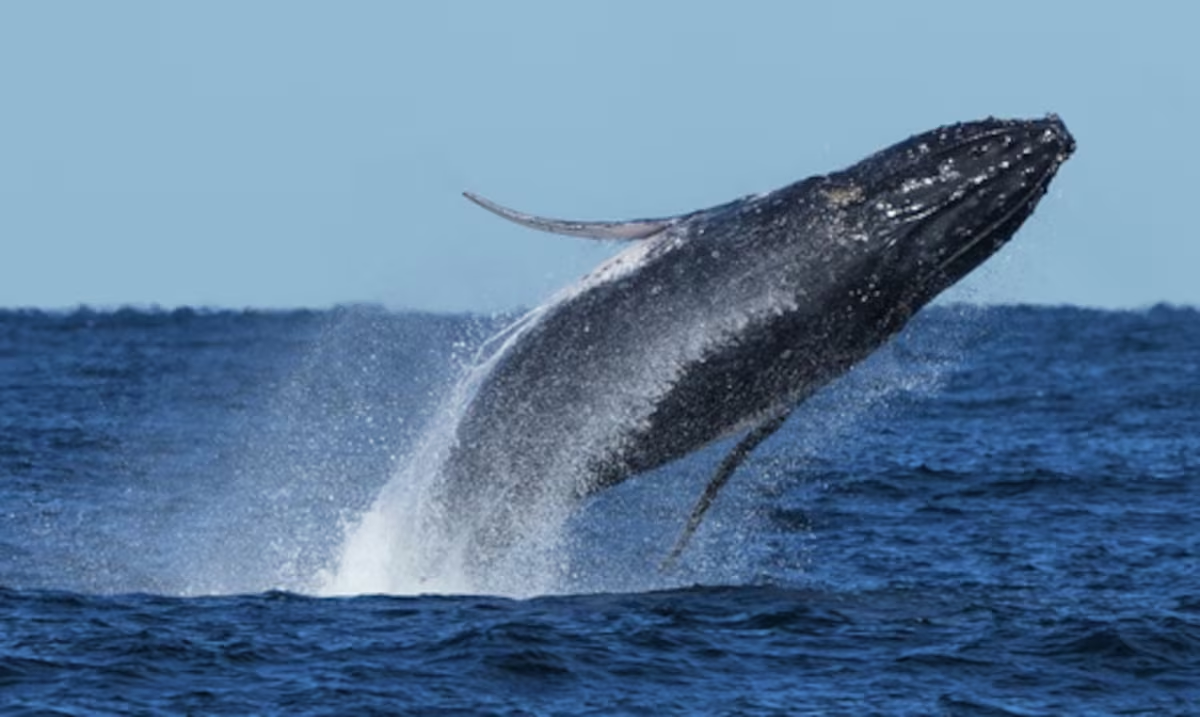
Cape Town, South Africa – A South African couple found themselves in an unusual situation when they spotted a “super pod” of humpback whales made up of almost 300 of these giant marine mammals.
According to scientists, it is an indication of how the populations of some species of whales have recovered strongly in the oceans of the southern hemisphere, decades after the international ban on whaling came into force in 1986.
Chris and Monique Fallows said they were used to seeing increasingly large pods of humpback whales off the west coast of South Africa, but they were unprepared for what they saw one morning last December. The columns of water expelled by the whales rose into the air one after another from the blowholes, and the couple found themselves with their boat in the middle of what is known as a super pod.
“It was extraordinary,” recalled Chris Fallows, a renowned fine art nature photographer who has documented marine animals for 35 years. “We realized pretty quickly that there must have been several hundred whales congregating in one particular area.”
The scene, he noted, resembled an urban landscape of skyscrapers but formed by whale blows.
Chris and Monique documented 299 humpback whales in the group, they said. Monique Fallows, author and naturalist, explained that they count whales by taking a photograph of their tail, which is called the fluke.
Each whale’s tail is different and is a common tactic scientists use to identify individuals.
It appears to be the largest group of humpback whales ever sighted, according to Alex Vogel, Happywhale’s Africa coordinator. That organization has a global database of whales built from photos and information submitted largely by what it calls “citizen scientists,” ordinary people who capture images of whales that are then verified.
The organization took a count of the group the Fallows encountered.
According to assessments by scientists and the International Whaling Commission, which monitors whale numbers, humpback populations have rebounded strongly in the Southern Hemisphere: from fewer than 10,000 at the height of whaling to more than 100,000 whales today.
Only a few countries still hunt whales commercially.
Humpbacks are usually solitary or move in small groups, but sometimes they gather in super herds in areas rich in food. They feed on krill or small fish.
Humpback sightings are also increasing in other parts of the Southern Hemisphere.
Els Vermeulen, senior scientist at the Whale Unit at the University of Pretoria in South Africa, said humpback super pods began to be seen again around 2012 and that this is likely a result of their recovery from whaling.
“Overall, the moratorium on whaling can be classified as one of the strongest conservation success stories in the marine environment,” said Vermeulen, who has a doctorate in zoology.
1/7 | Humpback whales arrive on the coast of Puerto Rico. View of the humpback whales arriving at the coast of Rincón to mate. (Supplied)
Vermeulen explained that humpbacks that feed in super pods make sounds underwater that attract other whales.
Although humpbacks have seen the largest rebound following whaling, the World Wildlife Fund notes that recovery has been uneven for other whale species and that various threats persist, including entanglement in commercial fishing gear, ship strikes and climate change.
Seven of the 14 species of large whales are classified as endangered or vulnerable by the International Union for Conservation of Nature, including the critically endangered North Atlantic right whales, which today number only about 380.
Vermeulen also pointed to a new threat to minnow whales near South Africa: the conflict in the Middle East.
He said a recent preliminary analysis he co-wrote showed shipping around Africa’s southern tip had quadrupled since December 2023 — after war between Israel and Hamas broke out and Yemen’s Houthi rebels began attacking ships in the Red Sea.
That is compounded by the war with Iran and the security crisis around the Strait of Hormuz, which diverts more ships around Africa.
Since most whales that die from ship strikes sink in the ocean, there are no detailed statistics. But Gregg Oelofse, Cape Town’s coastal and environmental manager, said increasing numbers of whales and shipping traffic clearly increased the risk.
He added that some whale carcasses wash ashore with evidence that they have been killed by boats.
“We will often see the blow of the propeller going through the body of the whale,” Oelofse said. “So they’re like big cuts on the whale’s body.”
Vermeulen said she and others are pushing for official speed limits for ships near the South African coast to give them time to spot any whales in their path.
This story was translated from English to Spanish with an artificial intelligence tool and was reviewed by an editor before publication.