
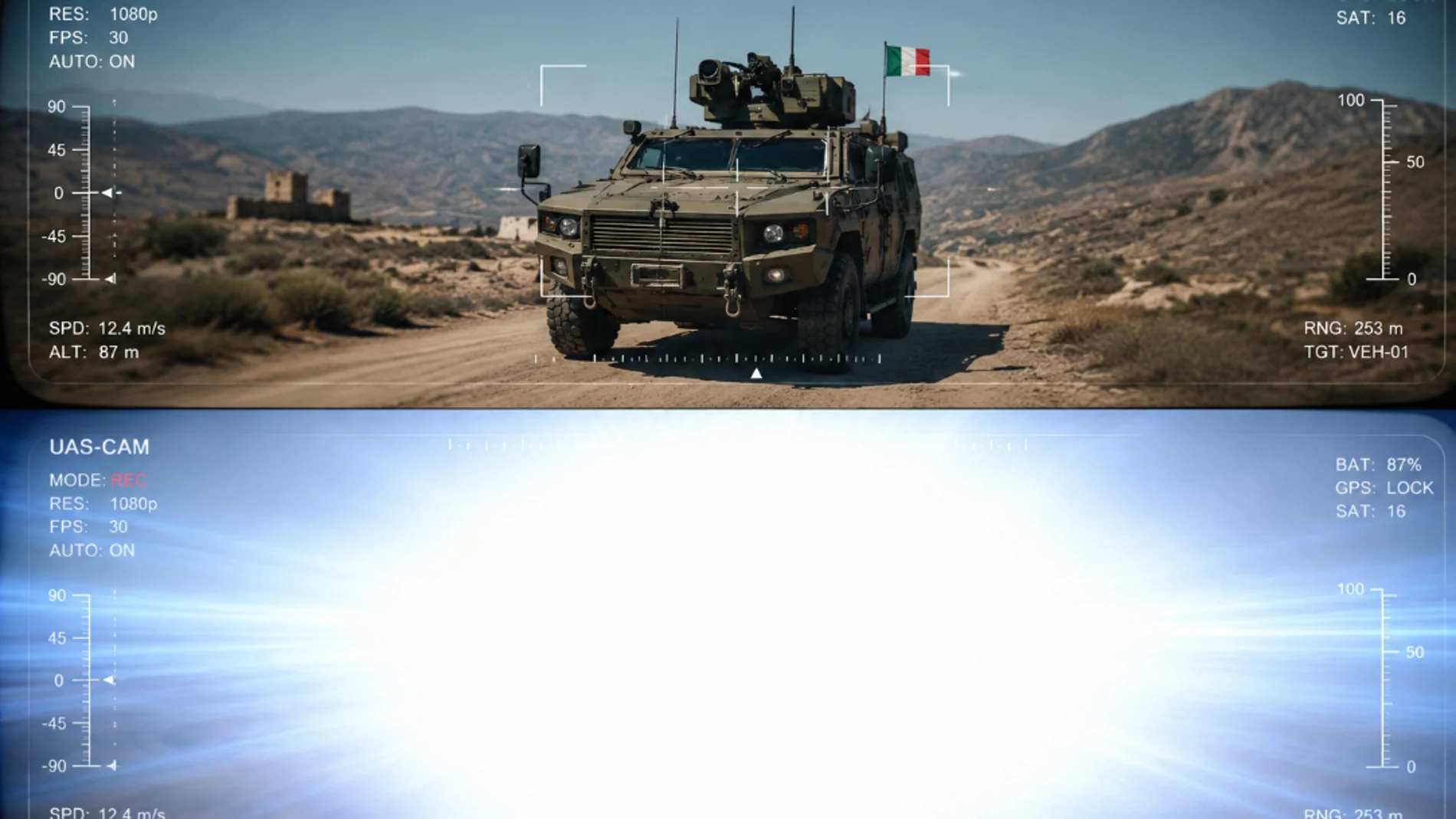
The war against drones is changing philosophy. For years, the solution was to shoot them down: missiles, anti-aircraft guns or high-speed projectiles tried to destroy the device before it reached its target. Then came lasers capable of burning its structure or melting its electronic components. Now A third way appears: not to destroy the drone, but to leave it blind.
The NUBURU company, together with the Italian company Tekne, has announced the first results of a new anti-drone system that uses a laser dazzlera laser designed to saturate the optical sensors of unmanned aerial vehicles. Instead of piercing the fuselage or setting fire to the electronics, the goal is to disable what allows the drone to orient itself, identify targets or transmit images.
It is the natural evolution of a technology that just a few months ago surprised with a portable rifle capable of dazzling drones. Now that same concept makes the leap to a much more sophisticated and automated military platform. The rifle presented above It required an operator to locate the drone, manually aim it, and keep the beam on the target. The new system integrates detection sensors, automatic tracking and a laser module capable of maintaining the target while disabling its cameras.
It is a next-generation system that “combines green, blue and infrared (IR) laser sources in a single device architecture – says the NUBURU statement -. These non-kinetic solutions against unmanned aerial systems (UAS) are designed to provide day and night protection in operational environments land, sea and in fixed locations, where authorized.”
In other words, the protagonist stops being the soldier and becomes the system itself. Once the UAV is detected, the platform can automatically track its movement and direct the beam toward its electro-optical sensors, greatly reducing the operator’s workload. The idea is surprisingly simple: Most modern drones rely on visible cameras, infrared sensors, or optical systems to navigate, identify targets, or transmit information to the operator.
If those cameras are temporarily blinded by an intense laser beam, the device can lose much of its operational usefulness, even if it continues to fly perfectly. It is an important difference compared to the high-energy lasers that the United States, Germany or the United Kingdom are already developing. Those seek to physically destroy the drone by heating its structure until it is damaged. This system pursues something different: preventing it from fulfilling its mission.
Furthermore, this approach has several advantages. A dazzling laser consumes much less energy than one designed to destroy targetscan be used repeatedly without the need to reload ammunition and prevents drone fragments from falling on the protected area.
According to the NUBURU statement, the first Tests carried out within the Italian program demonstrated that the system was capable of disabling the optical sensors of different unmanned platforms during test scenarios.. Technical details remain limited and it has not been revealed, for example, how many drones it can engage simultaneously or what its operational range is. Everything indicates that the system acts on one target at a time, keeping the beam on its sensors until its observation capacity degrades. Thus, while just a few years ago the question was how to destroy a drone, today, more and more experts are asking a much simpler question: what if it were enough to prevent it from seeing?