
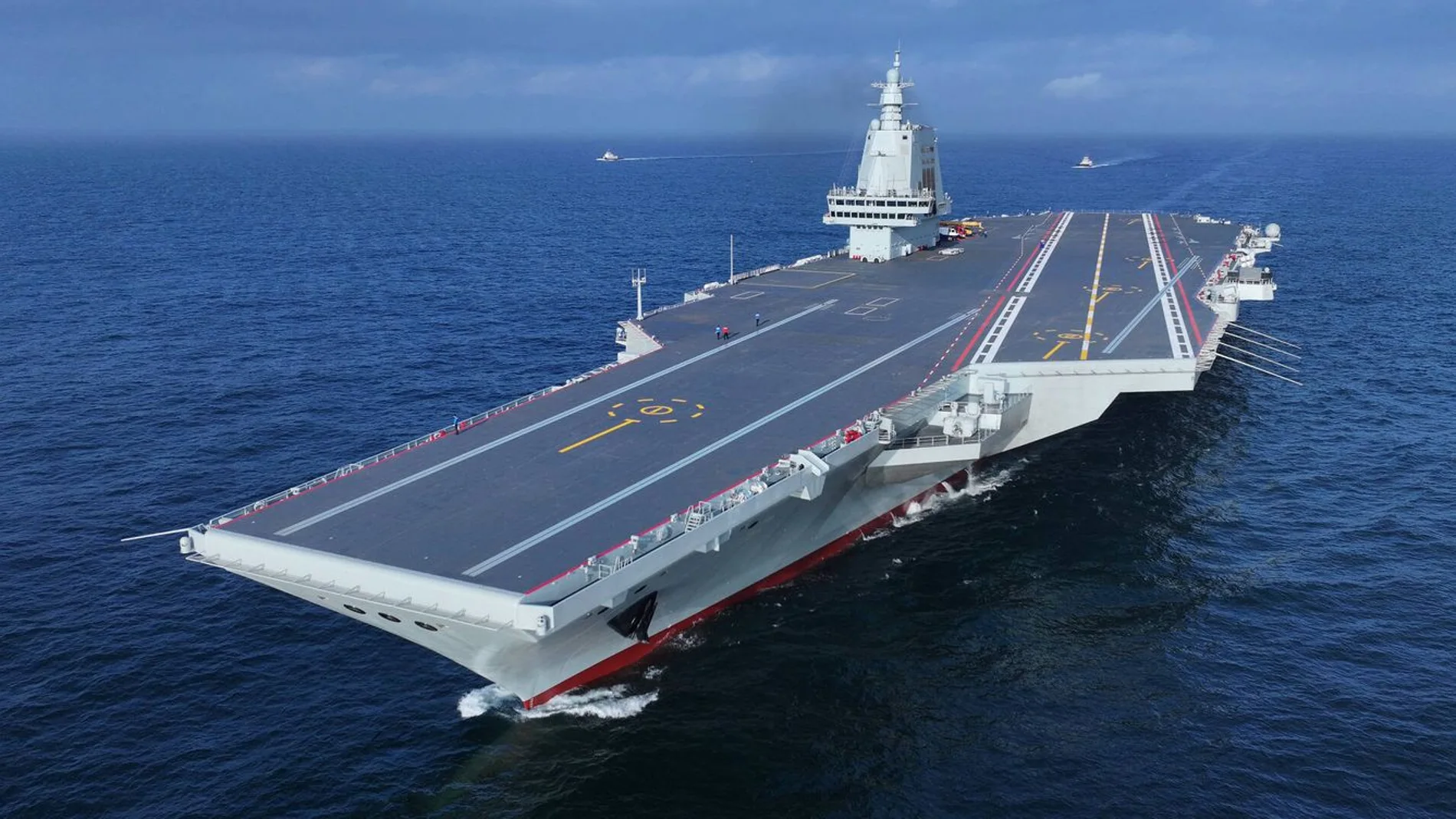
The new aircraft carrier Fujian could give to China a capacity unprecedented in a ship of this type. According to the Chinese military magazine Defense Review, the third aircraft carrier of the People’s Liberation Army Navy would be equipped with an anti-torpedo system intended to intercept underwater weapons before they reach the hull.
The Fujian entered service in November and is the first aircraft carrier designed entirely in China. One of its most striking differences compared to Liaoning and the Shandongthe other two aircraft carriers of the Chinese Navy, is under the flight deck. Instead of the 12-tube depth charge launchers present in them, the Fujian incorporates a 324 mm six-tube launcher which the publication identifies as a system ATTacronym for anti-torpedo torpedo.
If this interpretation is correct and the system is actually operational, the Fujian would be the first aircraft carrier in service in the world with such a submarine defense. The idea is not to deceive the enemy torpedo through acoustic decoys, jamming or evasive maneuvers, but to launch an interceptor against it in the final approach phase.
The threat that justifies this system is heavy torpedoes launched from attack submarines. Defense Review expressly cites the seawolf Americans and the future SSN(X) as a concern for large Chinese surface ships. The article maintains that a heavy wire-guided torpedo can cause even more damage to a warship than an anti-ship missilesince it explodes below the waterline and the water transmits the shock wave with much more force than air, amplifying the damage to the hull and machinery.
China already showed a previous anti-torpedo system in 2016, but the Fujian one would be a more advanced version. The publication assures that it should achieve a very high level in detection accuracy, destructive reliability and integration with the ship’s combat system. He also compares this evolution with the attempts of the United States Navywhich tested anti-torpedo systems in the past decade without deploying them in a general way.
The Chinese interceptor would use a combined propulsion that would allow it to reach between 50 and 60 knots, between 93 and 111 km/hin just three seconds, with little noise so as not to interfere with its own sonar.
First I would use a small rocket to gain speed after launching and then advance by a water jet thruster moved by an electric motor of rare earth permanent magnets, a compact and precise system that could adjust the speed, blade angle and nozzle flow in milliseconds. Thus it would have the ability to perform almost instantaneous maneuvers, rapid course corrections and follow complex S trajectories and sudden depth changes such as those carried out by extremely fast and maneuverable torpedoes, in the case of the American MK48practically without delay.
The anti-torpedo torpedo would carry a broadband sonar array in the head to distinguish a real target from decoys at several thousand meters. I would also have a two-way acoustic link with the aircraft carrier and capacity to coordinate with other interceptors in case of multiple attack.
To destroy the enemy torpedo, the system would combine a directional charge with high energy shock waves generated by a short-range explosion. The magazine even suggests that some versions could use supercavitationa technology that reduces water resistance and would allow speeds of up to 200 knots, about 370 km/h.
The Fujian will continue to rely on escorts, helicopters, anti-submarine aircraft and external sensors to protect itself from enemy submarines. This last defensive barrier underwater is designed to act when the torpedo has already passed all the previous layers.