
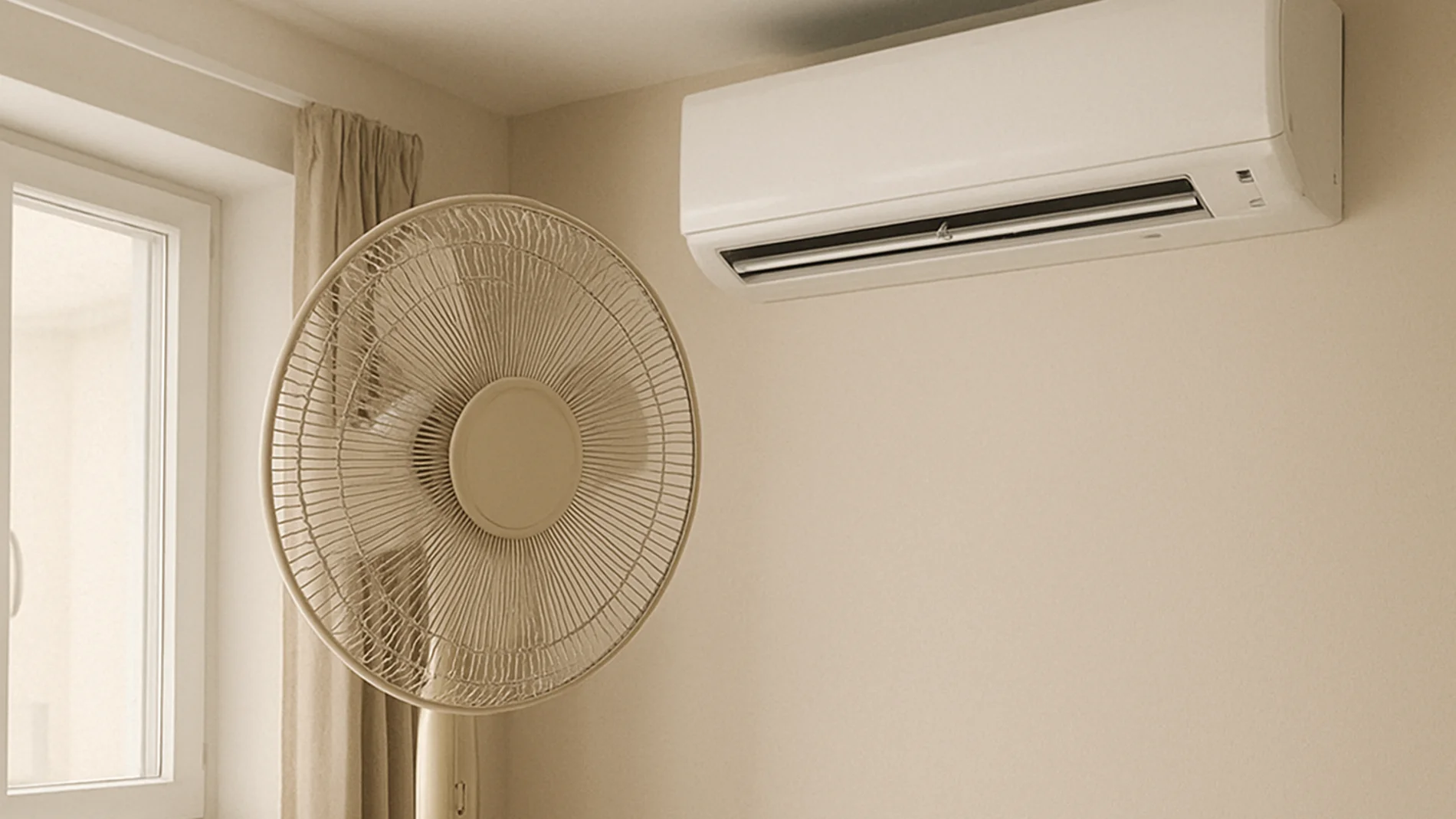
Temperatures have begun to rise and The dreaded tropical nights are getting closer and closer. For this reason, many people are looking for economical alternatives with which they can cool their home and reduce, even a little, the heat of these months. However, many people do not know if choose a standing fan, ceiling fan or air conditioner to leave on all night and help them fall asleep.
He fear that the electricity bill will increase It leads many people not to connect any appliance that cools the home at night. Few are aware that This expense may not be that high. as it seems, especially if different characteristics are taken into account when choosing and the price per kilowatt hour in each time slot.
How much does it cost to leave the air conditioning on at night?
One of the most useful appliances with the arrival of summer is, without a doubt, the air conditioning. Thanks to its power, this device is capable of cooling entire rooms in a short time and maintain the indicated temperature without having to keep an eye on it. However, it also becomes one of the options that consume the most energy and, therefore, more expensive to leave on all night.
Depending on the model installed, standard air conditioners, that is, those installed in homes, usually spend an average of between 900 and 3,000 watts per hour. This high energy expenditure translates into a significant increase in the electricity bill. To calculate it, you only need to convert the figure into kilowatts and multiply it by the price per kilowatt hour established for the time slot in which you want to use it.
If we take into account that the average price per kWh today, May 29, is 0.1457 euros, a device that consumes 2,000 watts per hour It costs 0.29 euros per hour. Therefore, if it is left on for 8 hours, which is usually the recommended time to have a restful sleep, the total expense would be 2.33 euros per night. If it is multiplied by the 30 days that a month usually has, the figure rises to 69.93 euros per month.
How much does it cost to leave a ceiling fan on overnight?
Due to the high cost of leaving an air conditioner on, some homes often opt for cheaper alternatives, such as ceiling fans. Although these are not capable of cooling a room on their own, they do. They are capable of making the room feel cooler due to air movement. This quickly brings relief to those below him.
These ventilation devices usually have a energy consumption of between 10 and 90 watts per houra figure notably lower than that consumed by air conditioning. In case of having a ceiling fan that consumes 70 Wleaving it on overnight will cost 0.08 euros. In a 30-day month, this expense translates to 2.44 euros more on the electricity bill.
It must be taken into account that your price is higher than that of a standing fan and that require a professional to install it. However, although they involve a slightly higher initial cost than a pedestal fan, it is much lower than that of an air conditioner. Likewise, leaving it on all night is usually much cheaper than other options, so it is the best option if you are looking for a permanent solution.
The pedestal fan is not the most economical alternative in the long term
Although the simplest and most popular alternative is usually the standing fan, this could not be the best option if you want a long-term solution. This is because their energy consumption is usually quite similar to that of ceiling fans, even though their power is not as high. Although they are still the perfect option for those people who want a device that they can change rooms based on your needs and for those areas where heat is not so common.
His energy consumption is usually between 25 and 100 Wso have a 65W pedestal fan It has a cost per night of 0.07 euros. This translates into 2.27 euros per month in the final electricity bill. This makes it a much cheaper alternative to air conditioning and easier to install than ceiling fans. However, it is important to know how the number of blades and the type of motor influence to find the model that best suits the needs of each home.