
Neither the PNV nor Junts are seriously thinking today about a motion of censure against Pedro Sánchez. They are thinking about the upcoming municipal elections next year and, above all, about how to prevent general elections from coinciding with the regional and local elections in 2027 on a “super Sunday” that drags all territorial politics towards the national clash between PP and PSOE.
That is the real conversation that is going through the Government’s parliamentary partners right now, much more, of course, than any speculation about immediate moves to overthrow Sánchez.
In private, nationalist leaders admit that simultaneous general elections would turn Euskadi and Catalonia into scenarios subordinate to state polarization, exactly the terrain where parties that live on their own territorial agenda handle themselves the worst.
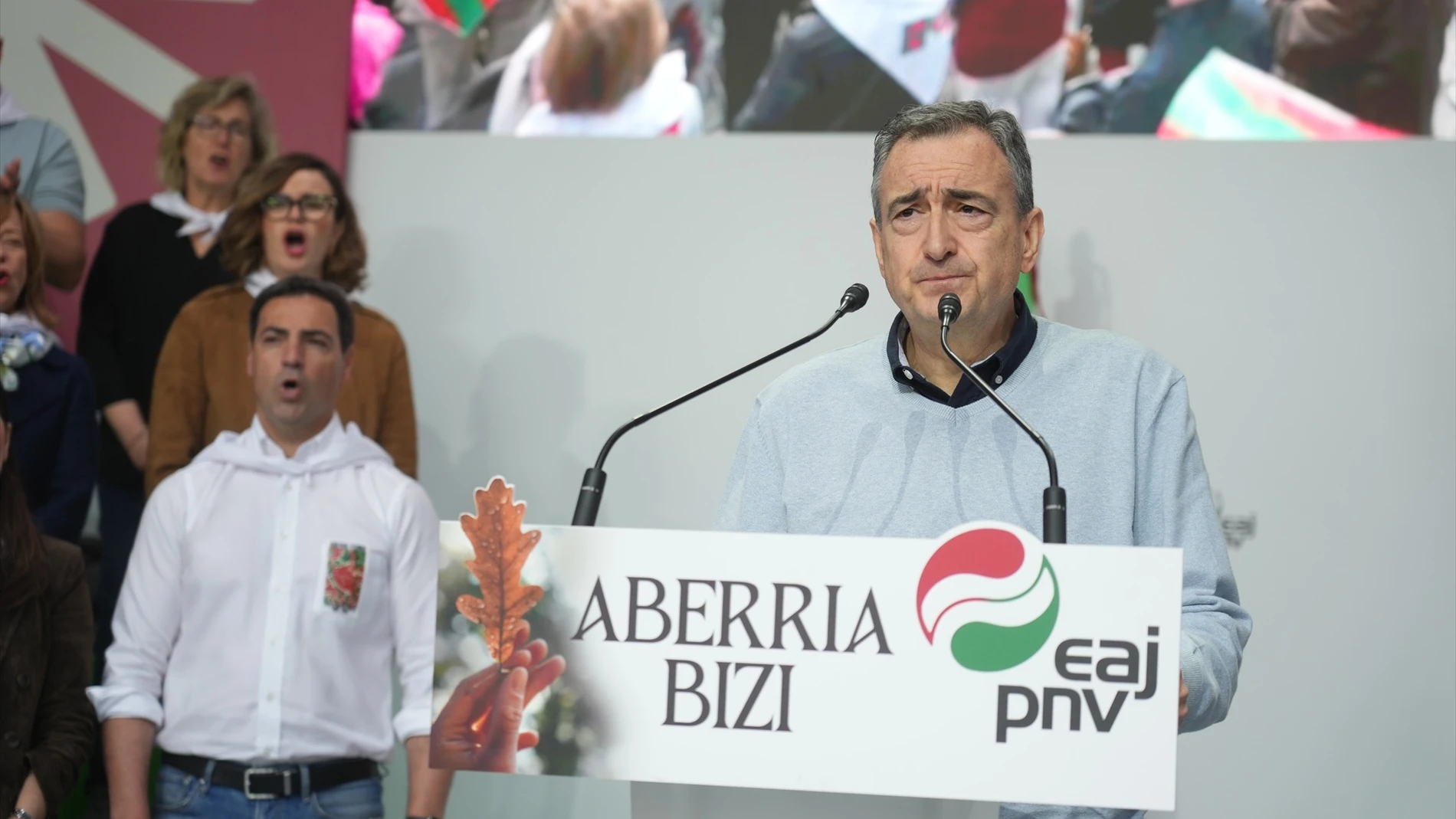
The president of the PNV, Aitor Esteban, verbalized this concern this weekend by warning that the general elections should not go beyond 2026 to avoid, thus, coinciding with municipal and regional elections. In the Peneuvista environment they put on the brakes on interpretations that read those words as a threat of an immediate break with Sánchez or as the anticipation of a motion of censure. The internal analysis is another: The PNV fears being trapped in a state campaign dominated by ideological confrontation, corruption and the Sánchez-Feijóo axis, where the management and self-government debates that traditionally benefit it disappear.
Sabin Etxea is especially concerned that a nationalized campaign will reactivate the constitutionalist useful vote in Euskadi and also fuel competition with Bildu in a plebiscitary manner. The PNV wants to reach the municipal elections defending management, institutional stability and territorial power. Not become a secondary actor in a Spanish political war that he does not control.
The reflection is similar in Junts, although with added complexity. Carles Puigdemont’s party fears that any movement to facilitate an alternative to the PP, supported by Vox, will trigger a total offensive by the independence movement against them. ERC, the CUP and even Aliança Catalana have been preparing the story for months that Junts has abandoned the independence confrontation to become a pragmatic right willing to make an agreement with Madrid.
This risk conditions any parliamentary calculation.
At Junts they are aware that a motion of censure against Sánchez would have an enormous internal cost in Catalonia. Not only because of the ideological erosion, but also because it could leave Puigdemont’s great pending political asset in no man’s land: his definitive return and the construction of a story of political victory after years of processes, amnesty and negotiation with the PSOE. For this reason, although the legislature is going through one of its most delicate moments due to judicial pressure and the political deterioration of the Government, the parliamentary partners are not yet moving in a key of immediate demolition but rather of their own electoral survival. And there the calendar weighs as much as the ideology.
In addition, Junts has been open for a long time an internal discussion increasingly less hidden about what the party’s future strategy should be in the face of Sánchez’s accelerated wear and tear. There are those who believe that it is still advisable to take advantage of the Government’s weakness to continue extracting concessions and those who consider that the political and judicial deterioration of Sanchismo may end up dragging down its partners as well.
The situation is complicated by another delicate factor: the interlocutors between the PSOE and the independence movement (Iván Redondo, Santos Cerdán, José Luis Rodríguez Zapatero) have ended up politically amortized, judicialized or out of circulation after the hardest years of the process and the subsequent negotiations. Puigdemont is still waiting for his return from Catalonia to become effective, while The deadlines committed by the PSOE have been successively delayed.