
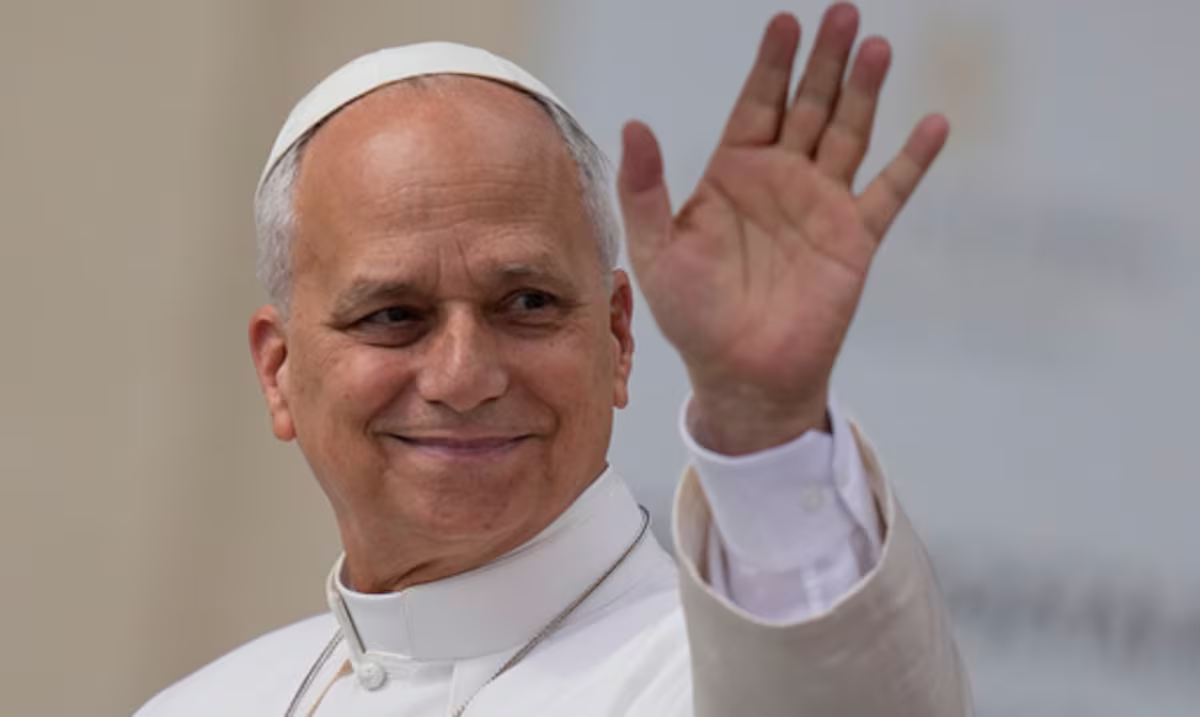
The defense of human dignity in the age of dehumanizing technologies is the great central theme of the first encyclical of Pope Leo XIV, entitled, “Magnifica humanitas” or “Magnificent humanity,” in Spanish. The document, published by the Vatican on May 25, was signed on the 15th of the same month, coinciding with the 135th anniversary of the document that paved the way for what would later be known as the Social Doctrine of the Catholic Church, the encyclical “Rerum novarum”, by Pope Leo XIII. Throughout 235 points, the pope offers a warning in the face of a world increasingly dominated by technologies such as Artificial Intelligence (AI) and, at the same time, several ways to confront them.
Here are some of the highlights of “Magnifica humanitas”:
A new tower of Babel
From the introduction of the document, Leo XIV places examples that he threads throughout the entire encyclical and that give a solid theological basis to the reasoning he discusses. The pontiff begins by comparing the current era of humanity with one of the best-known biblical stories from the Old Testament: the rising of the tower of Babel. The pope argues that humanity faces a crucial decision in which it must choose between the erection of a new tower of Babel, a symbol of human prideor the building of a new city in which God and humanity live together, making a direct comparison to the story of the prophet Nehemiah, remembering that in his mission, “he does not impose solutions from above”, but rather shows how the city is reborn not thanks to the initiative of a single person, but through the shared responsibility of the entire people: priests, artisans, heads of families, women and young people.
1/100 | This has been the first year of Leo XIV’s pontificate: 100 images of key moments. The historical moment when the conclave elected Leo XIV as the new pope. – ANDREJ ISAKOVIC
“Each generation receives as an inheritance the task of shaping its own time: making history mature as a place where the dignity of each person is protected, justice is promoted and fraternity is made possible. But in each era there looms the risk of building an inhuman and more unjust world,” León explains in the introduction.
Technology and the destiny of people
In the same introduction, the pontiff recognizes the importance that technology has had in the development of human life, but also highlights that the instruments that have allowed these advances are not morally ambiguous tools, but have been used to cause harm.
“Today, however, we find ourselves facing a new situation, in which the power and omnipresence of emerging technologies are intertwined with the fabric of daily life, shaping decision-making processes and deeply affecting the collective imagination: “Never has humanity had so much power over itself.” New technologies open a horizon that extends in directions that, although intuitive, we cannot yet fully foresee. This makes it more complex to evaluate its impact and its long-term effects on the dignity of people and the common good,” the document states.
Given this, the pope poses questions that he considers unavoidable to determine the future of these innovations and their role in society: where are we going? Towards which goal do we want to orient ourselves? What direction to choose as a human community and as peoples?
The role of technology
“Technology can heal, connect, educate, care for the common Home; but it can also divide, discard, generate new injustices. In the abstract, this, in itself, is not a solution to humanity’s problems, nor is it an evil in itself; but, concretely, it is not neutral, because it takes on the face of whoever conceives it, finances it, regulates it, uses it,” the pontiff explains in the encyclical.
León calls to avoid what he describes as the “Babel syndrome”: the idolatry of profit that sacrifices the weak, the uniformity that flattens differences, the pretension of a single language—even digital—capable of translating everything, even the mystery of the person, into data and performance. The reason being that by falling into this way of seeing things there is a great risk of falling into dehumanization. Faced with this increasingly growing temptation, the Pope insists on the duty to remain deeply human, to guard the love of that “magnificent humanity” that no machine can ever replace.
Artificial Intelligence vs. real humanity
In point 85 of the document, the pope maintains that technological innovations, including Artificial Intelligence (AI), are not neutral and that they can be used for the benefit or detriment of societies, being exploited to expand inequalities, control and exclusion. Here, once again, León invites the questioning of these technologies: do they really contribute to making people and towns grow in humanity and fraternity, in respect for the common Home and future generations?
The pontiff makes a clear distinction between human intelligence and AI, making it clear in point 99 that they are not comparable elements in any way, since the latter and its manifestations “do not live an experience, do not possess a body, do not go through joy and pain, do not mature in relationships or know from within what love, work, friendship and responsibility mean. Nor do they have a moral conscience: they do not judge good and evil, they do not grasp the ultimate meaning of situations or assume the weight of The consequences are just mere imitations that do not know what they produce, because they do not reside in the affective, relational and spiritual horizon in which the human being becomes wise.
AI and morality
In point 103, the pope explains that the practice of allowing an algorithm to have the power to select who is worthy of life or not, without anyone assuming the weight of that decision, decreases empathy towards the excluded and, above all, political responsibility, since the action of discarding the weak is reduced to a neutrality and objectivity against which it is impossible to protest, thus allowing injustice to be carried out silently and compassion, mercy and forgiveness, not as a simple appearance, but as political gestures, disappear from the horizon.
1 / 15 | “Choose peace!” Pope Leo XIV condemns wars in his first Easter mass. Pope Leo XIV celebrated his first Easter Mass as pontiff on Sunday with a call to lay down arms and seek peace in global conflicts through dialogue. -Alessandra Tarantino
“Disarming AI means removing it from the logic of arms competition, which today is no longer just military but economic and cognitive. It is the race for the most effective algorithm and the most extensive data bank, to consolidate a geopolitical or commercial advantage over all the others. Disarming means breaking this equivalence between technological power and the right to govern. Disarming does not mean giving up technology, but preventing it from dominating the human. It means removing it from monopolies, making it debatable, refutable, and therefore habitable, reestablishing in it the plurality of human cultures and forms of life.”, reads point 110 of the document.
The search for truth as a perpetual mission
The pope is very concerned about the role of truth in a society in which it increasingly seems like an element that can be detached. This, he argues, is a serious blow to democracy and paves the way for violent forms of government.
It says in point 134: “Disinterest in the truth leads slowly but inexorably towards totalitarianism, for which, as the philosopher Hannah Arendt wrote, the ideal subjects are not so much those who are ideologically convinced, but rather “the people for whom the distinction between fact and fiction (i.e., the reality of experience) and the distinction between the true and the false (i.e., the norms of thought) no longer exists.”
Given this, he offers as a response not to demonize or idolize the media, but to manage them by seeing the truth as a common good and not a property of those with power or visibility, placing special emphasis on what he calls “communication ecology”: establishing rules that make the criteria with which content is selected and amplified more transparent and that protect personal data, the strengthening of intermediate organizations, serious journalism and spaces for debate in which argumentation and verification prevail over immediate reaction.
Technology as a new form of slavery and colonialism
“If a technology promises emancipation, but produces new forms of global subordination, it contradicts the fundamental principle of the dignity of the person,” reads the document in point 173.
The pope explains that due to the silent way in which large technology companies operate, colonialism has acquired a type of invisibility. It no longer only dominates bodies, but also appropriates data, transforming personal lives into exploitable information. León points out the particular vulnerability of entire territories, especially those with less geopolitical relevance and greater structural fragility that are traversed by this new logic of extraction.
A human solution to a human problem
At the end of the encyclical, the pope recalls the words of the writer JRR Tolkien, author of “The Lord of the Rings”: “It is not for us to dominate all the tides of the world, but to do what is in our power for the good of the days in which we have lived, extirpating evil in the fields we know, and leaving those who will come after a clean land for tillage.”
With them, León explains that daily and public responsibility is a possible way to face this new reality and proposes five ways: dismantling words, building peace in justice, assuming the perspective of the victims, cultivating a healthy realism and relaunching dialogue and multilateralism.
Above all, the pope insists on the need to abandon individualism, recognizing, in its place, the human being as a creature in relation to all creation.
“In the humble fidelity of each day, the time of AI can also be a step in which the Spirit matures the civilization of love in our lives; the Lord continues to make all things new and keeps open for each age the possibility of becoming a history of salvation in the light of the Incarnation. I entrust this wish to the Mother of Christ, to the woman of the Magnificat, so that she may accompany our steps in the present that changes and guard in each of us trust in the Gospel, so that we can witness the beauty of a magnificent humanity inhabited by God,” the document concludes.