
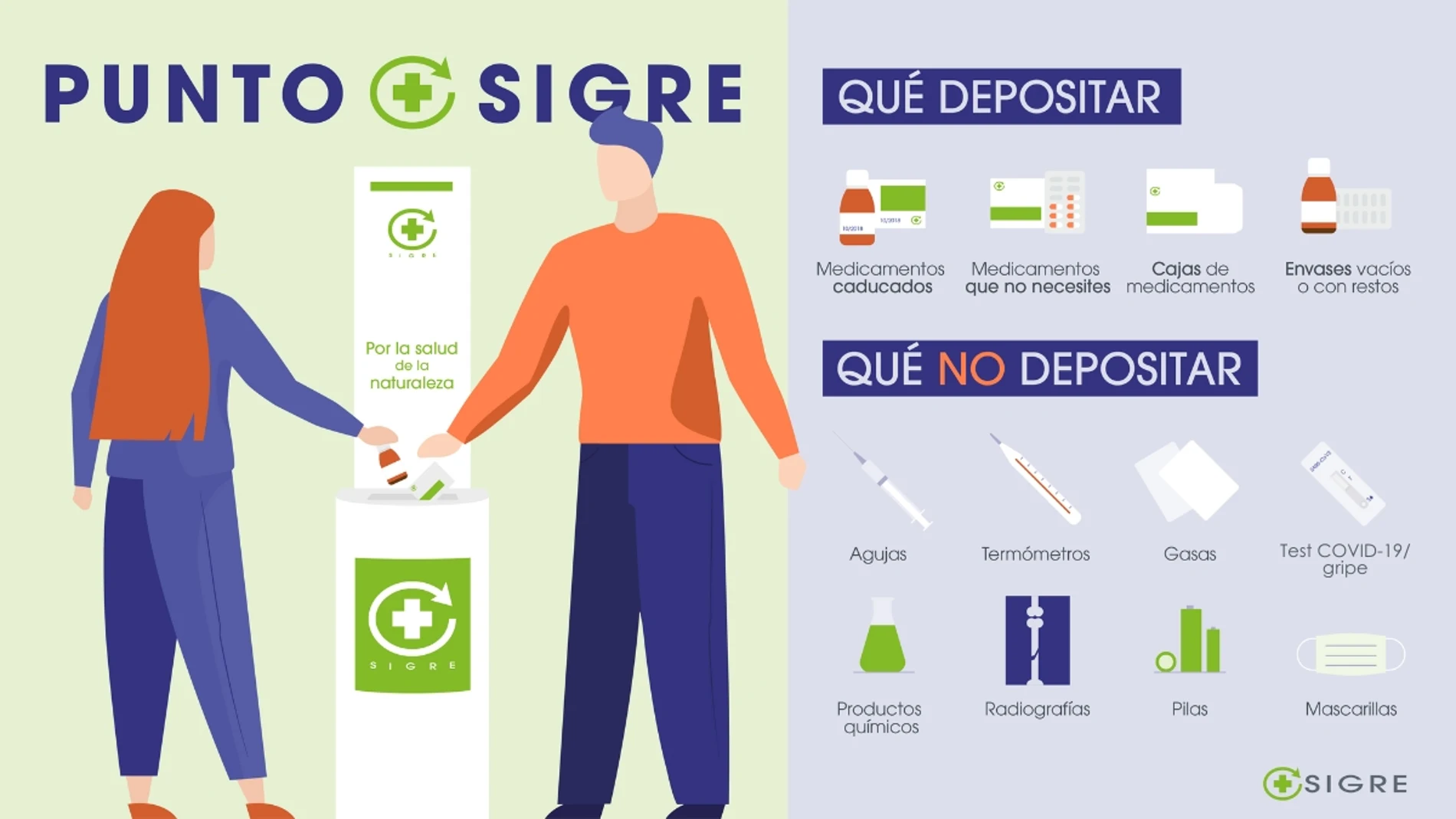
Citizen commitment to recycling is a reality that grows every year. In the case of medicines and their packaging, proof is that in 2025 the total number of empty containers or those with remains of medicine deposited at Sigre Points was 5% higher compared to the previous year, according to Sigre data.
This gesture, carried out by the two million citizens who visit pharmacies daily, allows Sigre, – the entity in charge of guaranteeing the correct environmental management of the remains of medicines and their packaging generated in homes -, to perform an essential function to achieve four objectives, all related and all with positive impact. One of them, also essential, is to take care of public health.
Four benefits
The first is to prevent leftover or expired medications from remaining in homes with the risk of inappropriate consumption. Therefore, it is advisable to check your home medicine cabinet periodically and remove whatever is in those two categories.
The second is to make possible the correct environmental treatment of the remains of medicines and their packaging. Throwing them in the trash or the toilet is not an option, because they pose a clear risk of contaminating rivers and soils.
The third is the recovery of all the materials that these containers contain, paper, glass, plastics, aluminum, etc. for recycling. It is the circular economy, which ultimately reduces the extraction of non-renewable raw materials and the resulting environmental impacts. And, as a culmination of all this and by extension, the protection of the health of the planet and, linked to it, human health.
One Health
Recycling, in this case that of medicines and their packaging, is also a public health measure. «When we reduce waste, reuse materials and recycle correctly, we reduce soil, water and air pollution; “We prevent plastics, metals or poorly managed organic waste from affecting animals, food chains and human communities.” explains Miguel Vega, general director of Sigre. He adds: «The World Health Organization estimates that 23% of deaths in the world are related to the environment. “There are more than 12 million people every year around the planet.”
For this reason, the interrelationship between the health of the living beings that inhabit the planet and the environment is known as One Health.
This approach is an essential framework for addressing global health and environmental problems. The certainties about the link that exists between human health and planetary health demand that the important threats represented by the loss of biodiversity, the contamination of ecosystems and climate change be addressed comprehensively and with coordinated actions. In this context, World Recycling Day, on May 17, is an opportune moment to focus attention on the linear, use-and-throw consumption model to focus on the circular use-recycle-reuse model. “Because recycling,” explains Vega, “acts on an environmental cause that ends up having health consequences, such as soil, water and air pollution, or plastics, metals and other garbage affecting animals, food chains, and human communities.” Finally, it is not just about eliminating waste and pollution, but what it is about is preventing them from their origin: “less extraction of raw materials, fewer landfills, fewer emissions, less exposure to toxins and less pressure on habitats,” summarizes Miguel Vega.
Beyond our environment
The general director of Sigre also reflects on the fact that “recycling has an ethical and educational component, which shows how our daily decisions have effects far beyond our own environment and interest: on other living beings, on future generations and in remote territories.”
All of this encompasses the One Health concept, which expands the vision to show that it is not enough to take care of individual health, but that it is interconnected with the ecological conditions that make it possible, “with which Sigre identifies and, therefore, defines our activity. In which, in addition, the entire pharmaceutical chain collaborates, from citizens to the industry. And that, after 25 years of operation, it is consolidated.
Which, on the other hand, as Vega emphasizes, “does not at all mean that we do not consider new challenges and advances in awareness, separation, waste prevention and sustainability of pharmaceutical packaging through eco-design.”