
For decades, a tank was, above all, a matter of steel and the progression was logical: more armor, a bigger gun, more weight. The objective was to outlast the enemy and hit harder. But recent wars, especially in Ukraine, have begun to shatter that idea. Today, A relatively cheap drone can destroy a multi-million euro vehicle from several kilometers away. And that forces us to rethink what it really means to “protect” a tank.
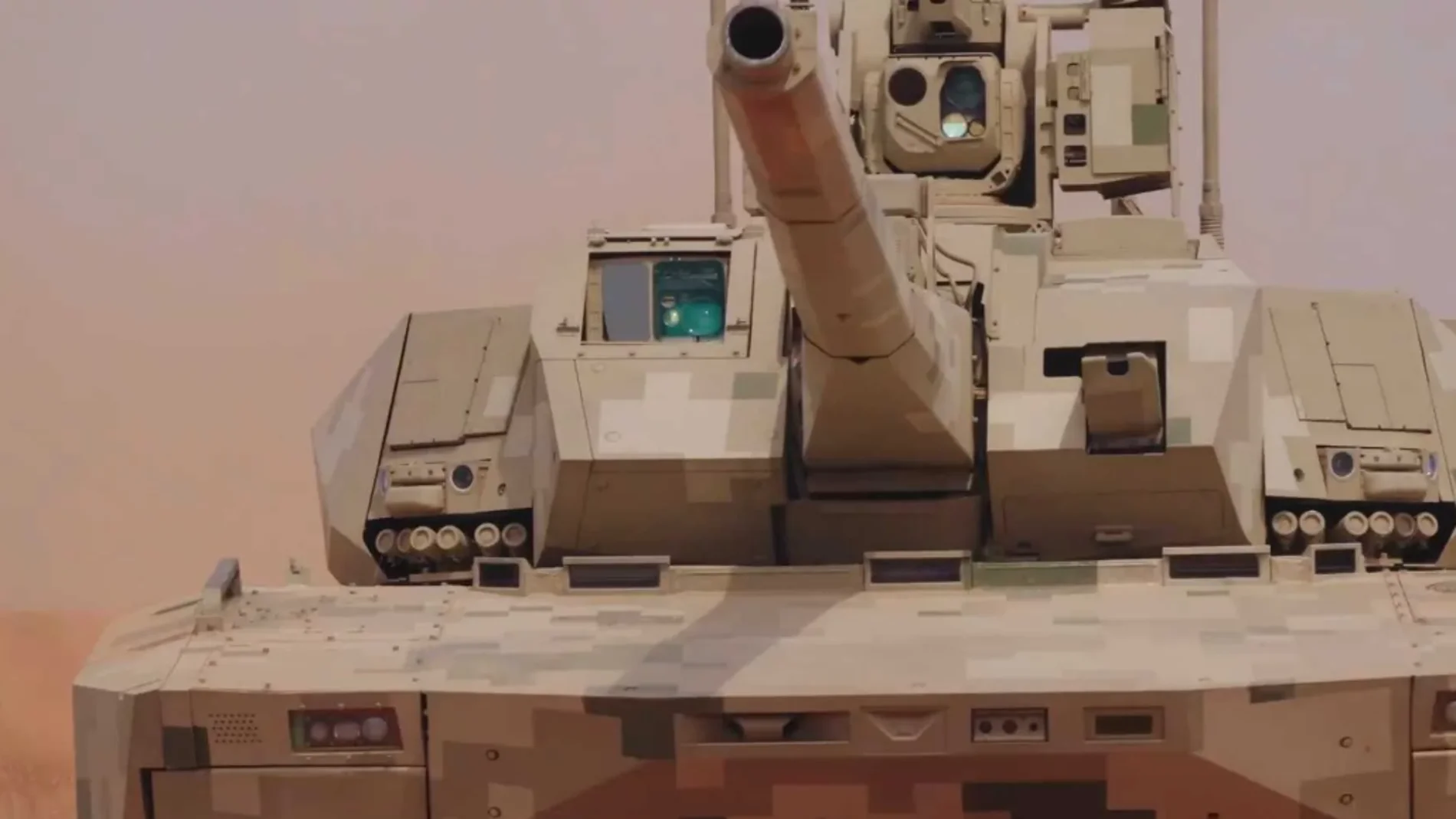
China appears to have taken that lesson on board. And the new Type-100 or ZTZ-100, which has just officially entered service with the People’s Liberation Army, is perhaps the best proof of this. The first images released by the Chinese Ministry of Defense show something that It looks less like a classic tank and more like a tracked digital platform. The vehicle abandons part of the traditional philosophy of heavy combat tanks to focus on sensors, automation and connected warfare.
The first big change is that the Type-100 uses an unmanned turret. The crew (three people) remains encapsulated in the front part of the hull, physically separated from the ammunition. The idea is simple: If the tank receives a critical hit, the chances of survival increase. The human charger disappears; Now that function is performed by an automatic system.
Another innovative feature is how the tank “sees” the battlefield. Traditional optical systems and many of the periscopes have been replaced by cameras, radars and augmented reality helmets that offer a 360-degree view to the operator. Instead of looking directly through a peephole, the crew receives a kind of digital environment built from external sensors.
Thus, the tank stops depending solely on human vision and begins to function as an information node. The vehicle collects data, merges it and shares it with dronesartillery units and other connected vehicles. According to Chinese military media, the goal is to create “intelligent, computerized and unmanned” warfare.
That’s why the Chinese tank prioritizes active protection systems against the massive increase in armor. Instead of relying solely on steel plates, it incorporates interceptors capable of destroying anti-tank missiles or drones before they impact the vehicle.
It is also lighter than previous models such as the Type-99. Some estimates place its weight between 35 and 45 tons, while the previous version reached 54 tons.. This improves mobility and reduces consumption, especially thanks to its diesel-electric hybrid system.
That detail is not minor. Hybrid propulsion allows something that a few years ago seemed almost contradictory in a tank: moving temporarily in silence, with a lower thermal and acoustic signature. In an environment saturated with drones and infrared sensors, “making less noise” may be as important as having more shielding.
He Main armament remains a 105 mm cannon, smaller than many modern Western tanks.but compensated, according to Chinese sources, with high-velocity ammunition and advanced targeting systems. However, the most interesting debate may not be technical, but conceptual. Because the Type-100 seems to assume that the tank of the future will not necessarily be the heaviest or the most resistant, but rather the most connected.