
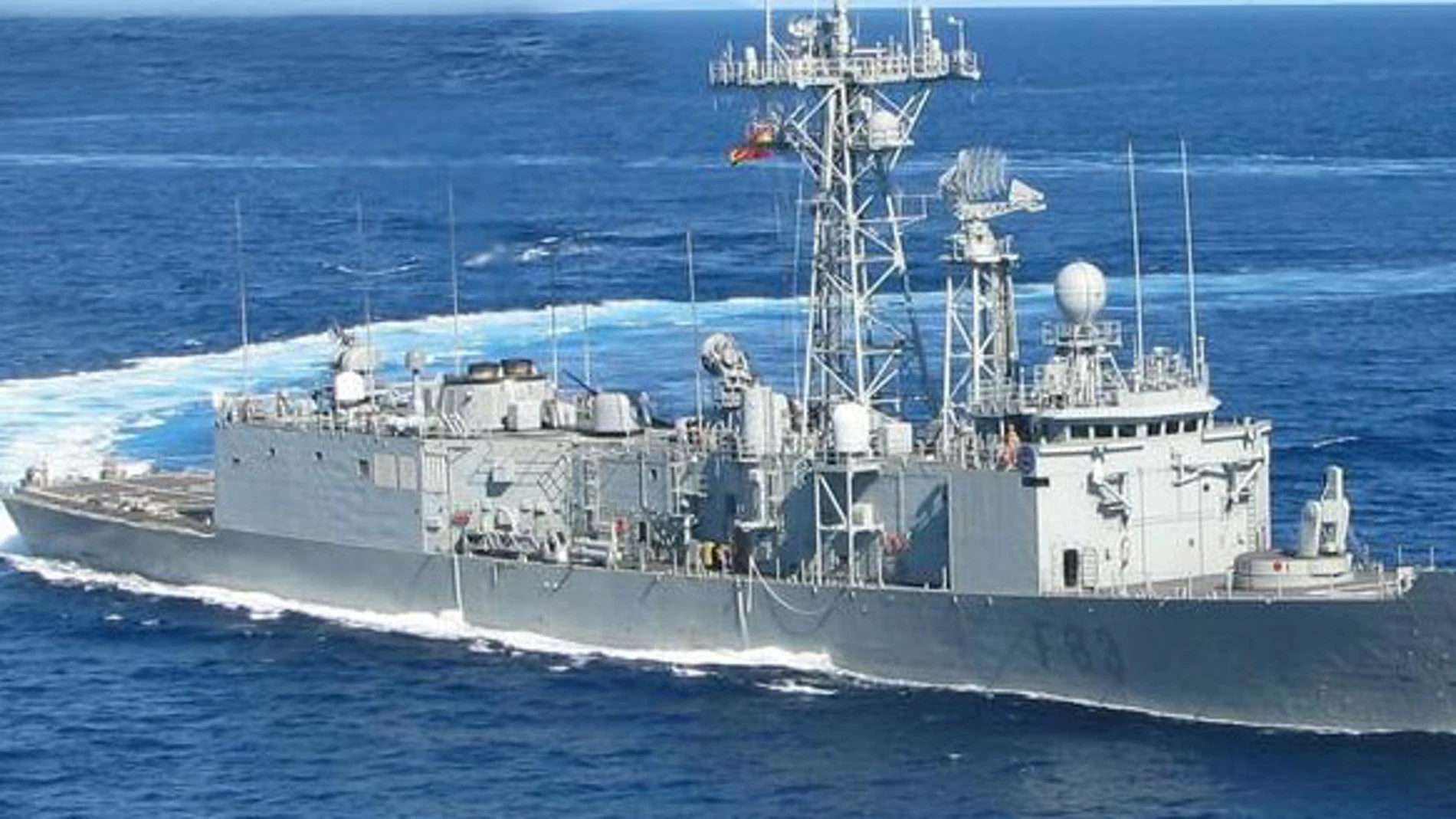
New technological trends have not only created new forms of communication, but have also transformed war conflicts. Given the increase in the use of drones in military operations, the Spanish Navy has carried out tests of the Crow anti-drone system with the frigate Numancia. Some exercises carried out at the Rota Naval Base, in Cádiz, in which the effectiveness of the system to neutralize unmanned aerial threats.
The tests lasted three days, in which the Armed forces They were able to see the functions of the Crow anti-drone systemdeveloped by Indra. This system is also operational in the Air and Space Army and is characterized by detecting, identifying, tracking and neutralizing unmanned aerial threats such as drones. All thanks to high resolution radars and electro-optical sensors, which are capable of finding small aircraft.
During the tests, launches of drones of different sizesflight forms and characteristics from the frigate Numancia and the tugboat La Grañawhich allowed us to observe its effectiveness in different scenarios. All this thanks to the direction of the Navy Combat Evaluation Center and to collaboration with those responsible for civil development of the system and professional pilots of unmanned aircraft.
The Crow anti-drone system is capable of detecting small drones and distinguishing between threats and legal activities
One of the main strengths of the Crow anti-drone system is its ability toect microdrones commercial aircraft and swarms of coordinated unmanned aircraft, which could cause a saturation of the Spanish defenses. Therefore, the implementation of this system and the tests demonstrate an update of the capabilities of the Spanish Navy, betting on a technology capable of complement and reinforce your available assets.
This system was created to be able to deal with scenarios in which there is a real air threatsince its optronic system is capable of detecting when an activity is legal and when it will lead to a hostile attack. Once the presence of an enemy drone is confirmed, the Crow deploys a series of measures such as RF jamming and GNSS jamming, which nullifies its offensive capacity. Likewise, it is possible to add systems to expand its defensive capacity, creating protective bubbles.
This system has been implemented in both the Air and Space Army and the Spanish Navy.
Beyond their technical capabilitiesthis system also has the capacity to be implemented on different platforms, both on land and on ships. This wide range of adaptability has enabled its presence in both the Spanish Navy and the Air and Space Army, improving the capabilities of the Armed Forces Spanish in all scenarios. For this reason, the tests carried out with the frigate Numancia show the possibility of its implementation in onboard systems and expanding its protection work against different types of unmanned threats.
It should be remembered that the frigate F-83 or Numancia It is a Santa María class ship that has participated in different national and international operations. The first war zone in which it was assigned was the Persian Gulf area, during the embargo prior to the Gulf War against Iraq. Since then, it participated in the first air strikes on Iraq, joined NATO groups and participated in the Operation Atalantabeing deployed in areas such as the Gulf of Aden or the coasts of Somalia.
Furthermore, the NATO has also tested the Crow anti-drone system during the “blind” exercises of the Operation Performance Challenge. Specifically, its compatibility with other technologies, both existing and new, was verified, demonstrating that it did not require major modifications to be able to combine with the tools already present in the armies. All thanks to a command and control system that can be configured to respond to the needs that arise.