
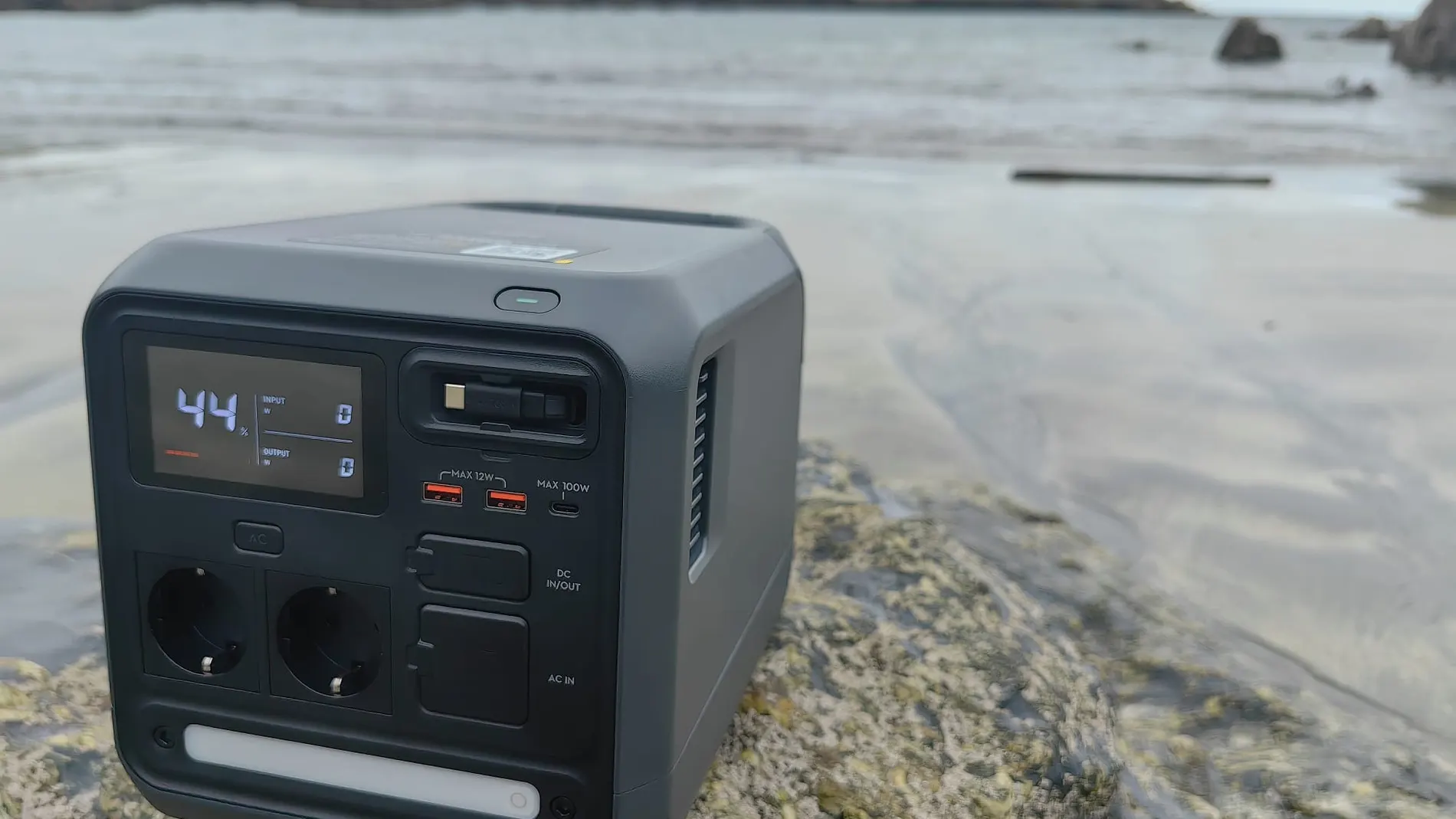
We had already tested the DJI Power 2000, the Power 1000 and now it was the mini version of the latter. There’s an interesting paradox about this new DJI charging station: everything about it seems designed to be discreet. It is compact, transportable, its design goes almost unnoticed, but as soon as you start using it, It behaves like a system. And one whose size, similar to a shoe box, has several surprises.
The first thing that surprises you is its scale. With only about 11.5 kg and dimensions that place it practically halfway between a large powerbank and a complete stationthe Power 1000 Mini breaks one of the usual rules of the sector: the more capacity, the more volume. Not here.
With its 1008 Wh capacity (hence its “last name”) we are in serious territory: enough to charge cameras, drones, laptops or even small appliances, but in a format that you can really take with you without thinking too much about it. One of the most successful points is how DJI has solved connectivity. Everything is concentrated in the front, clean and accessible. There is no empty minimalism here: there is pure functionality.
The station includes 2 AC outlets, 2 USB-A ports, 1 “normal” USB-C and one with integrated 100W retractable cablein addition to the specific SDC port for accessories and drones. That detail of the integrated cable is more important than it seems. It’s not just comfort: it’s eliminating friction. Do not search for cables, forget adapters and avoid moving the charging station. Simply pull and connect. And on a day-to-day basis, this is appreciated more than any technical figure..
Potentially… it is worth being honest: it is not a station designed to power an entire house. Your departure continuous around 800 W (up to 1000 W peak), which places it in an intermediate category. But that apparent limitation is actually a design decision. Thanks to this I was able to charge two cell phones, a tablet, a laptop and a drone… simultaneously. And twice minimum. The best thing is that then it took me just over an hour to refill the 1000 Mini and get it working again. And what surprised me most, favorably, was that in about 50 minutes I already had 80%.
But what is interesting is not only the speed, but the versatility. I could choose to charge it with the electrical grid (the fastest option), with the car battery and with solar energy… In the latter case it depends a lot on the intensity, but the minimum is four hours. The good news is that we can charge a mobile phone while using the solar panel (not included). Important question: should we buy a solar panel? DJI’s cheapest option is €150. The DJI Power Mini 1000 is priced at €579. We are looking at a little more than 700 euros. It is an investment that, At least it will last about 4,000 charge cycles thanks to the use of LFP batteries (lithium iron phosphate). This means that if we charge it once a day, the performance should maintain for just over 10 years. It is 70 euros per year.
And another important detail, the DJI Power Mini 1000 is not only compatible with solar panels: it is designed for them thanks to its MPPT controller (Maximum Power Point Tracking). Basically it is about an algorithm that optimizes charging efficiency: up to 30% more performance. In my personal opinion, for use on the road and with various devices, the solar panel is a highly recommended extra. If the use is going to be for an emergency at home, it doesn’t make sense. To demonstrate its capacity, a few examples are enough: It allows you to charge a mobile phone 55 times, a laptop 9 times, a drone 8 times and a portable console 50 times.
Verdict
The Power 1000 Mini does not try to be the most powerful or the most complete on the market. It does seek to be the most efficient kilo by kilo, watt by watt. And with just over 11 kilos he achieves it. And in doing so it makes portable power truly portable. It is the closest thing to a beastly external battery that currently exists. And I have found that that is more useful than any record number.