
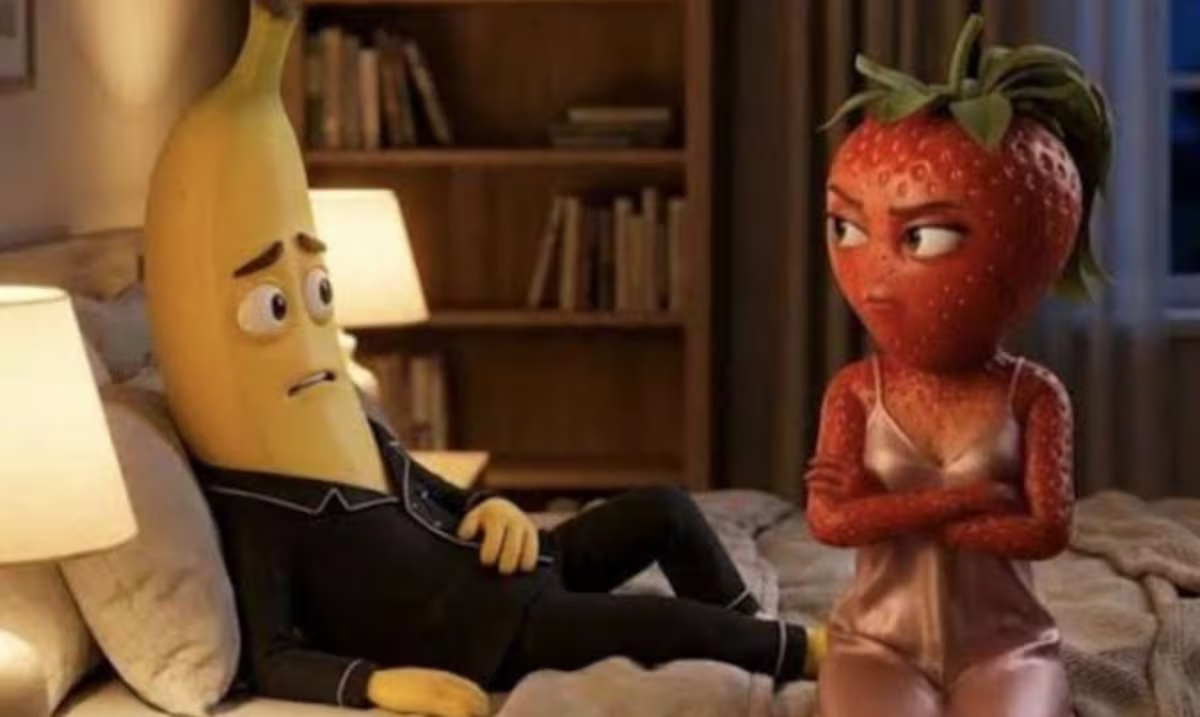
Family dramas, love betrayals and personal revenge are no longer the exclusive territory of flesh and blood actors; fruits and vegetables generated by artificial intelligence (AI) are the protagonists of the “frutinovelas”a new audiovisual format that parodies classic soap operas and accumulates millions of interactions on networks.
In the dizzying ecosystem of TikTok and Instagram, the new drama stars muscular bananas, spiteful strawberries and vengeful apples.
The gallant and unfaithful Black Banana contrasts with the character of “The apple”which represents the traditional and conservative wife.
They coexist with others like the peach Durazgelaa naive and very attractive young woman, or Strawberrythe seductive “homewrecker” par excellence.
The “frutinovelas” are microdramas which demonstrate that the AI is transforming audiovisual production. Quick formats lasting one to three minutes that, despite their comic and surreal appearance, replicate the codes of traditional melodrama and ‘reality shows’accumulating millions of views (some videos have reached 300 million).
“They have the perfect cocktail to succeed because you get hooked with zero effort and it covers up unpleasant emotions that we have had throughout the day,” explains psychologist Silvia Álava.
Despite its humorous veneer, the phenomenon has not been without controversy. In an era that boasts of having advanced in the gender perspective, banishing clichés and stereotypes that promote inequality in relationships, family structures and sexuality, the format that today reigns in networks goes in exactly the opposite direction.
Far from offering modern models, the characters in the “frutinovelas” openly contribute to hypersexualization and the most rancid sexist biases.
The “female fruits” They are relegated to two archetypes: the self-sacrificing, long-suffering and submissive wife (represented by a traditional apple) or the hypersexualized, vengeful and “home-wrecking” villainess (a passionate strawberry, dressed in a suggestive way).
Of course, the male protagonists, like Banana, perpetuate the role of the tough “bad boy” or the womanizing heartthrob, whose toxic attitudes are romanticized or justified by the plot.
Extreme jealousy, ruthless revenge and partner control, packaged in an animated format that relativizes its impact and normalizes unequal power relations.
The dark side, a “fried brain”
Psychologists and sociologists warn of the dark side of “frutinovelas” and raise alarms about the underlying content of these videos, which they link to the “brain rot” phenomenon, an expression used to refer to low-quality internet content and the effect it has on the people who consume it.
Álava warns that this type of content “hacks the brain’s attention”, creates a “flat encephalogram, without critical capacity” and makes it “much more difficult for us to concentrate on other things or develop a working hypothesis that involves a more elaborate development.”
The creator of the original format that sparked the phenomenon is William Andres Ricoa young Colombian student. What began as a university exercise to practice narrative and scenario continuity, led to the project “FrutyStory”the original account, which has accumulated almost a million followers on TikTok in just five weeks.
Unlike million-dollar television productions, the “recording studio” of a “frutinovela” fits on a laptop.
The process, now replicated by thousands of creators, is based on a workflow with tools like ChatGPTto create the plot, and programs specialized in creating avatars and that allow synchronizing the lips of fruits with audio generated by AI.