
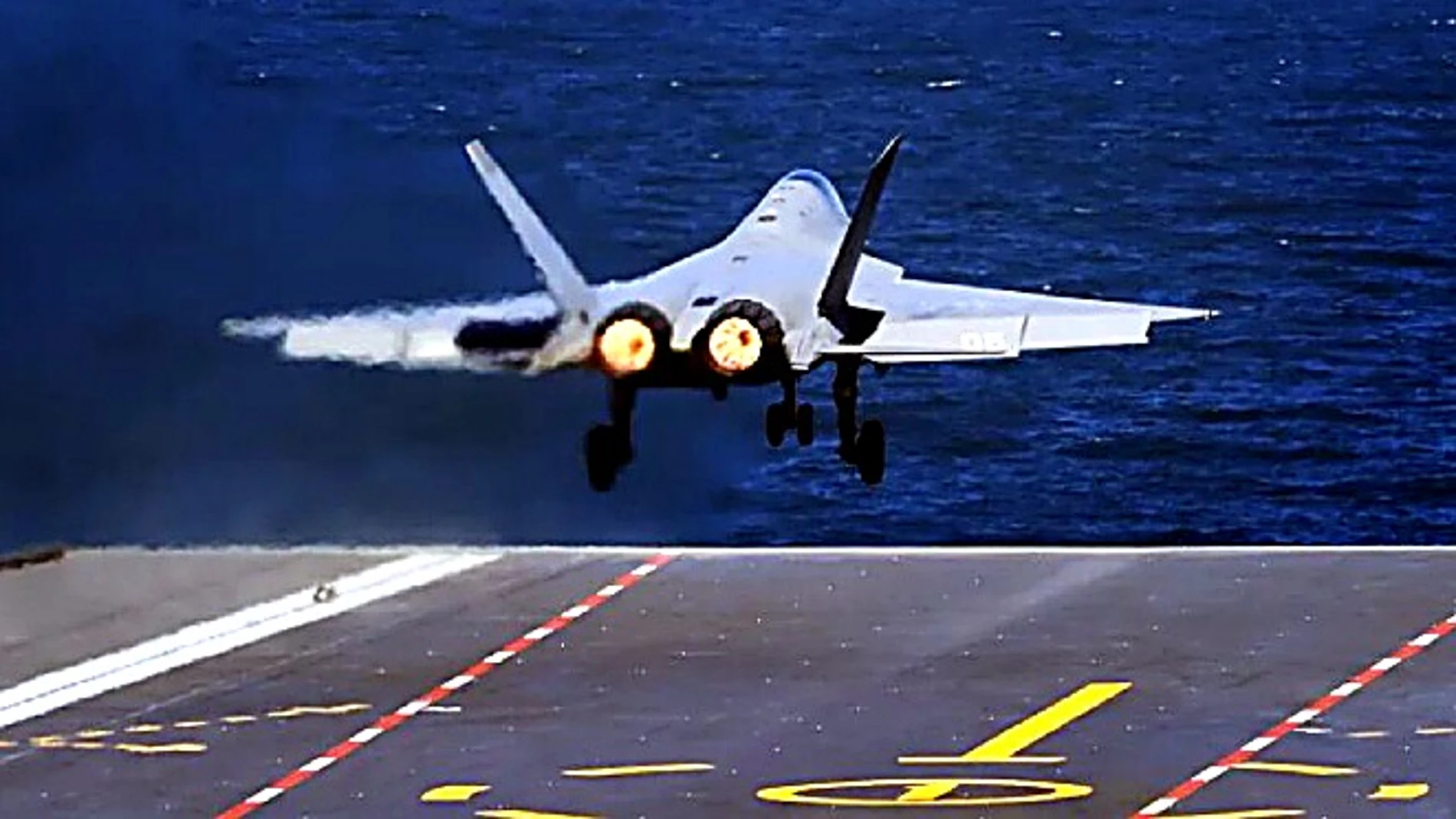
China has the habit of nicknameing its ground fighters with variants of the name ‘Dragon’ and their fighters embarked with those of ‘Shark’. Thus, at Shenyang J-15 is known as ‘Flying Shark’while the J-15D received the name of ‘Electric Shark’. In that line, the Shenyang Aeronautical Corporation has announced that the official name of the new naval stealth fighter of the People’s Liberation Army is ‘Blue Shark’‘Blue Shark’ in Spanish. Beyond curiosity, formalizing its name indicates that the aircraft is passing from the development phase to early operational integration within its naval air branch, according to Army Recognition.
The one until now known as the naval version of the Shenyang J-35A has a similar role to that of F-35C ‘Lightning’ in the United States Armed Forceshaving stealth capabilities and being designed to operate from aircraft carriers. Being close to its operational phase, China becomes in the second country in the world, after the United States, to have two models of stealth fightersadding it to Chengdu J-20also called ‘Mighty Dragon’ either ‘Mighty Dragon’.
The J-35 is an airplane single-seater and multipurposemeaning it can carry out air combat and strike missions. The device provides the Chinese Navy with the ability to operate from an aircraft carrier in heavily defended areas.
The Shenyang Aeronautical Corporation announced the name last Thursday, April 23, confirming rumors that emerged in the Zhuhai Air Show November 2024 on its name.
The aircraft has come a long way since its first official test flight in October 2012. Redesigns, better engines and improvements in stealth and aerodynamics culminated in its first catapult launch test in 2021.
Although it is primarily designed for use by the Chinese Navy, there is also a land-based variant called the J-35A. The onboard version incorporates many of the features necessary to operate from aircraft carriers, including folding wings and heavily reinforced landing gear.
It also has a landing hook and a catapult attachment system to operate from China’s most modern aircraft carriers, such as the Fujian. However, what is most relevant to China is the J-35’s stealth capability.
It has internal weapons bays and an angular fuselagedesigned to deflect radar waves and reduce their detectability. The plane too hides the front of the engines using S-shaped intake ductsdesigned to reduce their visibility to radar.
According to the media, the J-35 also offers a very flexible weapons carrying capacity. It can carry a combination of missiles or bombs internally, but also has the ability to mount ammunition externally at six hardpoints when necessary.
This includes some of China’s most advanced missiles, such as the PL-15 and the PL-21. Its combat radius is about 1,200 kilometers and its maximum takeoff weight is around 30,000 kilos.
Overall, the J-35 is known to be flyable, has been manufactured in small quantities, and has been tested on aircraft carriers. However, has not yet reached a fully operational state.
In the industry, this is known as initial production at low rateor LRIP for its acronym in English. This means China is now focused on manufacturing enough units to train pilots, test systems and fix any design issues. Not yet ready for mass production, though probably will be soon.