
The US Secretary of Agriculture, Brooke Rollins, was speaking a few days ago in the Senate about the high prices of fertilizers or bird flu. Asked about laboratory meat, Rollins answered with a resounding no to this protein having any chance of having the Product of USA seal.
Is lab-grown meat on the decline? USA It is one of the few countries in the world where the marketing of these products was authorized. The first licenses were granted in 2023; However, in a February publication by the National Conference of State Legislatures (an association of public officials made up of serving state legislators not affiliated with any party) they recall that «Florida, Alabama, Texas and Montana banned the marketing of this ‘meat’ between 2024 and 2025. South Dakota In 2025, it restricted the use of public funds for the purchase of cultured meat products and prohibits public institutions from conducting research with them. Colorado, Iowa, Mississippi, South Dakota and Utah have adopted labeling laws requiring these products to be clearly identified as lab-grown. “A smaller number of states are focusing on regulatory study and review,” they say, pointing to cases like Illinois.
The so-called laboratory meat represents growing cells taken from animals (usually with a biopsy) in tanks or bioreactors containing a “nutrient” broth and whose conditions of temperature, humidity, etc., are similar to those of an organism. Over time, cells form fibers and tissue.
Its defenders talk about a smaller environmental footprint or animal welfare, because there would be less dependence on livestock farming, but there are many questions about the energy consumption of growing meat, industrial scalability or the nutritional capabilities of these products. «I don’t see a short-term development for many reasons. First, for the safety of the product. Actually, the consequences of this accelerated cell growth and the incorporation of this product into our own metabolism raise doubts. It is true that in some areas of the world they are sold, but it is also true that this type of project has been highly supported by large investors. For me it doesn’t add up either from a technological point of view or from a consumer acceptance point of view, nor from a safety or health perspective. Furthermore, it seems evident that it has not been financially attractive either,” comments Javier López, director of the Interprofessional Beef Meat Association (Provacuno).
For Máximo Florín, professor of Environmental Technologies at the University of Castilla-La Mancha: «Artificial meat is not going to be a massive alternative and it does not even seem to be viable. It happens as with other alternative meats, such as vegetables, that when they are new they experience a certain boom, but people end up getting tired of them and prices are still not competitive years after they arrive on the market. Furthermore, from an environmental point of view, they will never be as efficient in terms of energy or resource use as grazing animals. The director of Provacuno agrees: “The disappearance of a type of production, traditional livestock, implies loss of biodiversity and the maintenance of the environment provided by livestock in the countryside.”
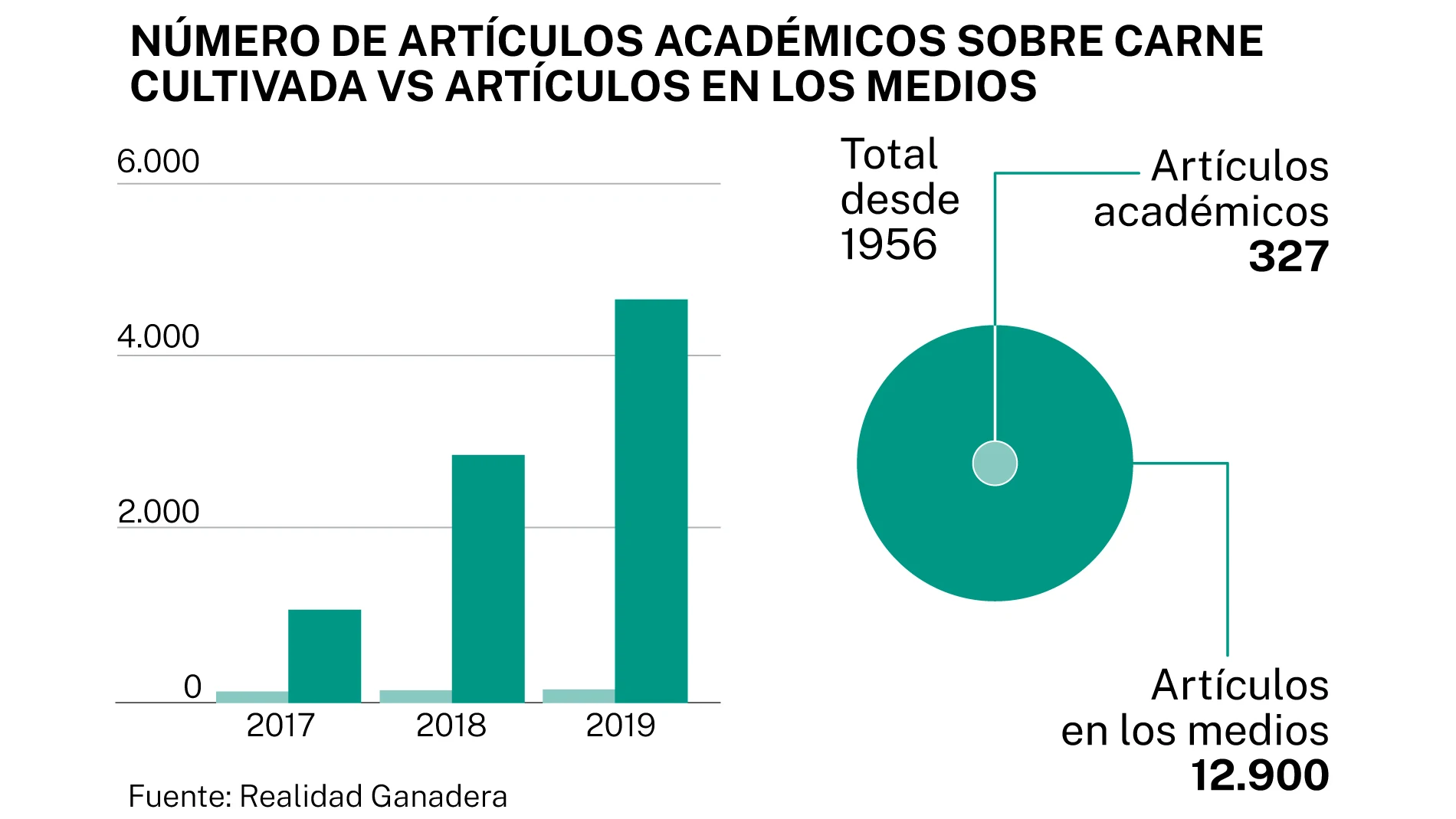
Between 2021 and 2022 there was a boom in ads and press publications (the volume of scientific articles is much smaller). Big projects, companies that had investors like Bill Gates and announcements of factory openings. But today, there is only a few countries where these products are for sale: Singapore, the United States (with many nuances, as has been said), Australia or the United Kingdom, the only country on the old continent that authorized the sale of this meat, but exclusively for pet food.
In Europe, Italy or Hungary have directly banned its marketing and there are some considerations to take into account. Alejandro Gutiérrez, deputy director of Provacuno, says that “the term meat could not be used with these products. The Commission has protected terms such as meat or fillet, which can only designate products of animal origin..
It is true that there are some pending authorizations, such as a foie gras from the French Gourmey (requested in 2024), but before being marketed “any new food (Novel Food) must demonstrate safety for the consumer. A complete technical dossier must be provided with information on the characterization of the cell line, stability and purity control, composition and control of the culture medium (including growth factors), absence of contaminants and microbiological control, description and validation of the process (traceability, critical points, quality), nutritional composition…”, explains Andrés Pascual, director of Innovation at the Ainia technology center.
Goodbye financing
It is not only regulation that has limited the arrival of these products on the market; The business fabric also seems to be falling apart. According to The Good Food Institute (a think tank focused on accelerating innovation in alternative proteins), the funds for Cultured meat companies have shrunk from 1.38 billion in 2021 to 139 million in 2024. The Dutch Meatable, founded in 2018, has closed. So has the Israeli Believer Meats (the firm had announced the construction of the largest cultured meat plant in the world in North Carolina) and the best-known case, Beyond Meat (has the support of Bill Gates), lost 77% of its stock market value at the end of 2025. «GFI identified 174 companies in 2023 and 155 specialized companies in 2024. If we only count companies whose main focus is cultivated meat, the number is smaller than if we also include key suppliers (culture media, bioreactors, scaffolds) and hybrid projects. After the investment boom of 2021–2022, the sector has entered a phase where financing has fallen and investors are asking for clearer milestones,” comments Andrés Pascual, from Ainia. The technician adds that still There are challenges to overcome, such as “scaling up while maintaining productivity and sterility, making media cheaper, especially growth factors, moving towards completely whey-free formulations, achieving consistent texture, juiciness and nutritional profile or consumer acceptance.”
According to a report by Business Insider, the CEO of Impossible Foods (alternative plant-based proteins) has stated that alternative meats have been marketed incorrectly and the market has fallen. “We scientists have to do some self-criticism, because many times we sell the bear’s skin before hunting it due to the pressure of transferring knowledge to the industry,” Máximo Florín states emphatically.
A harassed sector
►The meeting in the US Senate a few days ago had as a point of special interest the fertilizer price crisis, which is affecting the primary sector. The Secretary of the Department of Agriculture (USDA) said she is considering reviving the Fertilizer Production Expansion Program, designed during President Biden’s previous term, which promised to funnel money to small and medium-sized fertilizer production facilities through five-year grants. In 2025, the USDA plan to strengthen the US meat industry and “rebuild domestic capacity” was launched, including through “Product of USA” labeling.. Since 2017, the US has lost more than 17% of family farms, about 100,000 installations. Cattle numbers are at their lowest level in 75 years, while consumer demand for beef has grown 9% in ten years, according to the USDA.