
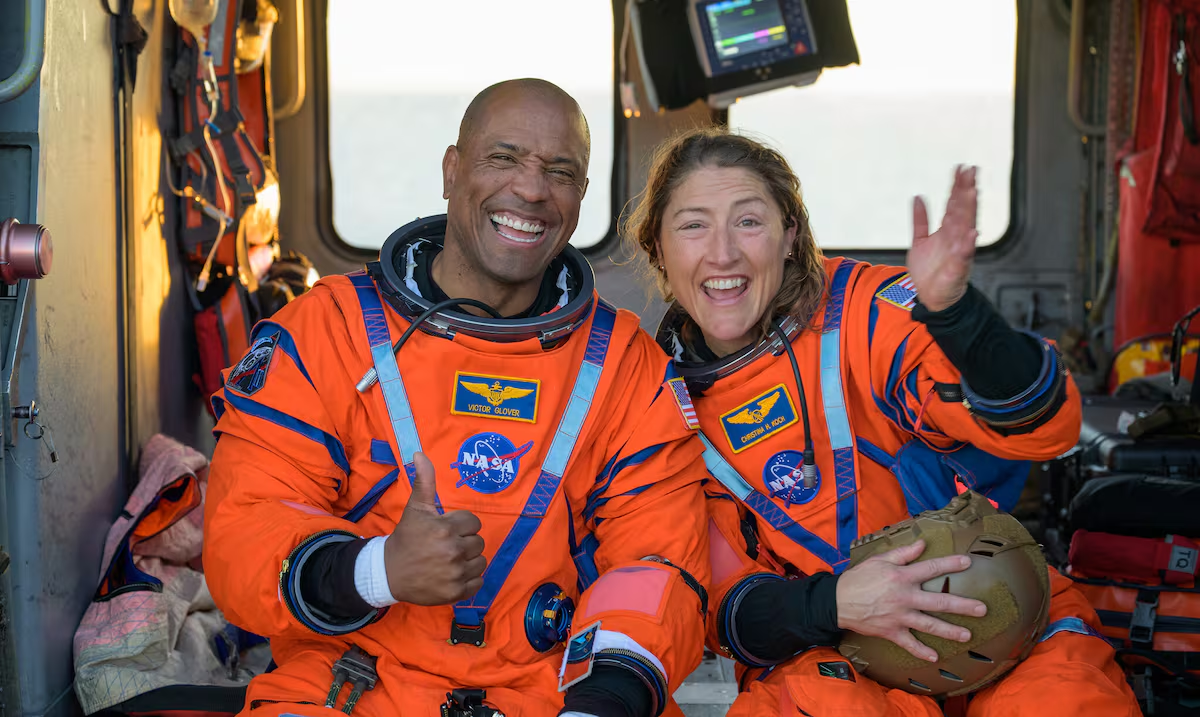
Behind him return of astronauts from the mission Artemis IIthe crew members of the Orion capsule had to undergo specific tests, since bodies undergo profound and immediate physical changes, therefore requiring a readaptation process that can last for weeks.
The four astronauts who were part of the Artemis II mission held a press conference to recount the highlights during the trip.
In this context, Christina Koch, one of the mission crew members, recounted the excitement of being part of this mission. “The Moon is the embodiment of something that is in the heart of each of us,” he reflected.
Likewise, the astronaut shared a video on her official Instagram account where she is seen performing specific exercises after her trip to the moon. “I guess I’ll have to wait a bit to surf again.”wrote the American engineer.
1/8 | Artemis II leaves the dark side of the Moon: photos from the ship. NASA’s Artemis II Orion spacecraft regained contact with Earth this Monday after spending about 40 minutes in absolute silence while flying over the far side of the Moon, a common interruption in this type of mission. – The Associated Press
To explain this phase, he maintained: “When we live in microgravity, the systems in our body that have evolved to inform our brain about our movements, the vestibular organs, do not function properly.”
In the video she shared, she can be seen trying to walk in a straight line with her eyes closed, while two people hold her up, an activity that is difficult for her after the trip.
“Walking in tandem with your eyes closed can be quite a challenge! Learning about this can help us improve the treatment of vertigo, concussions and other neurovestibular conditions on Earth,” stressed the NASA astronaut.
The reaction of the human body to the change in gravity
One of the main factors that explains the changes is the absence of gravitysince in that environment, the body stops working as it does on Earth and that generates multiple consequences.
As explained by the cardiologist Jorge Tartaglione in LN+crew members must undergo tests before and after the mission. “They have to be prepared psychologically to be isolated and physically so as not to lose muscle strength”he detailed.
“They are going to lose a lot of muscle strength”Tartaglione warned, explaining that In just 10 days they can suffer a reduction of between 1% and 2% of muscle massespecially in the legs and back.
Furthermore, he pointed out that there is also a loss of bone density similar to accelerated osteoporosisdue to the lack of load on the skeleton and the lower exposure to vitamin D.
Upon returning to Earth, one of the biggest challenges is to regain balance, since in microgravity, the body loses the reference of the center of gravity, which affects the spatial orientation.
“It’s not that they forget to walk, but they can’t keep their balance”indicated the expert and highlighted possible visual alterations and explained that can increase intracranial pressurewhich impacts the optic nerve and can cause vision problems.