
For years, decades rather, the entertainment industry sought to take us to the couch or to the cinema, but now it doesn’t want us to move a finger… Or rather, it wants us to slide just one: the thumb, to upload and download content without thinking, just move from one video to another. That’s what has made TikTok and Instagram so hypnotic. And that gesture (fast, repetitive, almost hypnotic) is where Netflix comes in now.
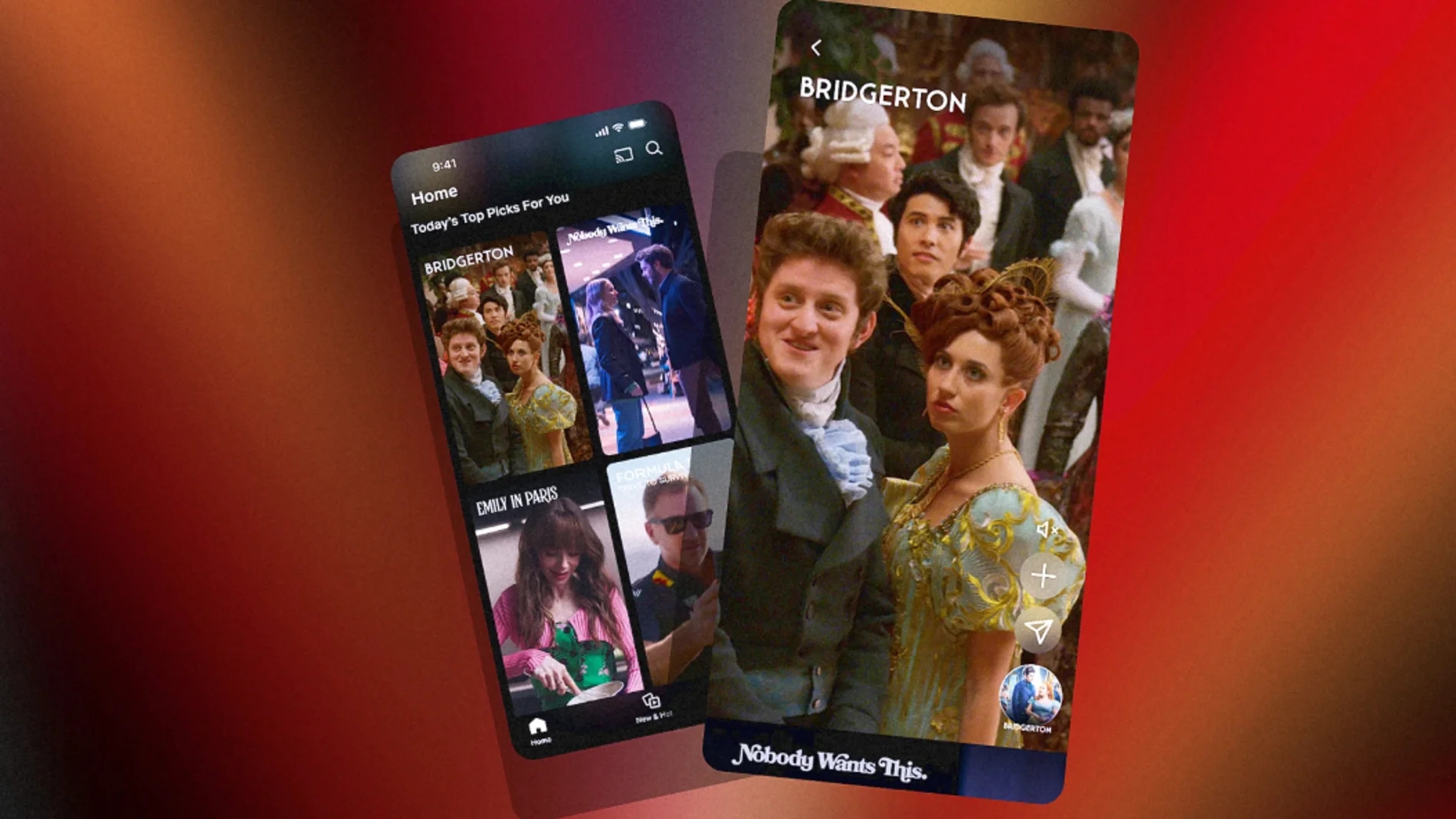
The platform that turned the “shall we see one more episode?” in a way of life is now trying something very different: a short, immediate vertical video feed, designed to compete directly with social networks. It is not just a change of format, but a deeper transformation: a new way of discovering content.
Because that’s the heart of the matter. For years, Netflix has functioned as a smart library. You entered, searched or let the algorithm suggest and choose. But the TikTok model changed the rules: You don’t choose as much anymore, they drop content in front of you, one after another, in an infinite sequence that learns from you in real time.
What Netflix seems to be testing now is precisely that: a system in which the fragments of their own series and films (scenes, key moments, even adapted trailers) are presented in vertical format, designed to be consumed in seconds. Not like traditional trailers, but like little capsules designed to hook you before you know it. Here comes another silent but decisive actor: artificial intelligence.
The new feed wouldn’t just be a collection of clips, but an experience shaped by algorithms that analyze what you watch, how long you stop, what you repeat or what you ignore. That is, they don’t just show you content: they learn how you react to it. And with each gesture, they refine the selection more. It’s the same principle that has turned TikTok into a near-perfect attention-grabbing machine. But there’s something interesting about how Netflix adapts this logic.
While on TikTok the content is already born with that format (creators who think vertically, in the immediate and the viral), Netflix works with material conceived in another way: long stories, slow narratives, scenes that are not always designed to be cut into 20 seconds. This requires a kind of translation: converting films and series into fragments that function as hooks.
And there appears a question that goes beyond technology: what happens to a story when it fragments? In a way, this movement reflects a very contemporary tension. On the one hand, we still want long stories, worlds in which to get lost for hours. On the other hand, We live in an attention economy where every second counts.
Netflix is not abandoning series or movies. is trying solve a previous problem: how to make you reach them in an ecosystem saturated with stimuli. Because today the competition is not just another platform. It’s whatever takes up your thumb.
If this experiment works, it could change the way we discover what to watch. We would no longer start with a title, but with a moment. A dialogue, a look, a scene that catches us without context… and that, if everything goes well, pushes us to see the rest.