
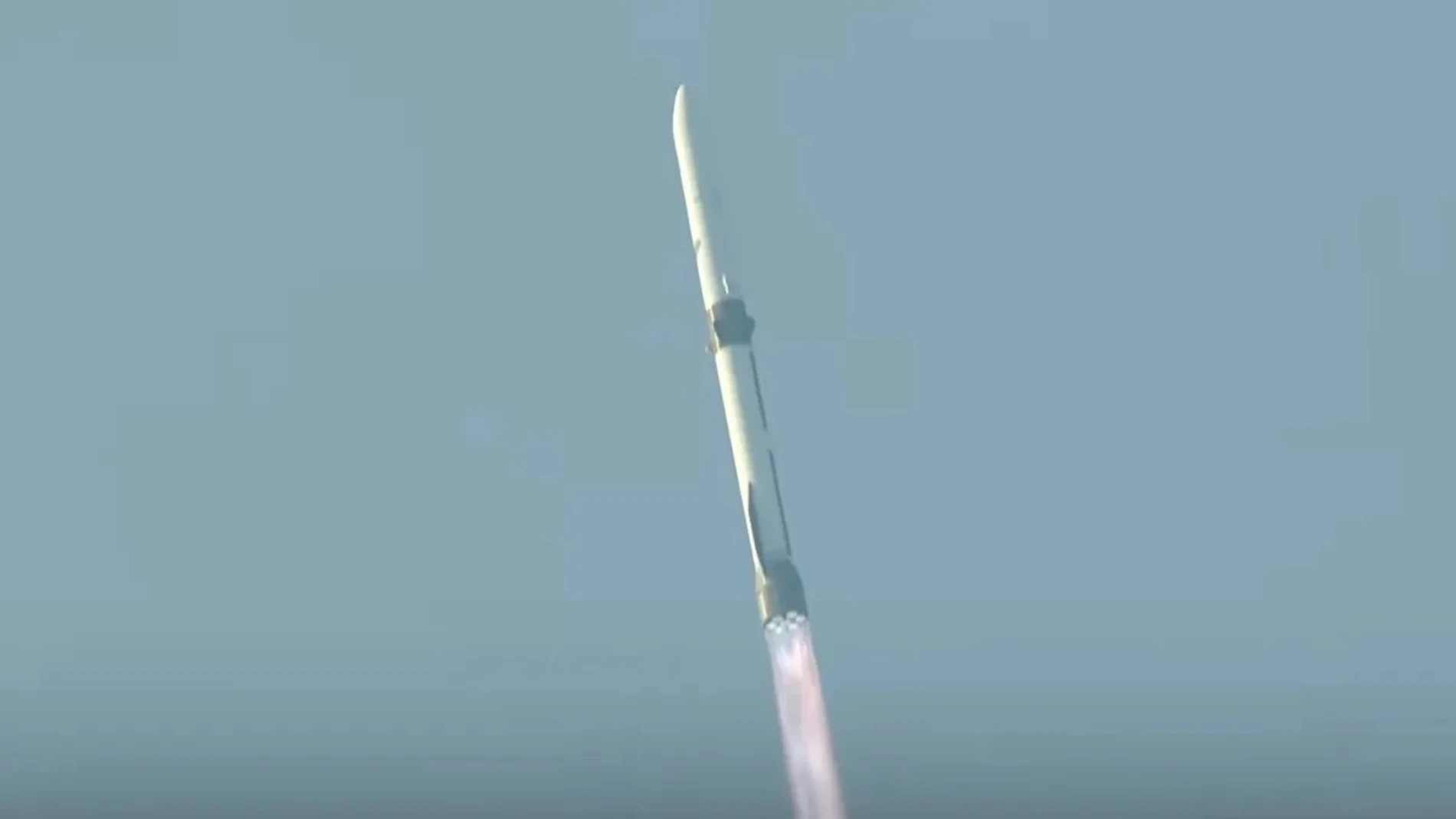
A great success of Blue Origin has been marred by a ruling that questions its ability to deploy payloads. While the first stage of New Glennwhich was used in the previous mission in November, NG-2landed again, making the aerospace company Jeff Bezos in the first competitor of SpaceX which achieves a reusable rocket, the second stage left the satellite BlueBird 7 in an orbit outside the planned one, ‘non-nominal’.
New Glenn took off from Cape Canaveral at 1:25 p.m.Spanish peninsular time, 40 minutes after the mission’s planned two-hour launch window opened NG-3. The countdown was stopped due to an unspecified technical problem, but was resumed.
— Dave Limp (@davill) April 19, 2026
What happened to BlueBird 7
The satellite BlueBird 7 of AST SpaceMobile was scheduled to separate about 75 minutes after takeoff into a circular orbit of 460 kilometerswith an inclination of 49.4 degrees. That separation was scheduled for five minutes later of a second ignition of the engines BE-3U of the upper stage, with a duration of 68 seconds.
However, Blue Origin, which The broadcast of the launch concluded after the successful landing of the first stageoffered no updates on that power-up or the payload deployment when they were scheduled to arrive.
An hour after the scheduled time for payload separation, Blue Origin confirmed on X that BlueBird 7 had separated and been turned on. ‘The payload was placed in a non-nominal orbit. “We are evaluating the situation and will update when we have more detailed information,” the company said.
NG-3 Update: We have confirmed payload separation. AST SpaceMobile has confirmed the satellite has powered on. The payload was placed into an off-nominal orbit. We are currently assessing and will update when we have more detailed information.
— Blue Origin (@blueorigin) April 19, 2026
The upper stage problem has overshadowed the first reuse of a New Glenn booster. The ‘booster’, baptized by Blue Origin as ‘Never Tell Me The Odds’ (Never tell me the odds), landed in jacklynthe company’s landing platform in the Atlantic Ocean, almost nine and a half minutes after takeoff. That booster launched the Martian mission ESCAPADE of the POT on flight NG-2.
AST SpaceMobile has issued a statement on the launch outcome late this afternoon, revealing what will happen to BlueBird 7. ‘During the New Glenn 3 mission, the upper stage of the launch rocket placed the BlueBird 7 satellite in a lower orbit than expected. Although the satellite separated from the rocket and activated, its altitude is too low to maintain operations with its onboard thrusters, so it will be exorbitant. The cost of the satellite is expected to be recovered thanks to the company’s insurance policy,’ notes AST SpaceMobile.
Partial reuse of the first stage
Blue Origin manages to put its head into a sector until now dominated by SpaceX, although it should be noted that propellant reuse is partial, not complete. Its most important component, the BE-4 engines, were new.
— Jeff Bezos (@JeffBezos) April 19, 2026
‘With our first reconditioned engine we opted to replace all seven engines and try some improvementsincluding a thermal protection system in one of the nozzles. We have planned use the engines we used in NG-2 in future flights‘, published on April 13 in X Dave LimCEO of Blue Origin. Reuse is key for Blue Origin to increase its pace of launches and meet the demand of AST SpaceMobile and other customers.
Great question! With our first refurbished booster we elected to replace all seven engines and tested out a few upgrades including a thermal protection system on one of the engine nozzles. We plan to use the engines we flew for NG-2 on future flights.
— Dave Limp (@davill) April 13, 2026
AST SpaceMobile plans with New Glenn
BlueBird 7, weighing 6,100 kilogramsincorporates a phased array antenna that, once fully deployed, exceeds 220 square meters of surface. That antenna is used to offer broadband services to mobile phones (direct to device, or D2D).
Bluebird 7 is the first satellite of this D2D constellation to take off since BlueBird 6 did it on an Indian rocket LVM3 in December. Abel Avellanthe company’s CEO, pledged in an earnings call in March to ‘the expectation of have 45 satellites in orbit and 60 satellites ready for shipment during 2026‘. The pace should accelerate, in part, because future spacecraft could be brought into orbit service more quickly thanks to lessons learned from BlueBird 6.
‘The other thing that will happen from (BlueBird) 6 and 7 is that we are grouping the satellites. We are no longer going to launch individual satellites. They will be grouped in batches of three, four, six or eight in a single launch,’ he said then.
He also stated that, after NG-3, ‘to sustain our launch cadence through 2026, We expect to reuse New Glenn’s propellant every 30 days or less after our ongoing launch‘, something that is now not so clear after the failure of the second stage, which will have to be resolved.
In this afternoon’s statement, the company points out that it maintains its objectives of launching every one or two months. ‘thanks to agreements with various suppliers and expects to have approximately 45 satellites in orbit by the end of 2026’.