
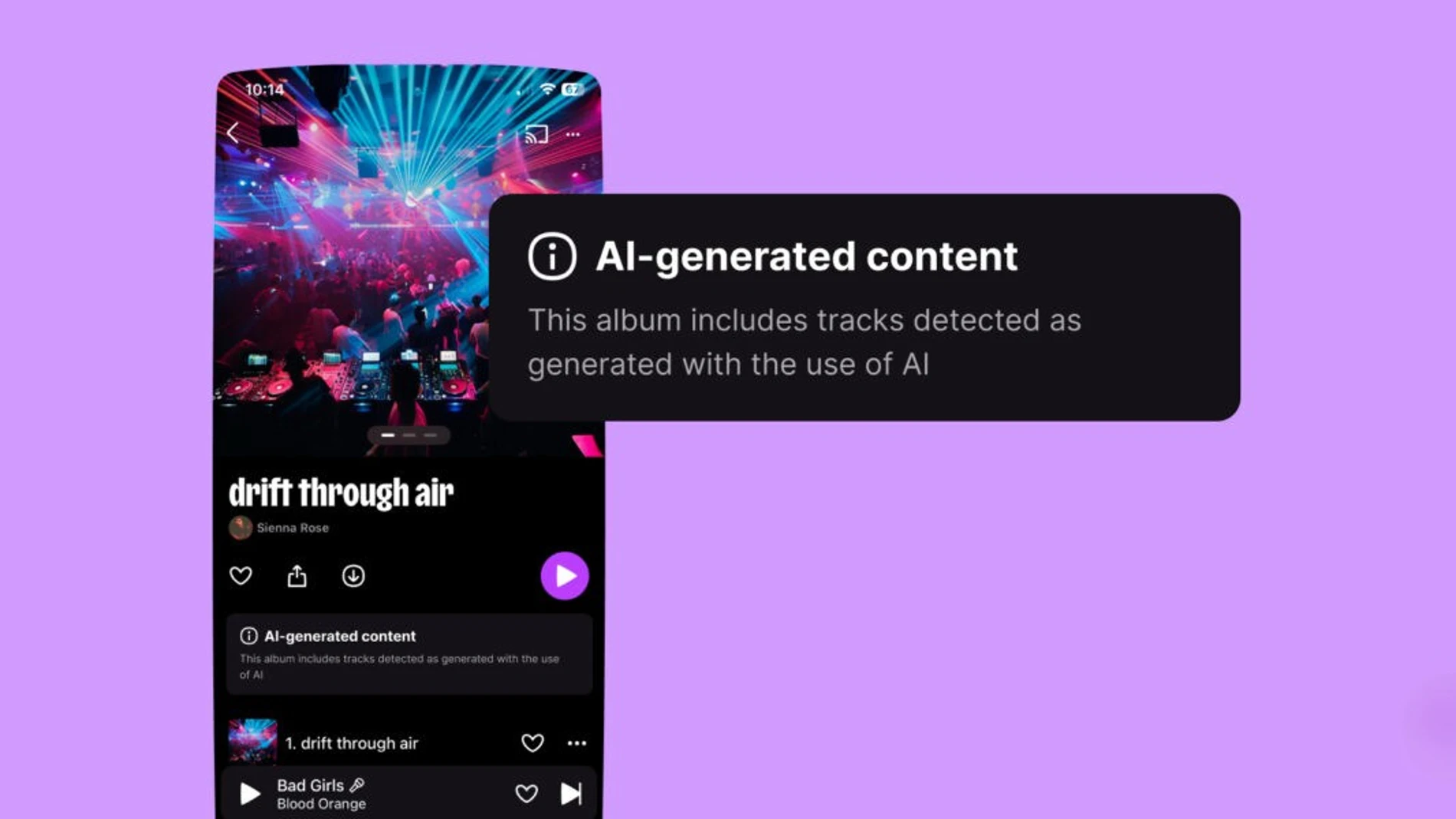
In these times, the most common way to listen to music is through streaming platforms, which facilitates new situations such as music generated by artificial intelligence reaches the user’s ears more easilyoften without knowing that it is that type of content. Most services don’t make a special effort to label AI-generated music, but Deezer has worked to develop technology to identify that content. In this sense, the company has recently pointed out that music created with AI is already close to half of all the new songs it receives for its catalog and that many reproductions are fraudulent.
AI-generated music has taken off in recent years, but it doesn’t get as much attention as other areas of the AI ecosystem. This is due, in part, to the fact that can go more unnoticed. With the right context and cues, an AI-created track can sound like generic music made by humans.
According to Deezer, its users have a hard time differentiating AI songs from real ones. In a company survey, listeners heard three songs, two of them generated by AI. An overwhelming 97% were unable to distinguish between AI songs and those made by a humaninforms the company.
Deezer supports AI-generated music on its platformbut detecting and labeling it. Its main interest is to prevent It is used to inflate listeners and thus lose money.
Deezer explains that its technology for detecting AI music allows it to be one of the few platforms that explicitly labels it. As music generating models increase, the rate of this type of content has reached a striking 44%, which is equivalent to 75,000 new AI tracks on Deezer every day. The company licenses its technology to third parties and claims that it has a false positive rate of less than 0.01%.
For Deezer, the main purpose of uploading all this AI-created music is fraudulent. The platform only pays for views when a person listens to them, so it is demonetizing about 85% of them because they do not correspond to human listeners.
Therefore, users do not find AI music organically on the platform. Deezer does not include it in the recommendations or lists it creates. As a result, streams of this type of music represent a small portion of platform usage, around 1-3%.
‘Thanks to our technology and the proactive measures we put in place more than a year ago, we have shown that AI-related fraud and payment dilution in streaming can be minimized‘, he stated Alexis LanternierCEO of Deezer.
The growth of AI-generated music is likely to continue to accelerate. Models like Lyria 3of Googlehave become cheaper and more available. Google now allows users of Gemini generate complete songs, when just a few months ago the limit was 30-second fragments. Suno and udio They also advertise their ability to create broadcast-ready tracks in a matter of seconds. However, these options incorporate watermarks, such as SynthID from Google, to point out that the songs have been generated by AI.
The problem is how easy it is to remove those watermarks from audio and generate music with custom models that do not incorporate them. As AI becomes cheaper, so does the creation of AI-generated mediocrities.