
The discovery of an organic molecule in a Martian sample could have been one of those moments in which history changes course. For a few moments, The word “organic” once again sets off all the alarms: carbon, complexity, the possibility (always tempting) of confirming that we are not alone in the universe.
But this time, the explanation is different. Much closer. Too close, perhaps. Because organic molecules are not, by themselves, proof of life. They are carbon-based structures, yes, but they can form both in biological systems and in purely chemical processes. The Curiosity rover, for example, identified relatively complex carbon chains in ancient sediments on the planet. Compounds that, on Earth, are usually associated with life… although they do not necessarily depend on it. We go by steps.
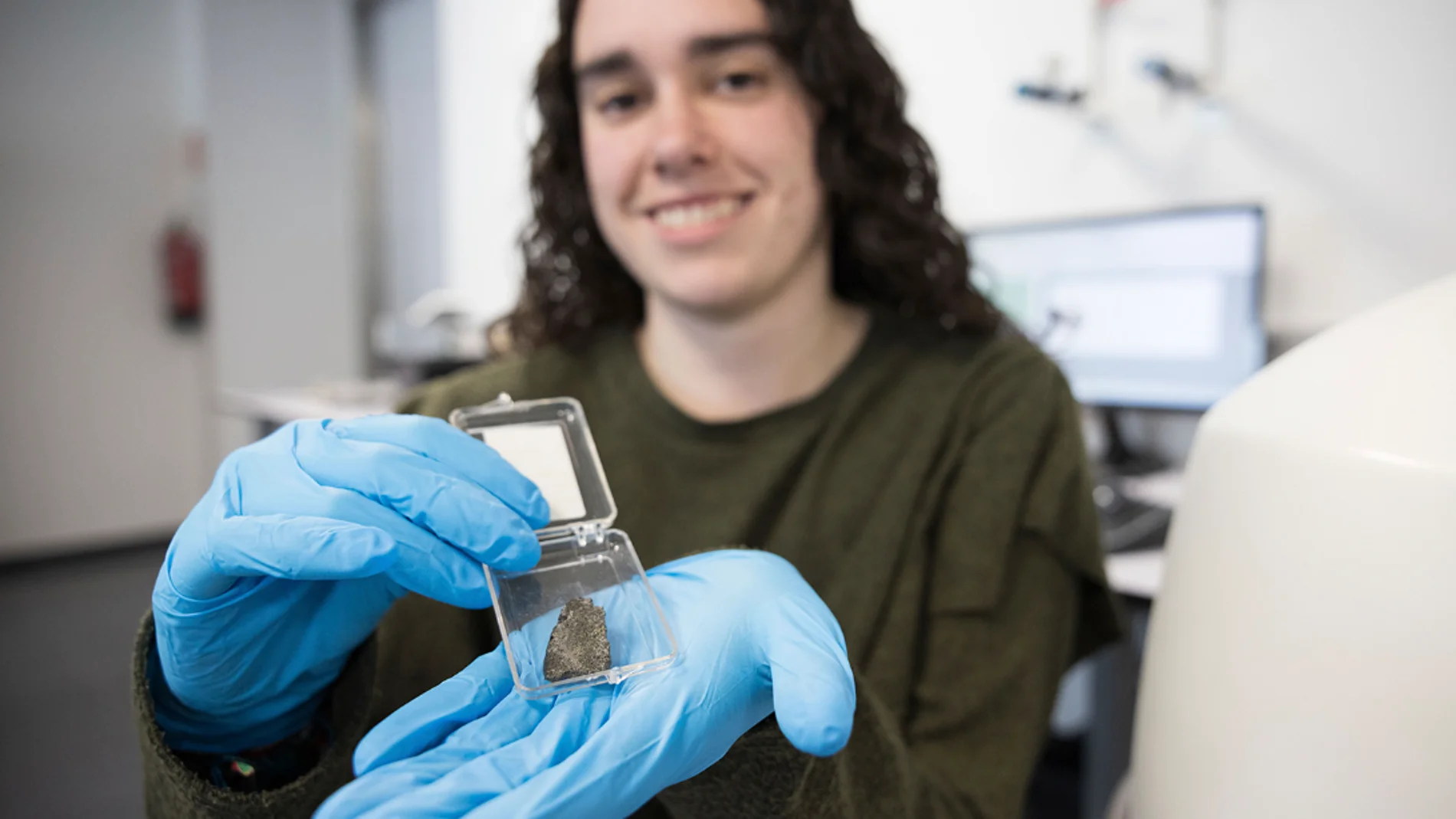
A fragment of Mars can travel millions of kilometers, survive a brutal impact with Earth, and still lose its history in something as banal as a stroke of a pen. That is, in essence, the warning from a team from the University of the Basque Country in a published study Applied Geochemistry. In their analysis of Martian meteorites, the authors, led by Leire Coloma, not only They have found minerals and compounds typical of the red planet, but also unexpected traces: contaminants introduced here, in our own laboratories. Among them, pigments associated with ink.
The discovery is not intended to discredit decades of Martian exploration, but it does introduce an uncomfortable truth. Because it arrives just at a time when NASA is once again placing organic compounds at the center of the debate. Detecting them on Mars always raises the same expectation: the possibility of biology. But this work reminds us that, before interpreting any signal, there is a prior question that cannot be avoided: are we sure that we did not carry it?
The study is based on techniques, such as Raman spectroscopy, capable of identifying substances with extraordinary precision. And that precision is, at the same time, an advantage and a problem. It allows compounds to be detected in minute quantities… but also makes the smallest traces of contamination visible. Remains of materials used in polishing the samples, particles from the environment or synthetic compounds that have nothing to do with Mars. Among them, ink.
The objective of Coloma’s team is to “analyze meteorites to determine their chemical and mineralogical composition, and to be able to continue advancing in the determination of the composition of Mars or the Moon,” the author herself points out in a statement. This external part is, therefore, altered and does not allow its original mineralogical composition to be determined exactly.”.
The problem is not just technical. It’s interpretive. Many of the molecules sought on Mars, especially organic ones, are chemically similar to those that are part of our daily lives. In that context, a sign may seem extraordinary when it is actually mundane.. Or worse: she can look like a Martian when she is human.
“The introduction and use of some external compounds during sample preparation could lead to incorrect characterization – adds Coloma -, since it would not be clear if the minerals detected are the result of contamination or if they are really original components of meteorites.”
It is, in a way, a constructive challenge inherent to science: to question with foundations and based on data. Not directed against NASA, but towards the entire scientific community. And it comes at a particularly delicate time. The Perseverance rover is collecting samples directly on Mars, sealing them in tubes designed to return to Earth on future missions. When that happens, every grain of dust will be analyzed with unprecedented precision. And in that scenario, distinguishing between an authentic signal and minimal contamination will be more important than ever.
The possibility of Knowing whether Mars hosted life depends, to a large extent, on our ability not to interfere with the question. And that means accepting something uncomfortable: that the biggest obstacle is not always on another planet, but in the ease with which we leave traces.
In this sense, scientists from the University of the Basque Country have proposed a series of corrective measures “to reduce or minimize such contaminations in future samples. This can be achieved by replacing certain solvents or materials used in the process. With our work We try to improve the protocols for preparing subsamples for analysisbecause work must be done in the laboratory avoiding introducing any type of contaminant into the samples,” the statement concludes.