
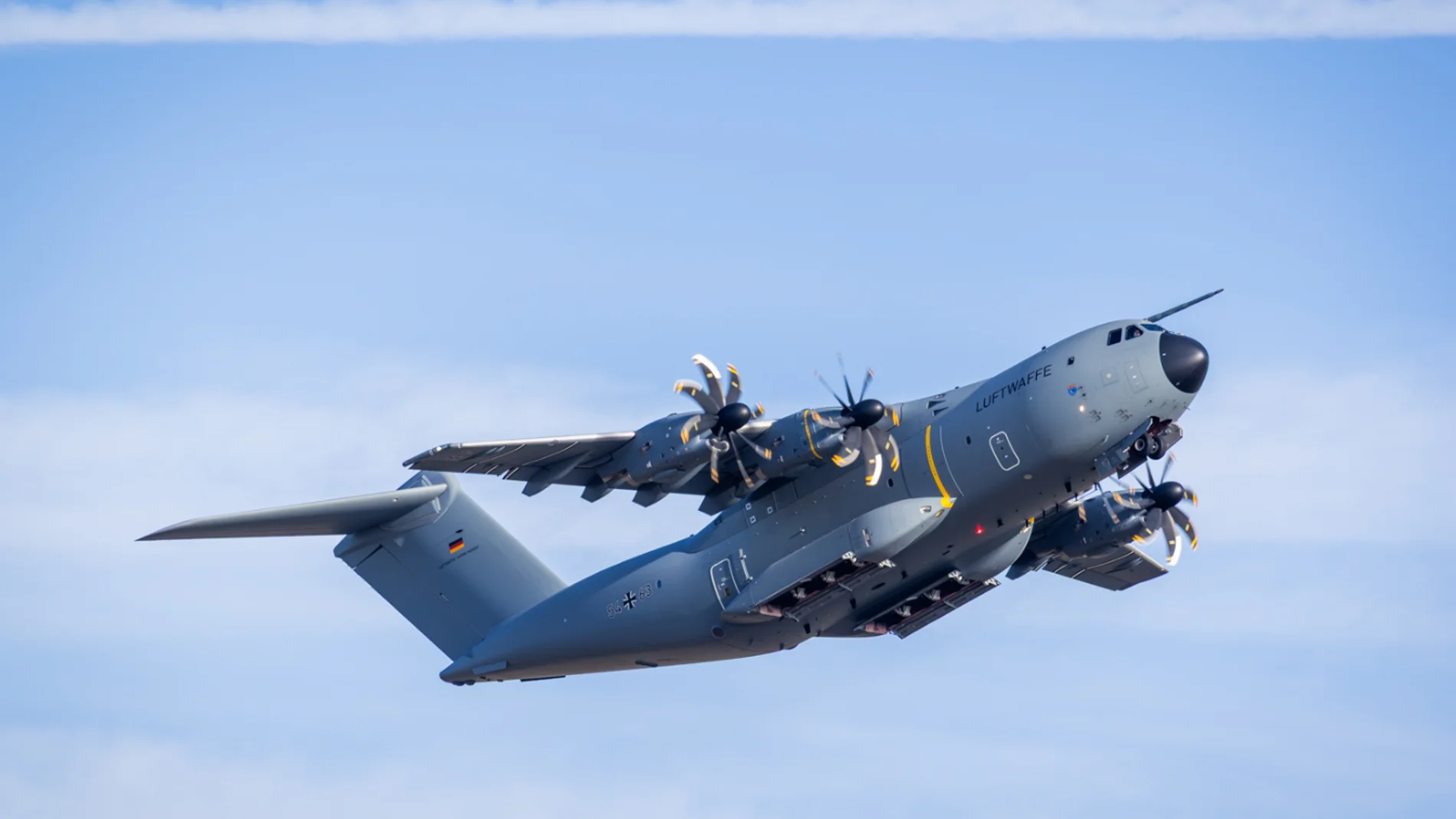
For years, the Airbus A400M Atlas has been, above all, a “pack animal”. An aircraft designed to move what others cannot: troops, vehicles, humanitarian aid. A practical giant, closer to logistics than to spectacle. But in recent months, that same plane has begun to hint at another possibility.
Airbus plans to turn it into something like a starting point in the air. Not an airplane that executes a mission, but one that delivers it. Dozens of drones could be released from its hold (up to 50, according to tests carried out and published on Twitter), or even cruise missiles, which would continue the operation independently.
We just handed over the keys of the 53rd German #A400M to the German Air Force! And we are not stopping here – we are continuing to unleash the potential of this incredible aircraft together with the operating air forces:
●Payload boost: Increasing the maximum payload from 37… pic.twitter.com/nQzismD8gI
— Airbus Defense (@AirbusDefence) April 18, 2026
The difference is subtle, but it changes almost everything. We are no longer talking about a platform that transports weapons, but rather one that deploys systems. As if the flight did not end at the objective, but rather fragmented before arriving.
The idea is not completely new, but its scale and approach are. The concept revolves around what in military terminology is known as “remote carriers”: unmanned systems that can be launched from a larger aircraft and operate autonomously or in a coordinated manner. In the case of the A400M, we are talking about figures that attract attention in themselves.More than a simple expansion of capabilities, this represents a change in logic. Traditionally, fighter jets or bombers have been closed platforms: they carry their weapons, execute the mission and return. Here, however, the plane becomes a node. It is not so much the main actor as the facilitator of a distributed system.
This approach fits with a broader trend in contemporary warfare: the replacement of single, expensive and vulnerable platforms with networks of smaller, redundant and difficult to neutralize systems. Instead of betting everything on one card, the risk is spread.
In this context, the A400M has an obvious advantage: its size and design. His The large warehouse, designed to transport armored vehicles or helicopters, becomes the ideal space to house and launch these systems. It is not necessary to redesign the aircraft from scratch, but rather to adapt its function. Convert a transport into a kind of aerial aircraft carrier.
But beyond the engineering, there is a question that hovers over the entire concept: What does it mean to delegate action, and in some cases, decision, to unmanned systems? Because, although the launch may be controlled by humans, operating dozens of drones in a complex environment requires increasing levels of autonomy.
It is not a new debate, but here it takes on another dimension. This is not a single drone operating under direct supervision, but rather swarms capable of coordinating, adapting and responding in real time. The complexity stops being in the vehicle and goes to the system.
There is also a strategic dimension. A plane like The A400M is not designed for direct combat. Its strength is logistics, the ability to be in the right place at the right time. Making it a nurse expands its role without necessarily exposing it to the same risks as a fighter or bomber. It can operate at a distance, outside the immediate range of enemy defenses, and still project force.
And yet, as is often the case with these technologies, innovation does not eliminate dilemmas, it displaces them. If launching 50 drones from a single aircraft is technically possible, the question is no longer if it can be done, but how, when and under what conditions.