
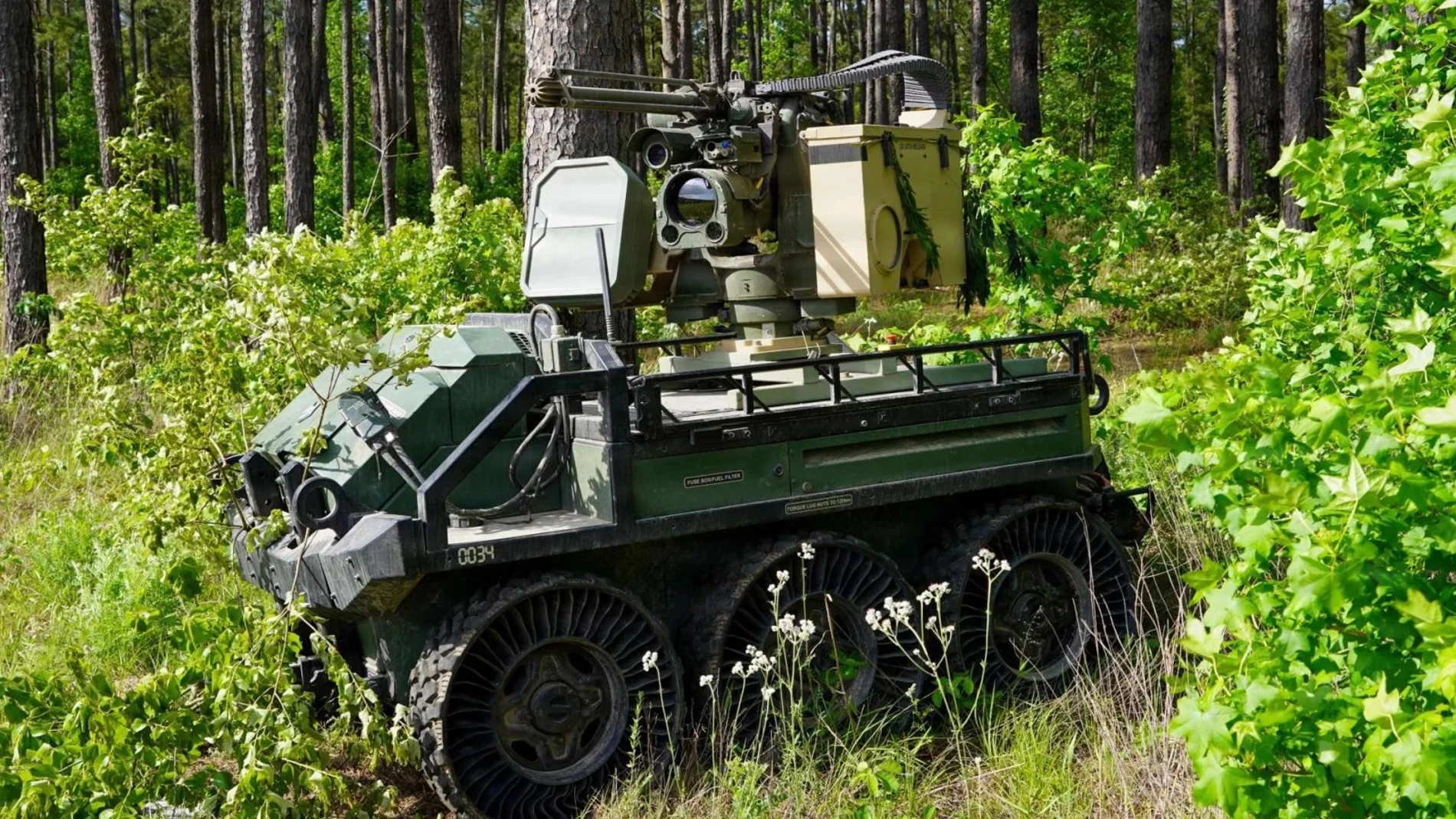
He Defense Visual Information Distribution Service of the United States has published new images this week that show an increasingly common trend in armies, armed robots moving alongside the troops. In this case, it is the UGVacronym in English for Unmanned Land Vehicle, Hunter Wolf who has participated alongside soldiers of the 3rd Mobile Brigade of the 101st Airborne Division in a combat simulation exercise in the Joint Readiness Training Center from Fort Polk, Louisiana, one of the most important combat training theaters for the United States Armyaccording to the defense media Army Recognition.
The presence of the Hunter Wolf at the JRTC shows the transition that the United States is making from experimentation to the integration of this type of systems in its Armed Forces. Units are no longer limited to testing unmanned systems in isolation, but rather they are placing them within realistic combat scenarios.
During the year, the vehicle assumed functions both logistics and securityfor which it was equipped with a remotely operated .50 caliber machine gun. The outlet highlights the relevance of this exercise by deploying the Hunter Wolf in a high-intensity training environment rather than in a prepared test scenario.
Logistics, surveillance and protection
The Hunter Wolf was selected within the program Small Multipurpose Equipment Transport of the Army with the main objective of reduce the load that soldiers must carrybut the images show a more ambitious direction for the robot. The UGV also had a radar EchoShieldwhich expands its role to surveillance and protection.
This combination allows units to expand their detection and fire capabilities without exposing troops, as The robot can advance, explore terrain and respond to threats while soldiers remain behind cover.
From a logistical point of view, the platform can transport ammunition, water, batteries, drones and communications equipment. Also clear a path with a system of blades and monitor defensive routes or sectors.
This dual role reflects the functioning of current battlefields, which favor dispersion, speed and lower visibility. Unmanned ground vehicles fit that modelas they can distribute supplies across large areas and support small, independent units. When equipped with sensors and weapons, they also contribute to reconnaissance and local security.
This is the Hunter Wolf
The Hunter Wolf, manufactured by HDT Roboticsthe robotics division of Blade HDTis an unmanned ground vehicle 6×6diesel-electric hybrid propulsion, designed to support light infantry in terrain where a manned vehicle would have more difficulties. It can carry up to 1,270kghas dimensions of 2.5 x 1.4 x 1 meters and an autonomy of 300km off-road without refueling, plus a battery-only silent mode of about 12km. Its maximum speed is 16km/hcan wade up to 60cm and overcome slopes 30° and sides of 22°.
The UGV also stands out for its versatility. It can supply power to power external equipment, supports integration with third-party autonomy systems, and can be configured for evacuation, reconnaissance, logistical support, route opening, NBC warfare (nuclear, biological and chemical) missions or remote weapons stations. In addition, it can be transported by aerial platforms such as helicopters. UH-60 and CH-47the convertiplane V-22 and the plane C-130.